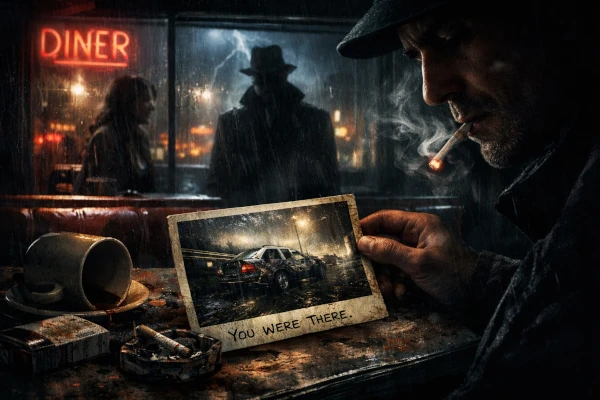
I was sitting in a crummy diner, the kind of place where the coffee tasted burnt, the lights buzzed like dying insects, and the windows made the whole world outside look even more hopeless than it already was. Beyond the glass, the street lay drowned in gloom. The distant skyline stood like a row of tired giants, their outlines fading into a bruised horizon of purple and orange. Above them, the heavens were restless, teasing the city with flashes of color, working themselves up for the storm that was coming. Tonight, rain was not just weather. It felt like a warning.
People hurried along the sidewalk outside, ghostlike shapes under flickering streetlights, collars turned up, heads lowered, all of them trying to outrun the night. I wasn’t in a hurry. I had nowhere to be, nowhere left to run that mattered. A few months ago, that would have been impossible. Back then I lived like the White Rabbit—always late, always breathless, always one step behind disaster. There was no wonderland at the end of my chase, though. Just wrong turns, bad choices, and the slow realization that Shakespeare had been right all along. Life was drama. I had simply played my part badly. Or maybe I had written the wrong script for myself from the very beginning.
I lifted my coffee and took a sip. It was cold now. Bitter. It tasted like regret.
That was when the feeling came again.
Déjà vu.
A cold little shiver at the back of my skull, as if time had folded in on itself and let me glimpse a moment I had already lived, ruined, and buried. I hated that feeling. But hatred changes nothing. Some things enter your life like unwelcome guests and sit down as if they belong there.
The bell above the diner door gave a tired jangle.
A woman walked in first. Pretty face. Sharp eyes. She was talking on her phone, animated, distracted, alive in a way that seemed foreign to me. For a second I watched her, not because I cared, but because her eyes held the kind of energy you notice when you’ve been dead inside too long. Then I lost interest and looked back into my cup.
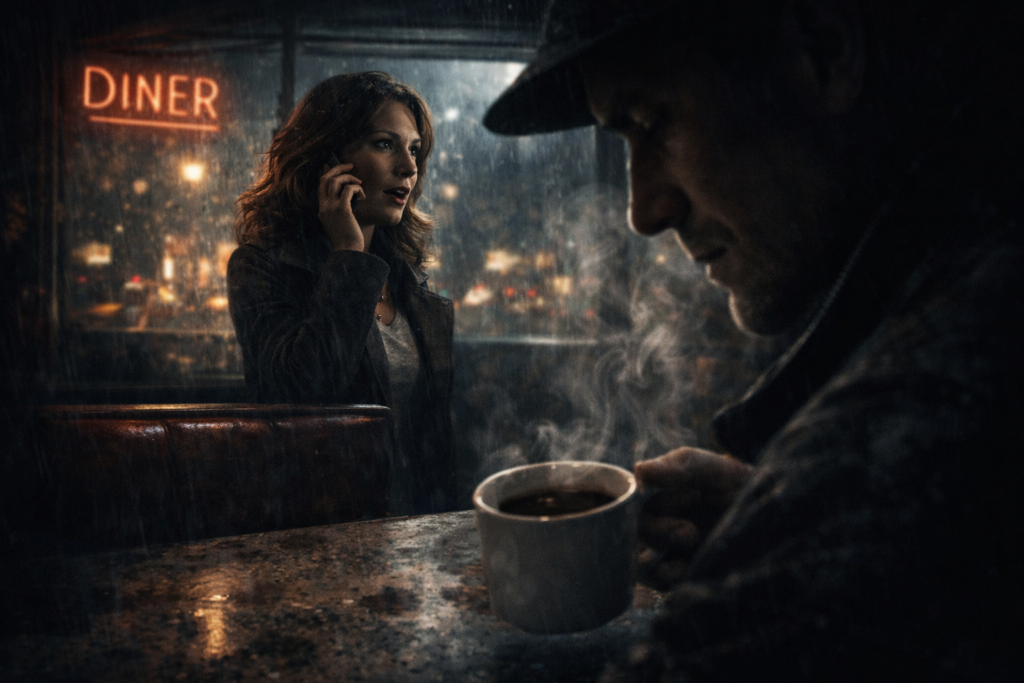
Where was I?
Right. The bitter coffee. The bitterer memories. The damned déjà vu.
Then the air changed.
You know how sometimes a room shifts before anything actually happens? Like your skin notices danger before your mind can name it? That’s what it felt like. A drop in temperature. A pressure in the silence. The unmistakable sense that something familiar had just stepped back into your life wearing a new face.
Someone stopped at my table.
I didn’t look up immediately. I already knew.
“This table’s taken,” I said.
“Oh,” the stranger replied, his voice calm, almost amused. “Thank you for the warm welcome on such a cold night.”
He sat down anyway.
I raised my eyes to meet his.
Same presence. Same rotten calm. Same feeling of being cornered by something that knew me too well.
“So,” I said, leaning back, “what do you want? An argument? A confession? A philosophical debate over bad coffee? I could use something to get the blood moving.”
He smiled, but there was nothing friendly in it.
“You thought nothing could touch you anymore,” he said. “You thought you could run. You thought I wouldn’t find you again.”
“One question at a time,” I muttered. “You always did like to hear yourself talk.”
“You’re a fugitive,” he said. “You can keep moving, keep pretending, keep changing scenery—but how far do you really think you can get before I’m there again? Right behind you. Right in front of you. Waiting.”
I let out a slow breath and stared at him. “I should have finished you when I had the chance.”
A flicker crossed his face. Satisfaction, maybe.
“Guilty, then,” he said softly.
“Yeah,” I said. “Guilty of letting you live.”
He laughed under his breath. “So much hate.”
“No,” I said, cutting him off. “Not hate. Precision. I don’t hate my life. I hate you. You make everything feel like a trap. Like I’m running through some endless maze and you’re always just around the next corner, smiling, waiting, hunting. But here’s the part you forget—I can hunt too. I can wait too. And if luck ever bothers to come back from whatever vacation she’s on, maybe one day I’ll paint the walls with whatever passes for your blood.”
His smile widened.
“You still think there’s a way out,” he said. “That’s the funny part. You don’t even see how deep you’re in. You’re drowning already. There’s a weight tied to your ankles, dragging you down into the cold dark, and all you’ve got left is attitude.”
“Go to hell.”
“I thought you already had.”
I leaned forward then, the table between us suddenly feeling too small. “Listen to me, you smug bastard. I didn’t ask for any of this. I didn’t invite trouble in, and I sure as hell didn’t send for you. Trouble just showed up, kicked the door down, and handed me choices so bad they weren’t really choices at all. When the only thing left to do is wrong, then maybe wrong is just another name for fate.”
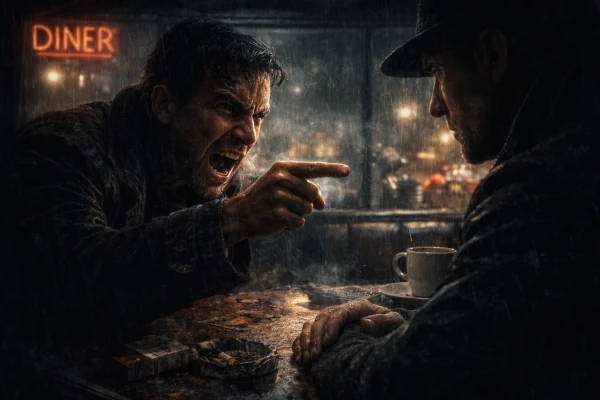
He watched me for a moment, almost approvingly.
“You’re getting poetic,” he said. “That usually means you’re tired.”
“I’m getting honest.”
“No,” he said. “You’re getting close.”
Lightning flashed outside the diner window, bleaching the world white for a heartbeat. The thunder rolled a second later, low and hungry.
He folded his hands and kept talking, because of course he did.
“You were reading about cascading effects the other day,” he said. “Thirty-six pages, wasn’t it? All those little failures, all those tiny fractures, all those harmless-looking mistakes that line up one after another until everything blows apart. You remember that?”
“I remember.”
“Well, there it is,” he said with a grin. “Your life, summarized. A series of bad moves, bad timing, bad instincts—and then the kaboom. One life gone. Another one born in the crater.”
“That wasn’t a mistake,” I said.
“No?”
“No. A mistake is knocking over a glass. Missing a train. Calling the wrong number. What happened…” I paused. “What happened was something else.”
He tilted his head. “A missed take?”
That almost made me laugh.
“Maybe,” I said. “Maybe it was just the wrong scene shot too many times.”
He studied me, and for the first time there was something colder in his eyes.
“You’re thinking of leaving.”
“I am leaving.”
“Walking away?”
“I’m done talking.”
He leaned back, unfazed. “There are no happy endings waiting out there.”
I stood up slowly. “Good. I stopped believing in those a long time ago.”
He didn’t move.
“By the way,” he said, almost casually, “even if there were a time machine hidden somewhere, you couldn’t afford the ride back. And if you could, you still wouldn’t know which moment to fix.”
I stared at him.
“History repeats,” I said. “That’s its favorite trick. But some things in the past are better left buried. I have no interest in digging up the dead.” I bent closer. “Though if you’d like to join them, I could be persuaded.”
Something dark and unreadable moved across his face.
“If I die,” he said quietly, “you die.”
I didn’t answer.
Because that was the problem, wasn’t it?
He wasn’t a man. Not really. Not in the ordinary sense. He was the thing that had followed me from room to room, city to city, mistake to mistake. The voice behind every sleepless night. The shape waiting in every mirror after midnight. He had another name once. Now he was just Incognito. A shadow in a borrowed face. A debt that kept collecting interest.
And he was right.
If he died, some part of me probably would too.
So I turned and walked away.
The bell above the diner door rang again as I stepped outside into the rain.
It hit me at once—cold, sharp, needling into my skin. But it didn’t hurt. Not really. The pain was deeper than skin, older than weather. The rain was almost a relief. It cooled what nothing else could cool.
Then, without warning, the streetlights died.
Darkness rushed in so fast it felt alive.
For one suspended second the whole street disappeared, swallowed whole. I stopped walking. Not because I was afraid, but because I knew this darkness. I had lived inside it before. I had stumbled through it in dreams and waking life alike, through corridors that bent in on themselves, through memory and guilt and the kind of fear that doesn’t scream—it whispers.
Around me, people hurried faster, muttering, colliding, fleeing as though the night itself had grown teeth. Wind tore down the street, dragging rain sideways. It slapped my face, clawed at my clothes, wrapped its freezing fingers around my bones.
And I welcomed it.
Because the cold matched something in me.
Because there are moments when the world outside finally resembles the world within.
Lightning split the sky in violent flashes of blue and violet, and for an instant the city revealed itself in grotesque still frames—buildings like watching beasts, trees like twisted hands, shadows like things not quite human. Then darkness again. Then thunder, great and distant, rolling over the rooftops like a verdict.
I kept walking.
Slowly.
No umbrella. No destination. Just me and the storm and the strange peace that comes when you stop pretending you’re trying to be saved.
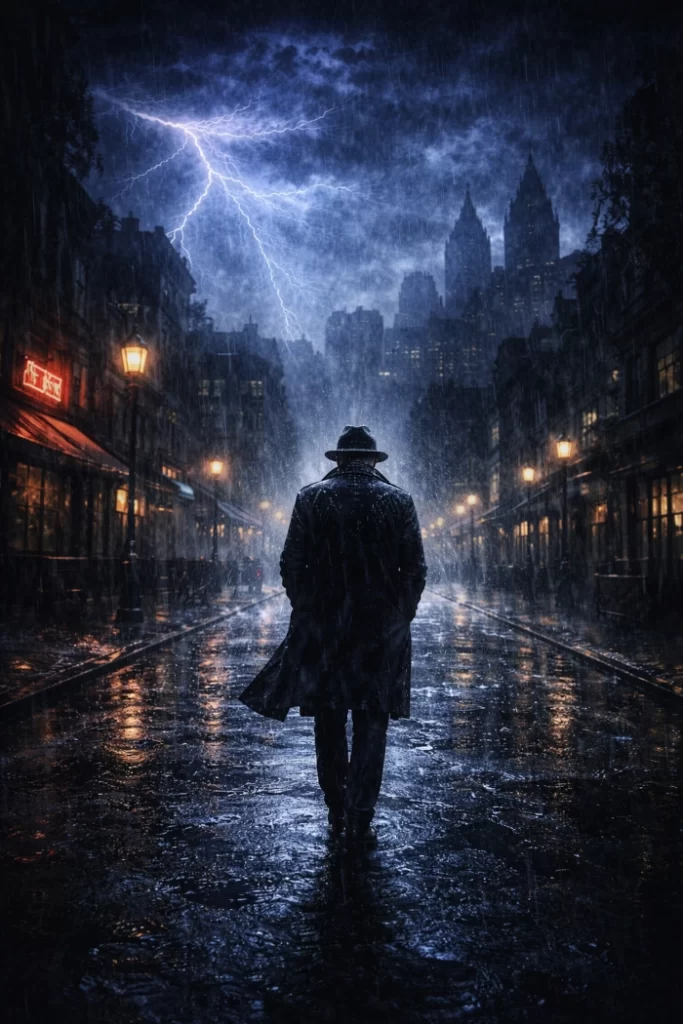
This wasn’t hell.
Hell was somewhere else. I had been there once, in my own way. I had ruled there briefly, bargained there, laughed there, sinned there. It had almost felt like power.
Then came treason.
Then came the fall.
Then came that old familiar shiver again—
Déjà vu.
My clothes clung to my skin as I moved down the street, soaked through, carrying my thoughts like demons on a leash. I was in no hurry. I had no fear left worth naming. The city hissed around me, alive with rain and memory and things that refused to stay buried.
And somewhere behind me—or inside me—I could still feel him smiling.