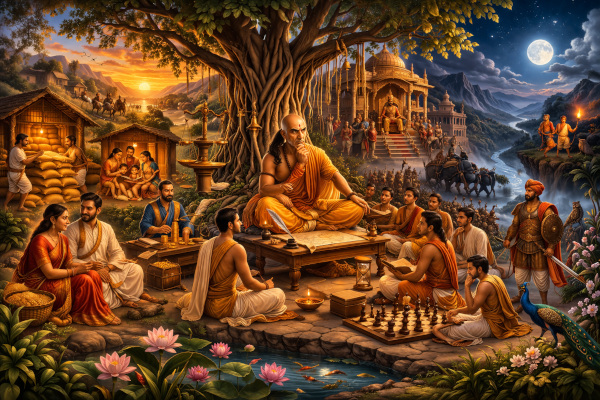
Chapter 3 of Chanakya Niti feels like the work of a man who had watched human society closely for a very long time and had finally decided that sugarcoating was a waste of everyone’s time. This chapter is practical, sharp, unsentimental, and often wickedly funny in its understanding of people. Chanakya begins by reminding us that no family is flawless, no person escapes illness, no one remains untouched by troubles or temptations, and nobody enjoys endless happiness. It is an ancient way of saying: calm down, everyone’s life is messy, only the packaging and branding is different.
From there, the chapter moves into the things that reveal a person’s true nature—conduct, speech, affection, discipline, education, and habits. Chanakya makes it clear that character cannot be hidden for long. A family is known by conduct, a land by language, friendship by warmth, and a person even by the way he lives and eats. In today’s world, where people polish their image like a showroom vehicle and hide their chaos behind motivational quotes, this chapter lands like a well-aimed slap.
A major theme in this chapter is wise placement and wise judgment. Chanakya advises that a daughter should be married into a good family, a son should be trained in learning, a friend should be aligned with righteousness, and an enemy should be pushed toward weakness. This is classic Chanakya: deeply practical, slightly ruthless, and completely uninterested in decorative foolishness. He is less concerned with how things sound and more concerned with whether they work.
The chapter also contains some of Chanakya’s most memorable warnings. A wicked person, he says, is worse than a snake, because a snake bites only once in a while, but a villain harms at every step. Beauty without knowledge is compared to a flower without fragrance. Excess in any form—beauty, pride, generosity, ego—leads to disaster. One worthy child can uplift an entire family, while one corrupt or foolish one can burn it down from within. This chapter has no patience for surface glamour, family vanity, or moral laziness.
Another striking quality of Chapter 3 is its realism about survival. Chanakya values effort, discipline, vigilance, moderation, and the wisdom to walk away from danger when necessary. He has no interest in noble stupidity. If the company is wicked, the times are dangerous, and the situation is collapsing, the person who escapes lives. It is brutally simple advice, and that is exactly why it has survived for centuries.
Overall, Chapter 3 is a hard, intelligent, and often darkly amusing guide to life. It speaks about family, conduct, education, friendship, enemies, discipline, children, reputation, and prosperity with the confidence of someone who has seen human beings repeatedly create trouble for themselves and would very much like them to stop. It is not a chapter built on fantasy. It is built on observation. That is what makes it so sharp, so relevant, and at times so hilariously accurate even today.
Chapter 3 – Sloka 1
कस्य दोषः कुले नास्ति व्याधिना को न पीडितः ।
व्यसनं केन न प्राप्तं कस्य सौख्यं निरन्तरम्॥ ०३-०१
Kasya doṣaḥ kule nāsti, vyādhinā ko na pīḍitaḥ |
Vyasanaṁ kena na prāptaṁ, kasya saukhyaṁ nirantaram || 03-01 ||
Meaning
“Who is there whose family has no flaws?
Who is there that has never been afflicted by illness?
Who is there who has never fallen into trouble, vice, or misfortune?
And whose happiness remains unbroken forever?“
Explanation
This verse is Chanakya looking at humanity with the expression of a man who has already heard too many people say, “Why is this happening only to me?” and has decided to end the drama in one stroke. He begins by asking which family is free from faults, and that alone is enough to make half the world sit down quietly. Every family has something simmering in the kitchen besides the curry. One has an inheritance dispute that has outlived three governments, another has an uncle who appears only when land papers are mentioned, another has cousins who smile at weddings like diplomats from rival nations, and somewhere in every household there is at least one person who has not spoken to another person since an argument so old that even the original reason has died of neglect. From the outside every family looks polished, respectable, and lovingly posed for photographs. From the inside it is often a highly decorated museum of grudges, habits, suppressed commentary, and someone asking who finished the pickle. Chanakya’s point is simple and devastating: stop imagining that perfection lives in the next house. The next house is also on fire; they have merely chosen better curtains.
Then he asks who has escaped disease, and this is where human pride gets dragged gently but firmly by the ankle. People walk around as though the body is a loyal kingdom under firm central control, when in reality it is a suspicious coalition government held together by sleep, digestion, and luck. One day your knee makes a sound like a broken cupboard. Another day your back resigns without notice. A slight throat irritation turns an ordinary person into a tragic hero standing at the edge of history. The body is forever announcing new conditions like a bureaucracy inventing new forms. Rich people do executive health checkups, poor people trust herbs, middle-class people do both and still ask Google whether they have vitamin deficiency, stress, sinus trouble, or the final trumpet of destiny. Chanakya is saying: illness is part of the human subscription plan. Nobody gets permanent premium membership in physical invincibility.
Then comes the line about vice, trouble, or destructive attachment, and here Chanakya sounds like he has met enough people to know that every mind eventually develops a hobby that quietly ruins it. In old times it may have been gambling, vanity, intoxication, lust, greed, or reckless ambition. In modern life it is doom-scrolling, online shopping during emotional weakness, checking messages every forty-three seconds, pretending to “network” while really collecting insecurity, or developing a relationship with coffee so intense it deserves legal recognition. Every person has some weakness that enters like a guest and settles like a cat. One man is addicted to praise, another to outrage, another to showing that he is “unbothered” while being spiritually governed by a comment from a stranger with a cartoon profile picture. Human beings love to act scandalized by their own bad habits, as though temptation arrived by administrative error. Chanakya is not impressed. He is calmly informing us that trouble visits everyone, foolish attachment seduces everyone, and no one walks through life with the moral neatness of a freshly ironed bedsheet.
And then he lands the final blow by asking whose happiness is continuous. This is the line that should be engraved above every complaint desk in the world. No one has uninterrupted happiness. No one. Life does not run like a devotional background track where sunlight falls at the correct angle and all relatives speak in moderation. Even your best day carries a hidden invoice. Salary arrives, then the gas cylinder finishes. You sit down for a peaceful meal, and suddenly a relative asks about marriage, children, career, promotion, property, weight, hairline, or why your face looks tired when you were perfectly happy until that moment. You buy a new phone and then drop it within forty-eight hours like a man reenacting fate in touchscreen form. Joy in human life comes in installments, often short ones, whereas irritation renews automatically like a streaming subscription nobody remembers approving.
With this verse Chanakya is not trying to make life sound miserable; he is trying to make people less melodramatic. He is telling us that difficulty is not a personal insult from the universe. A flawed family does not make your life uniquely cursed. A sick body does not mean destiny has chosen you for special persecution. A bad habit does not make you the first citizen of human weakness. Broken happiness is not a cosmic conspiracy. It is simply the shape of ordinary life. Once you understand that, a great burden lifts. You stop staring at other people’s polished surfaces and assuming they are living in uninterrupted bliss while only you have been issued a defective existence. Everyone is carrying something. Everyone is managing a flaw, a fear, a weakness, a health problem, a family complication, or some private absurdity that would look excellent in a tragic comedy.
The verse is deeply humane. It asks us to replace self-pity with perspective. It tells us to be realistic without becoming bitter, humble without becoming defeated, and compassionate because the human condition is gloriously untidy for everybody. In modern language, Chanakya is saying: relax, no family is fully normal, no body remains perfect, no mind escapes foolishness, and no life runs on permanent happiness mode. You are not a divine exception. You are a human being, which means you have entered the same circus as the rest of us.
Chapter 3 – Sloka 2
आचारः कुलमाख्याति देशमाख्याति भाषणम्।
सम्भ्रमः स्नेहमाख्याति वपुराख्याति भोजनम्॥ ०३-०२
Ācāraḥ kulam ākhyāti, deśam ākhyāti bhāṣaṇam |
Sambhramaḥ sneham ākhyāti, vapur ākhyāti bhojanam || 03-02 ||
Meaning
“A person’s conduct reveals the family they come from.
Their speech reveals the land or culture they belong to.
Their manner of respect and attentiveness reveals their affection.
And their body reveals the kind of food they consume.”
Explanation
This verse is Chanakya behaving like the ancient world’s most merciless background-check officer. He is basically saying that people reveal themselves all the time, even when they think they are putting on a polished performance. A person’s conduct reveals the family they come from, which is Chanakya’s way of saying that upbringing always leaks. You may wear a spotless kurta, quote philosophy, and sit with the gravity of a visiting saint, but if you are rude to servants, arrogant with waiters, and behave like a peacock which is horny, the truth has already come out of the bag and started dancing. Family culture does not stay hidden for long. Sooner or later, manners open the door and your house walks in.
Then he says speech reveals the land one comes from. This is not just about accent. It is about tone, rhythm, values, and the strange little habits people carry in language like invisible luggage. A person can say three sentences and tell you everything: where they come from, what sort of social climate shaped them, and whether they were raised among poets, traders, politicians, or people who solve every disagreement by shouting over tea. Speech is a dangerous thing. It exposes education, ego, patience, insecurity, and often the exact size of a person’s internal furniture. Some people speak and you think, “Ah, cultured.” Some speak and you think, “This man has fought with auto drivers in four states.” Chanakya is telling us that language is not just sound; it is biography wearing a mouth.
Then comes one of the slyest lines: respect and attentiveness reveal affection. This is wonderfully savage, because it destroys fake love in one elegant move. Anyone can say “dear,” “brother,” “my friend,” “my love,” and other decorative noises. Real affection shows up in care, in regard, in the little tremor of concern, in how someone listens, how they remember, how they treat you when nothing is to be gained. If the sweetness is loud but the respect is missing, that relationship is basically a fancy sweet box full of screws. Chanakya knows the type. The sort who say “I care for you deeply” and then talk over you, ignore you, borrow your charger forever, and behave like your time was grown in their backyard. Genuine affection has humility in it. Performance affection has volume.
And then comes the line that should make every snack shelf nervous: the body reveals the food one eats. Ah yes, the body, that brutally honest accountant. You can lie to society, lie to relatives, lie to your friends, and even lie to yourself with heroic confidence, but the body keeps receipts. It remembers the fried festival that became a lifestyle, the sweets that were supposed to be “just for today,” the late-night emotional samosas, the third plate taken in the name of hospitality, and the magnificent human tradition of calling something “light” because it was eaten after 10 p.m. Chanakya is saying that your body is basically your diet’s autobiography. It is the annual report of your kitchen decisions. You are free to declare that you live on discipline, purity, and balance, but if your body looks like it has personally negotiated peace treaties between sugar, oil, and regret, the evidence is already on display.
So the whole verse is Chanakya’s ancient announcement that human beings are terrible at hiding themselves. Conduct reveals lineage, speech reveals culture, respect reveals love, and the body reveals food habits. In modern terms, he is saying: you are a walking leak of personal information. Your habits are louder than your claims. Your manners are more truthful than your profile bio. Your speech tells on you. Your treatment of people tells on you. Your stomach, face, skin, energy, and posture all hold a press conference on your behalf without asking permission.
Chanakya is exposing the great human fantasy that image can permanently overpower reality. It cannot. Sooner or later, upbringing peeks through, culture slips into speech, affection is tested by respect, and the body rises like a witness for the prosecution. In one short verse, Chanakya looks at humanity and says, with devastating calm: “My dear people, you are all far less mysterious than you think.”
Chapter 3 – Sloka 3
सुकुले योजयेत्कन्यां पुत्रं विद्यासु योजयेत्।
व्यसने योजयेच्छत्रुं मित्रं धर्मेण योजयेत्॥ ०३-०३
Sukule yojayet kanyāṁ, putraṁ vidyāsu yojayet |
Vyasane yojayec chatruṁ, mitraṁ dharmeṇa yojayet || 03-03 ||
Meaning
“One should marry a daughter into a good family.
One should engage a son in learning.
One should involve an enemy in vice or destructive habits.
And one should engage a friend in righteousness.“
Explanation
This verse is Chanakya in full ancient life-coach-meets-political-strategist mode, looking at society and saying, “Kindly stop leaving important things to look like undercooked people.” He is basically explaining that human beings must be placed properly, because if you do not arrange life wisely, life will arrange it for you with the tenderness of a badly assembled IKEA cupboard. “Please stop handing your heart, time, and energy to disasters with good hair and look confident.” In a wider relationship sense, the first line means this: place yourself in good company, in healthy relationships, among people with values, stability, and decency. Do not get hypnotized by charm, style, romance, chemistry, deep eye contact, mysterious texting habits, or a person who says “you’re different” before ruining your peace for eight consecutive births. Chanakya’s point is that relationships are ecosystems. A person may be attractive, witty, intense, and capable of sending dangerously effective late-night messages, but if their values are rotten, their circle is toxic, and their emotional maturity was last seen hitchhiking in Himalayas, then the entire relationship becomes suffering with good lighting. In modern terms, he is saying: stop shopping for connection like a moth choosing lampshades.
Then he says a son should be joined to learning, which in a broader sense means that the people close to us boy or girl must be connected to growth. Anyone we care about should be moving toward wisdom, discipline, self-improvement, and understanding, not just aging loudly. A person without learning becomes very dangerous, especially when combined with confidence. The world is full of human beings who know four quotes, two podcasts, and half a fact, and now move through life like unpaid consultants to civilization. Chanakya is warning that real care means encouraging growth. If you love someone, you should want them to become wiser, steadier, and more grounded, not merely more decorative. Otherwise you end up emotionally investing in a person who has excellent selfies and the conflict-resolution skills of a dropped pressure cooker.
Then comes the truly delicious Chanakyan turn: an enemy should be engaged in vice. Ah yes, there he is, the old master of practical wickedness. He is not saying every enemy must be fought with swords, shouting, and a background score. He is saying something much more entertaining: let the fool ruin himself. Push him toward indulgence, addiction, distraction, vanity, greed, arrogance, bad habits, and other shiny traps in which human beings wrap themselves voluntarily and call it lifestyle. Why wrestle with your enemy if he is perfectly capable of becoming his own demolition project? Give an unwise man enough ego, comfort, temptation, and applause, and he will dig his own grave while posting inspirational quotes about winning. Some people do not need to be destroyed; they only need to be encouraged. Chanakya must have met enough self-important idiots to know that the quickest route to many men’s downfall is simply handing them a mirror and a little freedom.
And then, having briefly auditioned for the role of ancient intelligence chief, he turns noble again and says a friend should be engaged in dharma, in righteousness. This is the balancing stroke that makes the verse brilliant. A real friend is not someone who cheers every foolish decision like a drunk orchestra. A real friend is not the fellow who says, “Go for it, brother,” while you ruin your finances, your marriage, your liver, and perhaps local traffic conditions. No, Chanakya says a friend should be kept connected to what is right, decent, and stable. Real friendship does not sponsor self-destruction. It does not stand in the front row clapping while you dive into a well. It pulls you back, lectures you, irritates you, and sometimes saves you from the kind of decision that later begins with the sentence, “At that time it seemed like a good idea.”
Chanakya’s central point is that people are shaped by where they are placed. Good family elevates. Education sharpens. Vice corrodes. Dharma steadies. This is not poetry for a calendar. This is social engineering with a Chanakyan dark humor.
Chanakya clearly has no faith in vague optimism. He does not say, “Everything will work out.” He says, “Put the right person in the right environment, or prepare for premium-quality chaos.” He has seen enough of life to know that bad company, bad habits, and bad placement can ruin what good intentions never manage to save. In one verse he gives marriage advice, parenting advice, friendship advice, and enemy management advice, all with the crisp efficiency of a man who would have been terrifying in a board meeting. The whole thing reads like the ancient world’s most practical memo: protect your own, educate your heirs, let your enemies ferment in their own stupidity, and never confuse friendship with enthusiastic co-operation in foolishness.
Chapter 3 – Sloka 4
दुर्जनस्य च सर्पस्य वरं सर्पो न दुर्जनः ।
सर्पो दंशति काले तु दुर्जनस्तु पदे पदे ॥ ०३-०४
Durjanasya ca sarpasya varaṁ sarpo na durjanaḥ |
Sarpo daṁśati kāle tu durjanas tu pade pade || 03-04 ||
Meaning
“Between a wicked person and a snake, the snake is better, not the wicked person.
A snake bites only at the proper time, but a wicked person harms at every step.”
Explanation
This verse is Chanakya doing something truly remarkable: he looks at a snake, an animal famous for venom, stealth, drama, and a general lack of social warmth, and says, “Yes, but let us be fair here—the snake is still the better gentleman.” That is how bad a wicked person is in Chanakya’s eyes. He is basically announcing that if life gives you a choice between a cobra and a malicious human being, the cobra may actually offer the healthier long-term relationship.
Why? Because the snake at least has a work ethic with boundaries. It bites at a particular time. It bites when provoked, threatened, cornered, or when fate schedules the appointment. There is a certain professionalism in it. The snake does not wake up in the morning, stretch, drink tea, and think, “How may I ruin six people emotionally before lunch?” It has standards. It has timing. It has reptilian dignity. It does one horrifying thing and then moves on with its life.
But the wicked person, says Chanakya, is a far more advanced nuisance. He does not bite once. He bites at every step. Every step!!!! This is a person who treats cruelty like a subscription service. He injures in installments. He poisons the room, the mood, the conversation, the relationship, and sometimes the snacks. He can insult you, undermine you, flatter you falsely, spread doubt, create confusion, smile in your face, and then ask why you seem “a little off today.” A snake gives venom. A wicked person gives a full ecosystem.
The snake, at least, is honest. It does not pretend to be your well-wisher. It does not begin with “I’m only saying this for your own good.” It does not compliment your shirt before setting fire to your peace of mind. A wicked person, however, arrives wrapped in manners. He may greet you warmly, ask about your health, praise your family, and then casually drop one sentence that ruins your entire afternoon. He is the kind of human being who can turn a happy gathering into a post-mortem with one remark and still leave feeling that he was “just being frank.” Frankness, in the hands of such people, is usually cruelty wearing reading glasses.
You can see why Chanakya prefers the snake. A snake hisses. A wicked person networks. A snake shows its fangs. A wicked person hides them behind concern, advice, jokes, “honesty,” and fake innocence. The snake bites your leg. The wicked person bites your confidence, your reputation, your friendships, your plans, your marriage prospects, and perhaps your digestion. By evening you are sitting there wondering how one conversation became a natural disaster.
In modern life, this verse is painfully easy to understand. The snake is easier than that office colleague who says, “No offense, but…” and then delivers a speech that could qualify as a hate crime against your self-esteem. The snake is easier than that relative who visits your home, eats your snacks, inspects your life like a government auditor, and asks why your salary, skin tone, children, curtains, and spiritual aura are all underperforming. The snake is easier than that “friend” who smiles when things go wrong for you with the face of a man trying to suppress fireworks. Compared to certain human beings, a cobra begins to look like a minimalist philosopher: brief, direct, and wonderfully free of passive aggression.
Be careful of people whose harm is constant, casual, and built into their nature. A visible enemy can be managed. A wicked person keeps striking in conversation, in conduct, in suggestion, in rumor, in timing, and in false friendliness. The snake bites when the moment comes. The wicked man lives as though every moment is the moment. Chanakya, with magnificent dryness, is simply telling us: when even the snake starts looking like the more respectable option, perhaps it is time to stop inviting certain people into your life.
Chapter 3 – Sloka 5
एतदर्थे कुलीनानां नृपाः कुर्वन्ति सङ्ग्रहम्।
आदिमध्यावसानेषु न ते गच्छन्ति विक्रियाम्॥ ०३-०५
Etadarthe kulīnānāṁ nṛpāḥ kurvanti saṅgraham |
Ādi-madhy-avasāneṣu na te gacchanti vikriyām || 03-05 ||
Meaning
“For this reason, kings gather and keep noble people around them, because such people do not change in the beginning, the middle, or the end.“
Explanation
This verse is Chanakya paying tribute to one of the rarest species ever observed in nature, politics, family life, office culture, and group projects: the person who remains decent for the full duration of the event. Not just on Day One, when everybody is polished, smiling, and speaking with the moral fragrance of sandalwood. Not just in the middle, when things are still manageable and snacks are being served. But all the way to the end, when pressure rises, rewards appear, blame starts flying around the room like disturbed pigeons, and half the crowd begins adjusting its principles like loose drawstrings. Chanakya says kings gather noble people for exactly this reason: such people do not go weird halfway through.
And honestly, this is a miracle worthy of temple bells.
Because most people begin beautifully. In the beginning everybody is magnificent. New friends are loyal. New employees are committed. New allies are solid. New lovers speak like poetry has rented their tongue. New politicians look like they were assembled from public service and pressed white cotton. The opening phase of any human relationship is basically a grand exhibition of fake stability. Everyone is punctual, sincere, and full of sentences like “You can count on me.” Of course you can count on them. The real question is: beyond what number?
Then comes the middle. Ah yes, the middle!!!! The great testing ground where the human soul removes its makeup. This is where true character begins to leak out through the corners. Work becomes hard. Benefits become uncertain. Trouble arrives. Risk enters. Somebody has to stand by their word when it is no longer profitable, glamorous, or easy. And suddenly the same people who began like carved statues of integrity begin behaving like wet cardboard. Their loyalty develops conditions. Their honesty becomes flexible. Their support is now “contextual.” Their principles, once majestic and thunderous, are discovered to be on short-term rental.
By the end, the situation gets even more entertaining. When the finish line is near and consequences are visible, the average human being often transforms like a low-budget villain in the last fifteen minutes of a film. One man changes sides. Another develops selective memory. Another says, “I was never fully informed.” Another speaks of “nuance” with the urgency of a man trying to dodge a falling cupboard. Someone who began the journey calling you brother, friend, leader, partner, or soulmate now stands three feet away pretending he was merely a freelance observer. Human consistency, at this stage, often dies with so little dignity that even crows would hold a minute of silence.
That is why Chanakya says kings collect noble people. Not because noble people are glamorous. Usually they are the opposite. They are dependable, steady, unexciting in the most beautiful way. They do not arrive with fireworks and leave with stolen cutlery. They do not begin like saints, wobble like weather vanes, and finish like missing luggage. Their face is the same in the first meeting, the crisis meeting, and the final audit. In a world full of people whose ethics are updated more frequently than mobile apps, this kind of steadiness looks almost supernatural.
Chanakya has clearly watched enough people begin loyally, drift strategically, and conclude shamelessly to know that consistency is not common; it is royal treasure. Kings gather noble people, he says, because those people remain steady in the beginning, middle, and end. Which is a very elegant way of saying: “Find people who do not become snakes, smoke, or furniture halfway through the story.”
Chapter 3 – Sloka 6
प्रलये भिन्नमर्यादा भवन्ति किल सागराः ।
सागरा भेदमिच्छन्ति प्रलयेऽपि न साधवः ॥ ०३-०६
Pralaye bhinna-maryādā bhavanti kila sāgarāḥ |
Sāgarā bhedam icchanti pralaye’pi na sādhavaḥ || 03-06 ||
Meaning
“At the time of cosmic dissolution, even the oceans may cross their boundaries.
But noble people do not abandon their principles, even in such a calamity.”
Explanation
This verse is Chanakya looking at humanity during crisis and saying, with magnificent disappointment, “So this is the moment all of you become circus equipment.” He says that during a great catastrophe even the oceans may cross their boundaries, but noble people do not abandon their principles even then. In other words, the sea itself may lose control and start behaving like a dramatic uncle at a family property discussion, but a truly good person is still expected to remain within limits. That is the standard here. Not “be decent when convenient.” Not “be ethical until profits are affected.” Not “stay calm unless someone else gets promoted.” No. Even when creation itself is having a nervous breakdown, the noble person is supposed to keep his spine where it belongs.
The image is glorious. Think of the ocean. Normally it sits there looking very important, making waves, swallowing ships, hissing at the shore, and behaving like it owns the concept of majesty. It has discipline. It has boundaries. It knows where it ends. But when pralaya comes, when cosmic disorder arrives, even the ocean starts spilling out of line like a drunk billionaire at an airport lounge. It floods everything. It forgets decorum. It throws itself over the land as though boundaries were merely polite suggestions made by weaker elements. Chanakya says, yes, even the mighty ocean may lose its composure. But a noble person should not. Which is a savage way of saying that character must be stronger than panic.
Because let us be honest: most people’s principles are extremely elegant until inconvenience arrives. Under normal weather conditions everyone is a saint. When life is smooth, salary is credited, the refrigerator works, the relatives are elsewhere, and no one has insulted your ego before breakfast, morality is very easy. Anyone can look wise when the snacks are plentiful and the consequences are theoretical. The real test begins when chaos enters with muddy shoes. Suddenly the same people who spoke beautifully about values begin making noises like, “Well, in this situation we have to be practical,” which is often the opening hymn of cowardice wearing formal clothes. “Normally I would never lie, but…” “Usually I believe in fairness, however…” “In principle I support integrity, although…” This is how the human soul starts pawning its furniture.
Chanakya has clearly seen this performance too many times. He knows that crisis acts like acid on borrowed virtue. The polite man becomes vicious. The honest man becomes creative. The loyal man becomes “strategically flexible.” The brave man suddenly needs to “evaluate options.” The relative who spoke loudly of family unity begins quietly shifting jewelry into another bag. The office colleague who preached teamwork starts forwarding blame like a courier service. The politician who promised service discovers nuance. The businessman who praised transparency closes three ledgers and develops a cough. Human beings in crisis often behave like morality was a rental item to be returned once the storm began.
And that is precisely why Chanakya exalts the noble person. The noble person does not become cheaper when circumstances become expensive. He does not say, “Since the world is burning, let me also roast a few principles.” He does not loot ethics during an emergency clearance sale. He does not look at chaos and think, “Excellent, now I too can behave like a rabid auctioneer.” No. He remains steady. Even when the world becomes slippery, he refuses to become oily. Even when panic offers him profit, he does not turn into a discount villain with polished footwear.
In modern life this verse is painfully recognizable. During a corporate crisis, the oceans overflow when managers begin writing emails full of “alignment,” “visibility,” and “ownership,” while quietly throwing juniors under the nearest bus like priests making ritual offerings. During a family crisis, oceans overflow when calm adults suddenly become forensic investigators of old grudges, inheritance, dowry, wedding expenses, and who said what in 2006 near the water tank. During a political crisis, oceans overflow when leaders discover patriotism, restraint, and constitutional values only in the speeches of other people. During social media drama, oceans overflow every eleven minutes. Everyone becomes a judge, a prosecutor, a saint, a victim, and a digital arsonist before lunchtime. The world, in short, is full of overflowing oceans.
But the noble person, says Chanakya, remains within maryada, within limit, within dignity. That word maryada is beautiful. It means boundary, propriety, moral line, inner measure. It is what stops power from becoming cruelty, pain from becoming wickedness, fear from becoming betrayal, and opportunity from becoming theft. When maryada breaks, human beings become embarrassingly inventive in ugliness. Chanakya knows this. He has watched civilizations long enough to understand that disasters do not merely test systems; they expose character. They show who becomes calm, who becomes useful, who becomes selfish, and who becomes a fully portable epidemic.
When everything collapses, do not join the collapse out of enthusiasm. If the sea itself starts jumping boundaries, you do not take that as permission to become a scoundrel with a weather excuse. You do not use crisis as a temporary festival of shamelessness. You do not tell yourself that because the room is on fire, etiquette, conscience, and basic humanity may now be removed like footwear outside a temple. No. That is exactly when your real worth is measured.
In modern language, the verse says this: any fool can behave well when life is comfortable. The real legend is the person who remains decent when the group chat is exploding, the money is disappearing, the pressure is rising, and everyone else has become morally amphibious. Even the ocean may overflow in disaster. Fine. But if you also overflow into treachery, greed, and disgrace, then congratulations: you have successfully performed worse than floodwater.
That is Chanakya’s joke, and like all good Chanakyan jokes, it lands with a smile and leaves a bruise.
Chapter 3 – Sloka 7
मूर्खस्तु प्रहर्तव्यः प्रत्यक्षो द्विपदः पशुः ।
भिद्यते वाक्य-शल्येन अदृशं कण्टकं यथा ॥ ०३-०७
Mūrkhas tu prahartavyaḥ, pratyakṣo dvipadaḥ paśuḥ |
Bhidyate vākya-śalyena, adṛśaṁ kaṇṭakaṁ yathā || 03-07 ||
Meaning
“The fool is to be dealt with harshly / struck against, for he is a visible two-legged beast.
He pierces with the dart of his words, just like an unseen thorn wounds.”
This verse is Chanakya looking at a fool and refusing to grant him the dignity of full humanity. He does NOT say the fool is merely mistaken, uninformed, or “differently intelligent.” No, he says the fool is a two-legged animal. Nature went through the whole trouble of giving this man an upright spine, a face, language, and social access, and yet somehow he still arrives at the world like a buffalo that has learned to attend meetings.
The brilliance of the verse lies in the second line. Chanakya knows the fool is dangerous not because he carries weapons, but because he carries opinions. Sharp, loud, badly timed opinions. A thorn in the foot is painful, but at least it has the honesty to stay in the foot. A fool’s words are worse because they enter through the ear and set up a small illegal factory in the mind. One ridiculous sentence from the right idiot can spoil your peace for half a day. A hidden thorn makes you limp; a fool’s remark makes you replay the conversation in the shower, on the bus, during lunch, and perhaps during your next spiritual crisis. Physical injury has one location. Verbal foolishness travels.
Chanakya is also making a deeper point: the fool injures without even understanding the scale of damage. A snake knows it is venomous. A tiger knows it is hunting. A fool, however, says something catastrophic and then looks around with the innocence of a man who has dropped a gas cylinder in the kitchen and is asking whether anyone smells anything unusual. He can destroy trust with advice, sink a meeting with confidence, ruin a family gathering with one “honest” question, and derail good work by opening his mouth exactly when silence would have counted as a social contribution. He is the only creature who can turn common sense into a traffic accident.
In modern life, this verse is painfully easy to recognize. It is the colleague who interrupts a solid presentation with a question so stupid that even the projector loses faith. It is the relative who says, “I’m just saying what everyone is thinking,” when in fact no one was thinking it because everyone else was raised indoors. It is the man in the group chat who confuses volume with wisdom and certainty with intelligence. He is not merely wrong; he is energetically wrong, the kind of person who can spread confusion with the confidence of a prophet and the understanding of a brick. By the time he finishes speaking, three sensible people have developed a headache and one plant has died quietly in the corner.
What makes the verse so savage is that Chanakya is not annoyed by ignorance. Ignorance can be taught. He is annoyed by armed foolishness—the fool who possesses speech, certainty, and access to other people’s day. That combination is fatal. A silent fool is a weather condition. A speaking fool is a public hazard. He wounds like an invisible thorn because his stupidity does not always arrive in obvious form. Sometimes it comes dressed as advice, concern, leadership, patriotism, spirituality, practical thinking, or “just being real.” That is why it hurts. If a man walked in wearing a sign saying I am about to waste your emotional energy, people would prepare accordingly. But the fool often enters looking normal, which is how civilization keeps getting ambushed.
Chanakya is telling us that foolishness is not a decorative defect. It is an active force of injury. Teeth can bite once; a fool’s words can keep scratching from inside the memory. That is why wise people do not merely laugh at fools. They maintain distance, because some forms of stupidity do not sit quietly in one corner—they travel, multiply, advise, interfere, and then ask why everyone has become so negative.
Chapter 3 – Sloka 8
रूपयौवनसम्पन्ना विशालकुलसम्भवाः ।
विद्याहीना न शोभन्ते निर्गन्धाः किंशुका यथा ॥ ०३-०८
Rūpa-yauvana-sampannā viśāla-kula-sambhavāḥ |
Vidyā-hīnā na śobhante nirgandhāḥ kiṁśukā yathā || 03-08 ||
Meaning
“Those who are endowed with beauty and youth, and are born in a great family, do not truly shine if they are without learning—just like kiṁśuka flowers that are bright and beautiful, but without fragrance.”
Explanation
This verse is Chanakya taking a long, unimpressed look at beauty, youth, pedigree, family prestige, social glow, and all the other things human beings use to walk around as though destiny has personally signed their forehead. Then he says, in effect, “Wonderful. Very pretty. Now where is the brain?” It is one of his most elegant acts of public insult. He does not deny that beauty is attractive, youth is powerful, and noble birth carries social shine. He simply says that without learning, all of it is decorative upholstery. Expensive upholstery, yes. Eye-catching upholstery, yes. But still upholstery.
The comparison to the kiṁśuka flower is deliciously cruel. The flower is vivid, striking, and full of visual drama. It enters the landscape like it owns the season. But it has no fragrance. So Chanakya is saying that a person with beauty, youth, and elite background but no learning is basically a luxury flower with the emotional and intellectual aftertaste of painted furniture. Very impressive from a distance. Deeply disappointing on closer inspection. The eyes arrive excited; the mind returns hungry.

This is ancient India’s way of dealing with what the modern world has industrialized: polished emptiness. Today we have entire ecosystems built on looking important without the inconvenience of substance. People arrive with perfect grooming, curated confidence, expensive education-talk, and the posture of a person who has mistaken attention for achievement. Then they open their mouth and a light breeze comes out. Chanakya has no patience for this phenomenon. He is saying that if knowledge is absent, then beauty becomes showroom lighting, youth becomes temporary electricity, and family background becomes inherited packaging. The box is excellent. The contents are negotiating with air.
The verse is funny because it attacks one of humanity’s favorite fantasies: that external advantages can permanently hide inner vacancy. They cannot. A handsome fool remains a fool, just with better photography. A glamorous idiot is still an idiot, only now people discover it in 4K definition. A person from a great family without learning is like a royal spoon with no bowl: shiny, ancestral, utterly unhelpful in soup. Chanakya knows that society is easily dazzled at first. Good face, good age, good surname, good clothes—everyone starts behaving as though wisdom itself has entered the courtyard. Then comes the first serious conversation, and suddenly the illusion falls through the floor like a badly installed chandelier.
There is also a deeper sting here. Beauty and youth are temporary landlords. They collect admiration for a while and then move out without repairing the premises. Family prestige is borrowed light; it tells us where you came from, not what you are worth. Learning, however, is portable wealth. It travels with you, protects you, sharpens you, and gives depth to everything else. Without it, the rest becomes a parade of assets trying desperately to distract from the missing foundation. Chanakya is not anti-beauty. He is anti-empty display. He is saying: by all means be beautiful, be young, be well-born, but for heaven’s sake have something in the head besides hairstyle.
In modern terms, this verse is a direct attack on the human habit of confusing polish with value. It is the ancient equivalent of saying: a good face is lovely, a famous surname is nice, and youthful glow is excellent, but if every sentence sounds like it was assembled from motivational fridge magnets and weak Wi-Fi, the fragrance is missing. Chanakya wants substance. He wants the kind of person who is not merely seen but respected. Because charm may open doors, but learning prevents you from walking into the wall on the other side.
So the verse lands like a smile wrapped around a slap: beauty dazzles, youth excites, lineage impresses, but without knowledge the whole arrangement is a fragrant-looking fraud. Or rather, in Chanakya’s stricter botanical terms, a bright red flower with no perfume—splendid for display, disappointing for experience, and a reminder that nature, like society, is full of attractive things whose inner department never received funding.
Chapter 3 – Sloka 9
कोकिलानां स्वरो रूपं स्त्रीणां रूपं पतिव्रतम्।
विद्या रूपं कुरूपाणां क्षमा रूपं तपस्विनाम्॥ ०३-०९
Kokilānāṁ svaro rūpaṁ, strīṇāṁ rūpaṁ pativratam |
Vidyā rūpaṁ kurūpāṇāṁ, kṣamā rūpaṁ tapasvinām || 03-09 ||
Meaning
“For cuckoos, beauty lies in their voice.
For women, beauty lies in devoted fidelity.
For those who are physically unattractive, beauty lies in learning.
For ascetics, beauty lies in forgiveness.”
Explanation
This verse is Chanakya once again attacking humanity’s favorite pastime: judging everything by surface decoration like a village committee choosing mangoes by color and then acting shocked when one turns out to taste sour. He says the cuckoo’s beauty is its voice, which is already a lovely insult to appearances. The cuckoo does not win admiration by strutting around like a feathered aristocrat. It wins the moment it opens its beak and makes the whole season sound better dressed. Meanwhile there are plenty of birds with impressive plumage who look like royal processions and sound like broken brass utensils being thrown down a staircase. Chanakya’s point is immediate: true beauty is not always what the eye grabs first; often it is the quality that reveals itself in action.
Then comes the line about women, and in its traditional setting Chanakya says a woman’s beauty lies in pativratam, devoted fidelity. In older moral language, he is not talking about cosmetics, ornaments, or the architectural ambition of hairstyles. He is saying that inner steadiness, loyalty, and moral commitment outweigh decoration. Put in modern broader terms, the verse is praising depth over display: character over cosmetics, sincerity over staging. Because humanity has always had a weird talent for being dazzled by packaging. Silk, jewels, posture, lighting, and a face arranged like a festival invitation can hypnotize entire households, but one week of selfishness, disloyalty, or emotional chaos and the shine begins to peel like cheap wallpaper in the monsoon. Chanakya is saying: outward glamour is easy; inward steadiness is rarer, and therefore more beautiful.
Then he lands one of his best: for the physically unattractive, learning is beauty. This is one of the most democratic lines in the chapter. Nature may have distributed cheekbones unevenly, but knowledge is open enrollment. A person may not walk into a room looking like a sculpture, but if they speak with intelligence, insight, wit, and learning, suddenly the whole room listens. This happens all the time. Someone may arrive with average features, ordinary clothescand then they begin speaking with clarity and depth, and the room sits up like a class hearing exam tips. Knowledge has that power. It gives radiance to the face from the inside, which is especially useful because unlike youth and symmetry, it does not vanish merely as the calendar progresses.
And then Chanakya says forgiveness is the beauty of ascetics, which is perfect. Imagine an ascetic without forgiveness. That is just a hungry angry man with a reduced wardrobe. What makes a tapasvin glow is not bones, beard, posture, or the ability to glare spiritually from under a tree. It is restraint, softness, the refusal to explode every time humanity behaves like humanity. Forgiveness is the fragrance of spiritual discipline. Without it, austerity becomes ego on a diet.
The genius of the verse is that Chanakya assigns each being its real ornament. Not the showroom ornament. The true one. The cuckoo is adorned by sound, not feathers. The person lacking physical appeal is adorned by knowledge, not complaint. The ascetic is adorned by forgiveness, not dramatic cheekbones and a staff. And the whole verse is essentially one long ancient announcement that beauty is function plus virtue, not merely surface plus confidence.
Chanakya is not impressed by glitter. He wants the feature that justifies the form. He is basically telling the world: stop polishing the container and forgetting the contents. A cuckoo must sing. A wise person must know. An ascetic must forgive. Otherwise the whole thing collapses into costume drama with accessories.
Chapter 3 – Sloka 10
त्यजेदेकं कुलस्यार्थे ग्रामस्यार्थे कुलं त्यजेत्।
ग्रामं जनपदस्यार्थे आत्मार्थे पृथिवीं त्यजेत्॥ ०३-१०
Tyajed ekaṁ kulasyārthe, grāmasyārthe kulaṁ tyajet |
Grāmaṁ janapadasyārthe, ātmārthe pṛthivīṁ tyajet || 03-10 ||
Meaning
“One should sacrifice an individual for the sake of the family.
One should sacrifice a family for the sake of the village.
One should sacrifice a village for the sake of the country or region.
And for the sake of the self, one may sacrifice even the whole earth.”
Explanation
This verse is Chanakya arriving with a moral calculator and absolutely no interest in your sentimental group chat. He is saying that in real life, priorities must be ranked, and when crisis comes, somebody’s emotional speech has to sit down while hard decisions stand up. One person may have to be given up for the family, a family for the community, a village for the larger state, and in the end even the whole world may be abandoned for the sake of the self. This is not greeting-card wisdom. This is the kind of verse that enters the room, closes the curtains, and asks whether anyone present is actually capable of choosing the larger good when tears, ego, and relatives start performing.
What makes it so savage is that Chanakya is attacking one of humanity’s favorite delusions: the belief that every good thing can be saved at the same time. It cannot. Life is full of moments where something must be cut loose so that something larger survives. But human beings hate this. They want universal rescue. They want all parties satisfied, all snacks preserved, all egos padded, all reputations intact, and all disasters solved through a long emotional speech about togetherness. Chanakya, meanwhile, is standing in the corner like an ancient emergency surgeon saying, “Wonderful feelings. Now hand me the knife.”
The first line alone is enough to upset a family council. One person for the family? Humanity hates this because every family contains at least one professional inconvenience wrapped in emotional blackmail. There is always someone making terrible decisions with Olympic confidence while the rest of the household keeps saying, “What to do, he is ours.” Chanakya says that at some point “ours” is not a strategy. If one person is destroying the larger unit, sacrificing the peace of all for the chaos of one is not compassion. It is collective stupidity wearing a shawl.
Then he scales up. A family may be sacrificed for the village. This is where the verse starts sounding like it has no patience left for private melodrama. Chanakya is saying that the common good is larger than clan attachment. In modern terms: if one influential family is poisoning the institution, monopolizing resources, breaking order, or behaving like civilization was invented for their convenience, then their comfort is cheaper than the welfare of the whole community. This is ancient wisdom’s way of saying the world does not revolve around your surname, however majestically your relatives may enter weddings.
Then comes the village for the janapada, the region or nation. Now Chanakya is fully in statesman mode. If a local unit must be abandoned to save the larger realm, so be it. This is hard, cold, and realistic. Because disaster does not ask permission before demanding hierarchy. Floods, wars, famines, and political crises do not sit with a clipboard saying, “Can we preserve everyone’s feelings equally?” No. They demand ranking. They force proportion. Chanakya is teaching the deeply unfashionable truth that wisdom is often the ability to choose what is bigger, even when what is smaller is crying louder.
And then comes the line that really grabs the throat: for the sake of the self, one may abandon even the whole earth. This is where people often misunderstand him. He is not saying, “Be selfish and awful.” He is speaking of the deepest self, survival, core being, ultimate good, the irreducible principle that when the self is truly at stake, all external possessions and domains become secondary. In simpler comic terms, Chanakya is saying: there comes a point where even the entire circus of worldly importance must be dropped if it costs you your soul, your life, or your essential truth. The earth is a large asset, certainly, but it is still a terrible bargain if acquiring it requires you to become spiritually bankrupt, morally worm-eaten, or physically dead on schedule.
Chanakya is stripping away humanity’s decorative confusion. People love saying things like “everything is important,” which is a beautiful sentence if your goal is to make sure nothing gets handled properly. He is saying no, everything is not equal. Some things are higher. Some things must yield. Some losses are acceptable if they protect something larger. And some things, once you understand the true self, make even the whole world look like overstock.
In modern life, this verse applies everywhere. A company that protects one toxic star employee while destroying the whole team is behaving exactly how Chanakya warned against. A family that shields one habitual wrecking machine while everyone else develops blood pressure is doing premium-grade nonsense. A society that lets local selfishness sabotage national interest is merely scaling up the same stupidity with flags. And a person who sacrifices health, sanity, conscience, and inner peace for status, money, attention, or applause is essentially selling the throne room to buy the carpet.
Chanakya is telling humanity to stop acting like every attachment is sacred just because it is noisy. Some things are meant to be protected. Some are meant to be dropped. Wisdom is knowing which one is which. Otherwise people go through life trying to save the leaking boat, the broken oar, the wet luggage, the argument about who packed badly, and the dignity of the cousin who caused the whole problem, all while the river quietly prepares to teach them mathematics.
Chapter 3 – Sloka 11
उद्योगे नास्ति दारिद्र्यं जपतो नास्ति पातकम्।
मौनेन कलहो नास्ति नास्ति जागरिते भयम्॥ ०३-११
Udyoge nāsti dāridryaṁ, japato nāsti pātakam |
Maunena kalaho nāsti, nāsti jāgarite bhayam || 03-11 ||
Meaning
“For the industrious, there is no poverty.
For one who engages in japa, there is no sin.
Through silence, there is no quarrel.
For the vigilant and wakeful, there is no fear.”
Explanation
This verse is Chanakya sounding like an ancient efficiency consultant who got tired of watching humanity manufacture its own misery and then look surprised by the result. He gives four simple observations, each one so practical that it almost feels rude. Work properly, stay spiritually grounded, learn when to shut up, and remain alert. That is the whole package. Yet human beings, with astonishing talent, manage to ignore all four and then hold long meetings about why life feels difficult.
First, he says there is no poverty for the industrious. Now Chanakya is not promising that every hardworking person will immediately become a king reclining on silk while mangoes arrive with percussion. He is saying that effort fights scarcity. Work creates movement, skill, opportunity, resilience, and means. The lazy man, meanwhile, sits like an abandoned cushion, discussing fate with the authority of a person who has not completed one useful task before noon. Humanity has always produced this type. He calls himself unlucky, misunderstood, under-recognized, and “not given the right break,” while his main occupation is leaning, scrolling, postponing, and delivering insights about how the world should value talent. Chanakya’s point is brutal: industry may not turn everyone into a prince, but idleness has never once opened a grain store.
Then he says the one who does japa has no sin. This does not mean a man may behave like a professional nuisance all day and then cancel his moral receipts by muttering sacred sounds with the efficiency of a clerical adjustment. Chanakya’s idea is deeper. Repetition of the divine disciplines the mind. It cleans the inner room. It reduces restlessness, arrogance, and the swarm of impulses that usually lead people toward foolishness. A mind anchored in sacred remembrance has less time to run around biting furniture. Without some inner discipline, the human mind behaves like a monkey who found both coffee and a drum. With discipline, it becomes less eager to leap into every ditch wearing the mask of desire.
Then comes one of the funniest lines in all practical wisdom: through silence, there is no quarrel. Magnificent. Entire civilizations could be improved by this one sentence alone. Most quarrels do not begin with swords. They begin with one extra sentence. One unnecessary opinion. One “small point” delivered at exactly the wrong moment by a person who should have been eating quietly. Families are not destroyed by meteor strikes; they are often damaged by someone saying, “Since we are all here, let me be honest.” Offices collapse because one genius decides to “reply all.” Friendships break because somebody could not leave one remark unspoken. Marriages have seen storms emerge from the sentence, “I was only joking.” Chanakya is saying that silence is not weakness. It is often social insurance. Half the world’s fires would die unborn if people occasionally treated their tongues like confidential documents.

And then the final line: for the wakeful, there is no fear. This is not merely about refusing sleep like an anxious watchman who has had too much tea. It means vigilance, awareness, preparedness, mental alertness. Fear loves the careless. Trouble adores the drowsy. The alert person sees cracks early, danger early, fraud early, weakness early, betrayal early, and deadlines at least before the funeral stage. The careless person, on the other hand, is always shocked. Shocked by the bill, shocked by the exam, shocked by the betrayal, shocked by the fact that the roof has been leaking for months and now the house resembles a moral lesson. Chanakya is saying that awareness is protection. When you are awake to reality, fear loses much of its theatre. It still exists, but it does not get to walk in wearing a crown.
What makes this verse such a delight is that Chanakya solves with four blows what people today stretch into podcasts, conferences, wellness retreats, and captions under photographs of sunrise through curtains. Poverty—fight it with effort. Sinful drift—discipline the mind. Quarrel—close the mouth at the correct time. Fear—stay alert. But human beings are connoisseurs of unnecessary complication. We would rather create a panel discussion on workplace harmony than simply remain silent for three extra seconds. We would rather complain of bad luck than move our limbs with commitment. We would rather let the mind run wild and then ask why peace has moved to another district.
So the verse lands like a cheerful slap. Chanakya is not saying life is easy. He is saying many of its disasters are embarrassingly homemade. The industrious person does not sit waiting for rescue like a decorative vegetable. The spiritually disciplined person does not let the mind become a public playground for every passing temptation. The silent person avoids many battles by refusing to audition for them. The vigilant person is harder to terrify because he is not wandering through reality like a tourist with weak footwear.
In modern language, the verse says this: work before whining, steady the mind before it turns into a circus, keep quiet before your mouth invoices your peace, and pay attention before life teaches you through expensive surprises. Chanakya, as usual, is not here to flatter humanity. He is here to point out that many people suffer less from destiny than from their own laziness, noise, and sleepwalking.
Chapter 3 – Sloka 12
अतिरूपेण वा सीता अतिगर्वेण रावणः ।
अतिदानाद्बलिर्बद्धो ह्यतिसर्वत्र वर्जयेत्॥ ०३-१२
Atirūpeṇa vā Sītā, atigarveṇa Rāvaṇaḥ |
Atidānād Balir baddho, hy ati sarvatra varjayet || 03-12 ||
Meaning
“Sita suffered because of excessive beauty.
Ravana was destroyed because of excessive pride.
King Bali was bound because of excessive generosity.
Therefore, excess should be avoided in all things.”
Explanation
This verse is Chanakya standing over humanity with the exhausted expression of a man who has watched people ruin perfectly good lives by refusing to stop at a reasonable amount. His message is simple: too much of anything can become a beautifully decorated disaster. He does not say beauty is bad, pride is bad, or generosity is bad. He says excess is bad. Which is unfortunate, because excess is humanity’s favorite hobby. We do not merely enjoy things. We overdo them until they acquire legal consequences.
He begins with Sita and excessive beauty, which is Chanakya’s way of saying that even a great quality can attract danger when it becomes extraordinary enough to disturb the moral balance of fools. Beauty, in itself, is fine. But once society starts orbiting around it like moths with no survival instinct, trouble enters wearing Axe Deo Spray. Then comes Ravana, destroyed by excessive pride. Ravana was not brought down by lack of talent. That would have been almost respectable. He had power, intelligence, strength, learning, status, and kingdom-level swagger. What ruined him was arrogance so large it required its own postal code. Pride, once inflated beyond reason, turns a capable man into a self-driving catastrophe. It is the mental condition in which a person begins confusing desire with entitlement and confidence with immunity. After that, consequences stop knocking and start entering directly.
Then Chanakya gives one of his best twists: even King Bali, remembered for generosity, gets trapped because of too much giving. That is the genius of the verse. Usually people imagine vice destroys and virtue saves. Chanakya says life is far less sentimental. Even a virtue, when it loses proportion, can produce trouble. Give wisely and you are noble. Give without measure, caution, or context, and you may eventually end up donating your throne, your future, and possibly the floor beneath your feet. Humanity loves extremes because they look impressive in storytelling. Moderation, by contrast, rarely gets applause. Nobody writes poems saying, “He behaved with admirable proportion.” Yet proportion is what keeps people alive.
The verse is funny because it describes one of the oldest human patterns: taking something useful and driving it past sanity with the energy of a man accelerating toward a cliff while praising the engine. Beauty becomes vanity bait. Confidence becomes peacock behavior. Charity becomes self-erasure. Discipline becomes obsession. Love becomes suffocation. Ambition becomes a personality disorder with stationery. Every age produces people who cannot simply possess a quality; they must overcook it until even destiny says, “Enough, sit down.” Chanakya knows this species well. He has watched individuals turn strengths into liabilities through the simple inability to stop.
In modern life this verse is painfully current. A little self-confidence helps; too much and you become the office oracle who cannot be corrected even by gravity. A little generosity is graceful; too much and you become the emotional ATM for every manipulator within two postal zones. A little concern for appearance is healthy; too much and you are now in a committed relationship with mirrors, lighting, and the tragic belief that angles are character. A little ambition builds careers; too much and you start replying to emails at 2:13 a.m. as though burnout were a love language. Human beings are forever taking a teaspoon of quality and converting it into a bucket of nonsense.
That is why Chanakya ends with ati sarvatra varjayet — excess should be avoided everywhere. It is one of the most useful warnings in the whole text. Not because moderation is glamorous, but because excess has a talent for dressing as excellence right before it ruins the future. The problem with too much is that it rarely announces itself as “too much.” It arrives as passion, greatness, conviction, commitment, boldness, generosity, confidence, romance, or “just being true to myself,” which is often the final slogan before a person becomes difficult to insure.
So the verse is basically Chanakya saying: have beauty, but do not build your universe on it; have pride, but keep it on a leash; be generous, but do not donate your spine. Because the moment any quality becomes swollen beyond balance, it stops serving you and starts auditioning for your downfall. In that sense, this is not just moral advice. It is ancient damage control. Humanity, unfortunately, prefers learning it the expensive way.
Chapter 3 – Sloka 13
को हि भारः समर्थानां किं दूरं व्यवसायिनाम्।
को विदेशः सुविद्यानां कः परः प्रियवादिनाम्॥ ०३-१३
Ko hi bhāraḥ samarthānāṁ, kiṁ dūraṁ vyavasāyinām |
Ko videśaḥ suvidyānāṁ, kaḥ paraḥ priyavādinām || 03-13 ||
Meaning
“What burden is heavy for the capable?
What distance is far for the enterprising?
What land is foreign to the well-learned?
Who is a stranger to one who speaks pleasantly?”
Explanation
This verse is Chanakya in one of his most cheerful moods, which means he is about to compliment four kinds of people while simultaneously insulting the rest of humanity for moving through life like over-decorated luggage. He is saying that for the capable, no load is truly unbearable; for the industrious, no distance is too far; for the learned, no country feels entirely foreign; and for the pleasant-spoken, no person remains a stranger for long. It is a magnificent celebration of competence, initiative, knowledge, and charm. In modern terms, Chanakya is saying that some people carry tools inside themselves, while others carry only complaints.
First he asks, what burden is heavy for the capable? This is not because capable people enjoy carrying refrigerators uphill for spiritual recreation. It means that strength, skill, and preparedness shrink the size of difficulty. A task that crushes one person becomes Tuesday for another. The capable person does not stand before a problem like a man who has just discovered mathematics. He adjusts, plans, lifts, solves, persists. Meanwhile the incapable person treats every inconvenience like an assassination attempt by destiny. One form to fill, one bill to pay, one conversation to have, and suddenly he is huffing like a man climbing Everest in bedroom slippers. Chanakya is pointing out that burden is often measured not only by the load itself, but by the spine carrying it.
Then he asks, what distance is far for the enterprising? This is a wonderful insult to laziness. For the energetic and determined person, distance is just geography with attitude. He will cross cities, oceans, markets, obstacles, languages, train delays, airport misery, and the deeply personal insult of waiting rooms if there is something worth pursuing. The enterprising person sees faraway opportunity and says, “Fine, let’s go.” The lazy person sees the same opportunity and says, “Yes, but it is on the other side of effort.” To the industrious, miles are details. To the idle, the walk from bed to purpose is already a expedition through unchartered territory.
Then comes one of Chanakya’s most elegant lines: what is foreign to the truly learned? A learned person enters a new land and does not immediately behave like a confused rat. He has the adaptability that knowledge gives. He can understand patterns, decode people, absorb cultures, ask intelligent questions, and find bearings. Learning turns the world into a map rather than a maze. An ignorant man, on the other hand, can feel foreign in his own street if the shop changes its signboard. The well-learned carry civilization in portable form. They arrive somewhere new and make contact with it. Their mind has doors. The unlearned carry only local certainty and panic. Remove them from familiar snacks and three landmarks, and they begin looking at life as though it personally betrayed them.
And then Chanakya lands the sweetest blow: who is a stranger to one who speaks pleasantly? This is not fake flattery, oily charm, or the social technique of smiling like a salesman near a warranty trap. He means the person whose speech is kind, graceful, warm, and measured. Such a person travels through the world as though carrying invisible welcome mats. People open up. Doors soften. Conversations begin. Strangers stop being strangers. Pleasant speech is one of the cheapest and most underused superpowers in human history. Yet millions insist on behaving as though rudeness proves authenticity. It does not. It proves poor maintenance. A sweet-spoken person can enter a room full of unknown faces and leave with tea, directions, goodwill, and perhaps wedding invitations. A harsh-spoken fool can enter his own house and still generate diplomatic frost.
Through this verse Chanakya is quietly exposing how much of life depends on inner equipment. People often blame the world for being heavy, far, foreign, and unfriendly. But sometimes the real issue is that they themselves are underpowered. Burden feels unbearable because competence is thin. Distance feels enormous because effort is allergic. Foreign places feel hostile because curiosity never got vaccinated. People feel alien because the tongue moves through life like a police raid. Chanakya is saying that the right qualities reduce friction so dramatically that the world itself changes shape around you.
In modern language, this verse says: if you are capable, work stops looking like punishment; if you are driven, opportunity does not scare you just because it lives far away; if you are educated, the planet becomes less of a threat and more of a classroom; and if you know how to speak well, half of social life stops behaving like border control. The capable carry burdens. The enterprising cross distances. The learned cross worlds. The pleasant-spoken cross hearts.
Which is also Chanakya’s elegant way of telling the rest of us to stop behaving like a sofa dragged into responsibility against its will.
Chapter 3 – Sloka 14
एकेनापि सुवृक्षेण पुष्पितेन सुगन्धिना ।
वासितं तद्वनं सर्वं सुपुत्रेण कुलं यथा ॥ ०३-१४
Ekenāpi suvṛkṣeṇa puṣpitena sugandhinā |
Vāsitaṁ tad vanaṁ sarvaṁ suputreṇa kulaṁ yathā || 03-14 ||
Meaning
“By just one good tree, full of flowers and fragrance, the entire forest becomes perfumed.
In the same way, by one worthy son, the whole family becomes honored and uplifted.”.
Explanation
This verse is Chanakya reminding humanity that one excellent person can do more for a family than forty decorative underachievers sitting around with ancestral confidence. He says that a single fragrant flowering tree can perfume an entire forest. It does not need a committee, a branding exercise, or a strategic vision document. It simply stands there being excellent, and the whole place benefits. Likewise, one worthy child can bring honor, grace, and substance to an entire lineage. One. Just one. Which is a deeply inconvenient truth for families that measure success by headcount, wedding attendance, and how many relatives can fit into one photograph while pretending harmony.
Chanakya is being savage in a very refined way. He is saying quality matters more than quantity. A forest does not become memorable because every tree is loud. It becomes memorable because one tree blooms so beautifully that even the breeze starts carrying its résumé. In the same way, a family is not elevated because it has many members, many branches, many loud opinions, and three people permanently discussing “our great tradition” while contributing nothing except to cholesterol during festive meals. It rises because somewhere in that crowd there is one person of character, learning, ability, and dignity who makes the whole household smell less like old ego and more like actual merit.
The verse quietly insults the ancient and modern obsession with numbers. Human beings love saying things like “We are a very big family,” as though breeding itself were a moral achievement. Wonderful. So is a traffic jam. A hundred cousins are not automatically a blessing if ninety-two of them are specialists in gossip, borrowed money, political arguments, and arriving late with confidence. Chanakya says one good person is enough to bring fragrance. He does not say one loud person, one rich person, one dramatic person, or one fellow who wears sunglasses indoors and speaks of legacy. He says one worthy person. That is a much smaller and more dangerous category.
In modern terms, this verse is about the difference between presence and value. Every family has many people who occupy chairs. Fewer occupy history. One child studies deeply, behaves well, helps others, carries responsibility, speaks with sense, and lifts the name of the whole house. Suddenly the family gains a reputation. Doors open. Respect arrives. Even the lazier relatives begin standing straighter in public as though they personally engineered the achievement. Families are wonderfully efficient at this. One decent child works for twenty years, and six uncles immediately begin speaking like shareholders.
The beauty of Chanakya’s metaphor is that fragrance travels. A good tree does not perfume only its own bark. Its presence spreads outward. That is what a worthy person does. Their discipline improves the family’s standing. Their conduct cleans old stains. Their intelligence gives the house a new face. Their integrity functions like air freshener for generations of mediocrity. Suddenly a surname that once mostly produced noise begins producing respect. It is one of the great miracles of human life: one serious soul can rescue the atmosphere of an entire clan.
So the verse lands with both praise and warning. Praise, because one good person has enormous power. Warning, because being surrounded by numbers is not the same as being surrounded by worth. Chanakya is saying: do not boast of how many branches your tree has if none of them flower. Better one fragrant bloom than a whole orchard of entitled wood.
Chapter 3 – Sloka 15
एकेन शुष्कवृक्षेण दह्यमानेन वह्निना ।
दह्यते तद्वनं सर्वं कुपुत्रेण कुलं यथा ॥ ०३-१५
Ekena śuṣka-vṛkṣeṇa dahyamānena vahninā |
Dahyate tad vanaṁ sarvaṁ kuputreṇa kulaṁ yathā || 03-15 ||
Meaning
“By one dry tree catching fire, the entire forest is burned.
In the same way, by one bad son, the whole family is destroyed.”
Explanation
This verse is Chanakya reminding humanity that disaster rarely needs a crowd. One committed fool is often enough. He says a single dry tree, once it catches fire, can burn the whole forest. In the same way, one corrupt, reckless, arrogant, destructive child can set an entire family’s peace, reputation, wealth, and blood pressure ablaze. It is a wonderfully savage image because dry wood does not merely suffer fire; it becomes fire’s enthusiastic business partner. And that, according to Chanakya, is exactly what a bad offspring does inside a family.
Notice how cruelly accurate the metaphor is. A dry tree is already in bad condition before the flames arrive. It has no moisture, no vitality, no inner balance. So when fire touches it, it does not resist. It embraces catastrophe like a man who has just discovered both ego and free time. Likewise, a bad child does not simply make one mistake and sit down quietly in shame. No, that would be too civilized. He becomes a full distribution network for chaos. He borrows money, insults people, ruins trust, creates scandal, disrespects elders, wastes opportunity, develops expensive bad habits, acquires useless confidence, and behaves as though the family name were a public object issued for recreational damage.
That is what makes the verse so funny and so painful. Families spend years building respect brick by brick, meal by meal, sacrifice by sacrifice. Grandparents save. Parents struggle. One generation swallows pride, another works through illness, somebody studies under hardship, somebody gives up comfort, somebody quietly keeps the house standing—and then along comes one deluxe-quality idiot with hair product, bad company, and the decision-making power of a falling ceiling fan. Within a few years he can do what drought, tax, enemies, and inflation failed to accomplish. The family that survived history now has to survive him.
Chanakya is also mocking the sentimental blindness of relatives. Every family, when faced with its resident disaster, becomes a temple of denial. “He is young.” “He will improve.” “At heart he is good.” “Bad company spoiled him.” “These days all boys are like this.” “After marriage he will settle.” Civilization has heard these prayers for centuries. Meanwhile the dry tree is already smoking in the corner and the forest elders are still debating whether this qualifies as warmth. Chanakya, who has clearly attended enough such family tragedies, says with ancient impatience: no, one bad branch is enough to burn the entire grove.
In modern terms, this verse applies far beyond biology. One irresponsible heir can wreck a business. One corrupt member can stain an institution. One loud fool in a group can poison the atmosphere for everyone. One man with no discipline and unlimited entitlement can turn a respectable house into a daily episode of crisis management. Human beings love boasting, “We are a great family.” Wonderful. But if one person within it is actively manufacturing disgrace at industrial scale, greatness begins to smell highly theoretical.
So Chanakya’s point is savage but clear: do not underestimate concentrated damage. People fear armies, epidemics, and economic collapse, but often the real destroyer is one badly formed human being with access to the family name. A good child perfumes the lineage like a flowering tree. A bad one turns into a bonfire with opinions. That is why formation matters, discipline matters, and blind indulgence is often just future smoke in soft clothing.
In short, the verse says this: a forest does not always die by storm; sometimes one dry tree is sufficient. And a family does not always collapse by outside attack; sometimes one overconfident domestic tornado can handle the assignment personally
Chapter 3 – Sloka 16
एकेनापि सुपुत्रेण विद्यायुक्तेन साधुना ।
आह्लादितं कुलं सर्वं यथा चन्द्रेण शर्वरी ॥ ०३-१६
Ekenāpi suputreṇa vidyāyuktena sādhunā |
Āhlāditaṁ kulaṁ sarvaṁ yathā candreṇa śarvarī || 03-16 ||
Meaning
“Even by a single good son, endowed with learning and noble character,
the entire family is gladdened—just as the whole night is delighted by the moon.”
Explanation
This verse is Chanakya once again reminding humanity that one solid human being is worth more than a decorative crowd of relatives eating snacks and contributing noise. He says that one good, learned, noble child can fill an entire family with joy, just as one moon brightens the whole night. It is a beautiful image, and also a very elegant insult to the ancient obsession with quantity. Chanakya is basically saying: you do not need a battalion of offspring if even one of them turns out wise, decent, educated, and useful. One moon is enough. Nobody looks at the sky and says, “This is pleasant, but could we have seventeen more moons for family prestige?”
The comparison is perfect. The night is dark, uncertain, sprawling, and mildly dramatic by nature. Then the moon appears, and suddenly everything looks softer, calmer, almost civilized. Paths become visible. The sky gains dignity. Poets become unbearable. In the same way, one good child changes the emotional weather of an entire household. The family walks straighter. The elders feel relief. The surname stops sounding like a pending legal issue. Even the more useless relatives begin speaking as though the child’s excellence was a community farming project in which they all played a role.
That is the funny part of the verse. One capable, decent child studies hard, behaves well, acquires learning, speaks with sense, carries responsibility, and earns respect through actual merit. Immediately a whole clan of previously ornamental people begins glowing in reflected light. Uncles who contributed nothing except loud throat-clearing at weddings start saying, “In our family, values were always strong.” A distant aunt who once confused the child’s name with someone else’s now speaks like an early investor. Relatives are magnificent creatures when it comes to attaching themselves to success. One moon rises, and suddenly every rooftop claims partial ownership of moonlight.
Chanakya is also very precise in his choice of words. He does not just say suputra—a good son or worthy child. He adds vidyāyukta, endowed with learning, and sādhunā, noble in conduct. That combination matters. Because a merely clever person can become a menace. A merely “good-hearted” person without learning can be adorable but strategically unhelpful. A merely educated person without character can turn into polished trouble with certificates. Chanakya wants the full package: learning plus decency. Brain plus moral spine. Light, not fireworks. A moon, not a disco ball.
In modern terms, this verse is about the one person in a family who becomes the stabilizer, the pride, the dependable center of gravity. The one who does not create WhatsApp-level drama every four days. The one who does not convert every gathering into a panel discussion on their poor choices. The one who actually studies, works, thinks, helps, and carries the family name without treating it like rented cutlery. Such a person does more than achieve personal success. They repair atmosphere. They reduce worry. They give older generations the deeply underrated gift of sleeping at night without inventing future disasters.
The moon metaphor is especially lovely because the moon does not scream, advertise, or hold a press conference about being luminous. It simply shines. That too is part of Chanakya’s joke. Truly worthy people often do not arrive with trumpets. They do not need six self-written bios and a personality built entirely on announcement. They quietly do what is right, learn what is needed, and their very presence begins improving the surroundings. Meanwhile the world is full of people who produce enormous noise with the illumination value of a power cut.
So the verse says, with beauty and precision, that one noble and learned child can fill an entire family with happiness the way one moon fills the whole night with light. Which is also Chanakya’s refined way of saying that a single source of calm brilliance is far superior to a crowd of dimly enthusiastic relatives wandering about like furniture that learned to gossip.
Chapter 3 – Sloka 17
किं जातैर्बहुभिः पुत्रैः शोकसन्तापकारकैः ।
वरमेकः कुलालम्बी यत्र विश्राम्यते कुलम्॥ ०३-१७
Kiṁ jātair bahubhiḥ putraiḥ śoka-santāpa-kārakaiḥ |
Varam ekaḥ kulālambī yatra viśrāmyate kulam || 03-17 ||
Meaning
“What is the use of having many sons who cause grief and sorrow?
Better is one single son who supports the family, and in whom the family finds rest.”
Explanation
This verse is Chanakya taking a direct swing at humanity’s ancient obsession with quantity. He is basically saying, “Wonderful, you have produced a full cricket squad of offspring. And what exactly has this achieved besides noise, expense, and recurring disappointment?” If many children only bring worry, tension, shame, debt, quarrels, and headaches, then their number is not an achievement. It is crowd-funded suffering. Chanakya’s point is ruthless and simple: a family does not need a parade; it needs support.
He asks, what is the point of many sons if they only generate grief? This is one of those verses that sounds gentle until you notice it is actually a beautifully sharpened knife. Because society loves numbers. Big family, many heirs, many branches, many descendants, many people to “carry the legacy.” Splendid. And then reality enters with constipated grimace. One is irresponsible, one is arrogant, one is addicted to bad decisions, one is allergic to work, one thinks confidence is a substitute for competence, and one has turned family peace into a seasonal casualty. At that point the house is less a lineage and more a badly managed franchise of anxiety.
Then Chanakya gives the counter-image: better one single child who becomes the kulālambī, the support, the pillar, the shoulder on which the family can rest. That word is beautiful. He is not praising mere biological existence. He is praising reliability. The child who steadies the household, carries duty without drama, supports parents without theatrical announcements, protects the family’s dignity, and becomes the sort of person whose presence lowers everyone’s blood pressure instead of raising it. That one person is worth more than an entire flock of decorative descendants wandering around with surnames and appetite.
The funny cruelty of the verse lies in how modern it still feels. Families often boast about size as though size itself were virtue. “We are a very big family,” they say proudly, as if a large WhatsApp group were proof of civilization. But Chanakya is unimpressed. A large family full of chaos is just a bigger venue for stress. Ten children who each contribute one fresh disaster are not a blessing. They are a rotating festival of concern. One dependable child, on the other hand, becomes shelter. That is why Chanakya says the family rests in such a person. Rest is the key word. Not panics because of him. Not apologizes for him. Not secretly hides from his phone calls. Rests.
A family is not uplifted by breeding like a rabbit alone. It is uplifted by worth. Because if numbers alone created greatness, then traffic jams would be sacred and call centers would be royal dynasties. Chanakya, as always, prefers quality. One steady soul on whom the family can lean is better than a crowd of descendants who only turn the household into a long-running emergency.
Chapter 3 – Sloka 18
लालयेत्पञ्चवर्षाणि दशवर्षाणि ताडयेत्।
प्राप्ते तु षोडशे वर्षे पुत्रे मित्रवदाचरेत्॥ ०३-१८
Lālayet pañca-varṣāṇi, daśa-varṣāṇi tāḍayet |
Prāpte tu ṣoḍaśe varṣe, putre mitravad ācaret || 03-18 ||
Meaning
“For the first five years, one should nurture the child with affection.
For the next ten years, one should discipline and correct the child.
But when the child reaches sixteen years of age, one should treat him like a friend.”
Explanation
This verse is Chanakya looking at parenting and saying, “Please stop raising children as either tiny emperors or long-term hostages.” He gives a three-stage model so practical that modern family life could save itself several expensive therapy bills by simply paying attention. First five years: love the child. Hold, protect, indulge a little, make the early world feel safe. Next ten years: train the creature before it becomes a fully mobile nuisance with opinions. And after sixteen: stop treating the young person like a household criminal and start dealing with him like a thinking human being, because by then the shouting method has usually achieved all it can, which is mostly mutual exhaustion.
The first part is lovely. Love the child for five years. Chanakya is not asking you to raise a tiny spreadsheet. A small child needs affection, warmth, play, delight, and the feeling that the world is not an income tax department. Early childhood is where trust is built. This is the phase when the child is adorable, absurd, sticky, unpredictable, and capable of asking questions that would confuse a parliament. At that age, harshness is stupidity pretending to be seriousness. A five-year-old is not plotting the downfall of civilization. He is usually trying to wear one slipper, eat chalk, and explain why the wall now has crayon philosophy on it.
Then comes the next stage, and here Chanakya becomes the ancient enemy of indulgent chaos. For the next ten years, he says, discipline the child. Which is his way of saying: now the soft potato has become a running, arguing, bargaining, excuse-producing human prototype. This is the age when character must be shaped. Habits must be formed. Boundaries must exist. Work, study, respect, restraint, responsibility—these have to be taught before adolescence arrives carrying drama, hormones, false confidence, and a haircut inspired by poor judgment. If you skip discipline in this phase, the child grows into that alarming species known everywhere: the teenager who thinks rules are oppression, effort is optional, and parents are unpaid support staff for his developing personality cult.
This is where many households collapses. Some parents refuse discipline because they want to be “nice,” and then spend fifteen years raising a domestic parliament of entitlement. The child cannot hear no, cannot sit still, cannot work consistently, cannot handle frustration, and reacts to basic responsibility as though the Geneva Convention has been violated. Others go the opposite way and turn discipline into a military dictatorship with family snacks. That too is foolish. Chanakya is after formation, not tyranny. He wants training, not theatrical oppression. The goal is not to produce a frightened child who jumps like a goat at every sound. The goal is to produce a steady person who knows how to live among others without behaving like a small natural disaster.
And then comes the best line of the verse: once the child reaches sixteen, treat him like a friend. This is classic Chanakya—firm, realistic, psychologically sharp. By that age, the child is no longer a soft toy with shoelaces. He is becoming an adult mind. If you keep treating him like a six-year-old accused of biscuit theft, you will raise either rebellion, secrecy, or a strange lifelong inability to think independently. At sixteen, command must begin giving way to conversation. Guidance must begin sounding less like orders from a fort and more like the counsel of a trusted ally. Because if the child cannot talk to you as a friend by then, he will absolutely talk to someone else—usually another teenager whose chief qualification is access to bad ideas.
This is the genius of the verse. Chanakya understands that parenting must change its costume as the child changes shape. The tragedy of many families is that they never update the script. Some continue babying the child until he is thirty-two and asking his mother where his socks are while discussing entrepreneurship. Others continue ruling by fear until the child learns to smile politely and reveal nothing, which is how homes slowly become diplomatic zones with worse furniture. Chanakya says no—each age has its method. Love when the heart is being formed. Discipline when habits are being built. Friendship when judgment is maturing.
A child overpampered in the discipline stage becomes a deluxe-quality headache with confidence. A child overcontrolled in the friendship stage becomes either a liar, a rebel, or a nervous system wearing a school uniform. One set of parents spend the early years shouting and later wonder why the child is distant. Another set spend the middle years pampering and later wonder why their son behaves like a prince whose kingdom consists entirely of other people doing things for him. Parenting, for Chanakya, is not random emotional weather. It is phased governance.
In modern language, the verse says this: cuddle the toddler, train the child, respect the teenager. Do not reverse the order. If you try to reason with a three-year-old like a philosopher, discipline a toddler like a prison warden, or keep barking at a sixteen-year-old like he is still caught stealing laddus, then you are not raising a human well—you are improvising with consequences.
Chanakya’s real brilliance here is that he sees parenting as the art of changing your role before life changes it for you. Be soft when softness builds trust. Be firm when firmness builds character. Be friendly when friendship builds wisdom. Otherwise the household ends up producing either a spoiled emperor, a frightened clerk, or an adult who still needs permission to think.
Chapter 3 – Sloka 19
उपसर्गेऽन्यचक्रे च दुर्भिक्षे च भयावहे ।
असाधुजनसम्पर्के यः पलायेत्स जीवति ॥ ०३-१९
Upasarge ‘nyacakre ca durbhikṣe ca bhayāvahe |
Asādhu-jana-samparke yaḥ palāyeta sa jīvati || 03-19 ||
Meaning
“In calamity, in the invasion or domination of another power, in a terrible famine, and in the company of wicked people—the one who escapes from these survives.”
Explanation
This verse is Chanakya taking direct aim at one of humanity’s dumbest habits: staying in obviously terrible situations because leaving would somehow look less heroic. He lists four things—calamity, foreign domination or hostile takeover, famine, and the company of wicked people—and then says, with the cold practicality of a man who has no time for cinematic nonsense, “Run. The one who runs survives.” That is the whole wisdom. No speech about standing tall in every circumstance. No decorative lecture about emotional courage while the roof is collapsing. No ancient motivational poster showing a man posing nobly inside a burning granary. Chanakya is saying that sometimes survival begins with the deeply underrated art of getting out.
This is hilarious because it insults a very popular human delusion: the idea that every dangerous situation must be endured to prove character. Many people would rather perish with style than retreat with intelligence. They stay in collapsing jobs, rotten friendships, poisonous households, corrupt political arrangements, and conversations with monsters because leaving feels dramatic in the wrong way. Humanity has a bizarre weakness for dignified self-destruction. Chanakya, meanwhile, sees a house on fire and does not say, “Become stronger through smoke.” He says, “Why are you still indoors, you decorative idiot?”
The verse starts with upasarga—calamity, affliction, disaster. Fair enough. If plague, flood, riot, invasion, or some large ugly event has arrived, this is not the time to stand there with folded hands discussing principles and neighborhood loyalty. This is the time to preserve your life. Then comes anyacakra—literally another power’s wheel, meaning foreign domination, hostile takeover, or a dangerous force rolling over your world. Again Chanakya’s instinct is wonderfully unsentimental. If a bigger machine is crushing the ground beneath you, do not stay and become a moral example with broken bones or broken dreams or both Move.
Then comes famine, which requires no poetic explanation. Hunger has never respected speeches. A starving man does not survive on family prestige, patriotic slogans, or memories of how good the harvest used to be. Chanakya is saying: if the land is dying, leave before your principles become a menu. Very practical. Very rude. Very Very correct!!!
And then he slips in the most socially explosive line of all: asādhu-jana-samparka—the company of wicked people. Here Chanakya becomes frighteningly modern. He is saying that bad company is itself a disaster zone. Not a mild inconvenience. Not “a phase.” Not “challenging personalities.” A full hazard category. In other words, if you are surrounded by manipulators, liars, bullies, parasites, habitual users, smiling traitors, and people whose moral center was last seen fleeing across a field, the wise move is not to heal them, decode them, reform them, out-nice them, or stay longer out of guilt. The wise move is departure. Swift, dignified, unceramonious departure.
This is the part modern people struggle with most, because they love the fantasy that they can survive evil through patience and strong boundaries written in tasteful language. Chanakya would laugh himself breathless. Wicked people are not a growth workshop. They are not a networking opportunity. They are not “difficult energies.” They are corrosion with pulse rates. Stay around them long enough and your peace, reputation, judgment, money, and sleep begin quietly filing for exit. A famine empties your stomach. Wicked company empties your life in installments.
Chanakya is shamelessly pro-survival. No vanity. No noble stupidity. No ancient version of “I can fix him.” If the kingdom is falling, leave. If the invader is rolling in, leave. If the grain is gone, leave. If the people around you are rotten, leave. The one who flees lives. Its a big NO to romanticize suffering. Chanakya has absolutely no interest in seeing you become a tragic hero just because you lacked the good sense to identify an exit.
In modern terms, this verse applies everywhere. If the company is sinking and the management resembles a committee of frauds, leave. If the friend circle is a sewer of jealousy, leave. If the relationship has become a full-time internship in emotional damage, leave. If the political climate is turning murderous, leave. If the workplace has more snakes than desks, leave. A person who stays in poison and calls it loyalty is not brave. He is marinating.
So Chanakya’s wisdom here is brutally simple: there are moments when endurance is noble, and there are moments when endurance is just badly marketed stupidity. Learn the difference. Because survival is not cowardice when the field itself has become hostile. Sometimes the greatest victory is to deny disaster the pleasure of finishing the job.
Chapter 3 – Sloka 20
धर्मार्थकाममोक्षाणां यस्यैकोऽपि न विद्यते ।
अजागलस्तनस्येव तस्य जन्म निरर्थकम्॥ ०३-२०
Dharmārtha-kāma-mokṣāṇāṁ yasya eko’pi na vidyate |
Ajāgalastanasyeva tasya janma nirarthakam || 03-20 ||
Meaning
“A person in whom not even one of the four aims of life—dharma (righteousness), artha (meaningful wealth), kāma (worthy desire), or mokṣa (liberation)—is present,his birth is useless, like the nipples on the neck of a goat.”
Explanation
This verse is Chanakya at his most savage, because he is no longer merely criticizing bad behavior, laziness, vanity, or foolishness. Here he looks at a completely aimless human life and says, in effect, “What exactly was the operational purpose of this arrival?” And then, because ordinary insults clearly did not satisfy him, he compares such a life to the useless little dangling tits on a goat’s neck—there, visible, anatomically committed, and contributing absolutely nothing to civilization. It is one of the most ruthless metaphors in classical literature. Chanakya does not merely say the life is wasted. He says it is functionally decorative nonsense like an appendix or coccyx.
The verse revolves around the four purusharthas—the classic aims of human life: dharma, artha, kāma, and mokṣa. Dharma means moral order, duty, right conduct, a spine for the soul. Artha means material well-being, livelihood, capability, the practical side of life that stops philosophy from starving in a ditch. Kāma means desire, enjoyment, emotional fulfillment, the lawful and meaningful pleasures that make life human instead of purely mechanical. And mokṣa means liberation, the highest release, freedom from ignorance and bondage. Chanakya says that if a person has not even one of these—not morality, not useful work, not meaningful enjoyment, not spiritual depth—then what, exactly, has he brought to the table besides oxygen consumption and repetitive noise?
Chanakya is attacking a type of person every age produces in abundance: the human being who is busy all day but meaningful in no direction. No dharma—so there is no integrity, no duty, no ethical center, just convenience dressed as personal style. No artha—so no real competence, no earned stability, no constructive contribution, just endless dependence and excuses ironed into confidence. No kāma in the noble sense—so no real joy, beauty, affection, love, art, or refined enjoyment, only impulse, distraction, appetite, and low-grade nonsense. And no mokṣa—so no inward quest, no wisdom, no reflection, no desire to rise above the mud of mere reaction. Such a person, Chanakya implies, has somehow managed to miss all four trains and still behaves as though the life owes him applause.
Chanakya says a person without any of the four aims is like that—alive, visible, technically included in the species, but not connected to the true functions of human birth. That is devastating. He is saying, “Congratulations, you have achieved biological attendance like a vestigial organ.”
In modern terms, this verse is a direct attack on drifting through life like a heavily accessorized default setting. Chanakya is speaking to the person who has no principles but many opinions, no skill but much entitlement, no real love of beauty or joy but endless consumption, and no spiritual hunger except perhaps when quoting something vaguely profound under a sunset photo. This is the person whose life is full of motion but empty of direction. Calendar full. Soul buffering. He works without purpose, desires without refinement, speaks without reflection, and ages without ripening. The body grows older, but the life itself remains spiritually undercooked.
What makes the verse especially funny is that Chanakya does not say everyone must achieve all four at once like some divine performance review. He says even one. Even one! If at least one pillar is alive in you, there is hope. A person deeply rooted in dharma has worth. A person committed to artha through honest effort has worth. A person who knows noble love, beauty, and meaningful joy has worth. A person seeking moksha has worth. But to miss all four is a spectacular level of negligence. That is not a small oversight.
What is my life actually oriented toward? Not what am I busy with. Not what am I reacting to. Not what am I posting about. What am I truly pursuing? Is there righteousness? Is there real work and capability? Is there worthy enjoyment? Is there any attempt at inner freedom? Or is the whole operation just meals, moods, bills, scrolling, irritation, and occasional decorative ambition?
Chanakya’s answer is pitiless. A human birth is too rare, too powerful, too significant to be spent as mere animated furniture. If none of the great aims of life are present, then existence slips toward absurdity. You may have a pulse, a wardrobe, and a contact list, but your life begins to resemble the goat’s neck tit: undeniably there, tragically pointless, and a standing insult to design.
That is why the verse stings so well. It is not merely mocking uselessness; it is demanding seriousness. Live for something worthy. Stand for something right. Build something real. Love something noble. Seek something beyond appetite. Otherwise, says Chanakya with terrifying calm, you may end up completing an entire lifetime while contributing less meaning than surplus livestock anatomy.
Chapter 3 – Sloka 21
मूर्खा यत्र न पूज्यन्ते धान्यं यत्र सुसञ्चितम्।
दाम्पत्ये कलहो नास्ति तत्र श्रीः स्वयमागता ॥ ०३-२१
Mūrkhā yatra na pūjyante, dhānyaṁ yatra susañcitam |
Dāmpatye kalaho nāsti, tatra śrīḥ svayam āgatā || 03-21 ||
Meaning
“Where fools are not honored,
where grain is properly stored,
and where there is no quarrel between husband and wife,
there prosperity comes on its own.”
Explanation
This verse is Chanakya giving perhaps the most practical prosperity formula ever written, and naturally it is so simple that modern civilization will ignore it and instead host a summit about sustainable abundance in a hotel ballroom with bad coffee. His point is brutally clear: if you want wealth, stability, and blessing in a house or a society, do three things. Stop worshipping idiots. Store your food properly. And keep peace in the marriage. That is it. No scented management jargon. No cosmic branding exercise. No “unlocking abundance mindset” from a man who rents his wisdom by the hour. Chanakya says Lakshmi goes where foolish people are not celebrated, resources are managed well, and the household is not sounding like a courtroom with cookware.
The first line alone is enough to save a civilization. Where fools are not honored. Magnificent. Because the decline of any place usually begins when stupidity acquires prestige. The minute the loud fool starts getting the chair, the microphone, the family authority, the political position, the wedding-stage respect, or the final word in meetings, the gods begin packing discreetly. A fool, once honored, becomes unbearable. He does not merely remain foolish in private like a small domestic inconvenience. No, he expands. He develops confidence, influence, and an alarming desire to advise others. Soon the sensible are silent, the useful are tired, and the entire environment starts smelling like a committee formed by wrong people for wrong reasons. Chanakya knows this pattern well. He is saying prosperity refuses to stay where idiocy is seated on cushions and called wisdom.
Then comes the grain. Where grain is well stored. Here Chanakya reminds everyone that wealth is not only about earning; it is about preserving. Civilization has always contained two kinds of people: those who prepare, and those who discover emergency with theatrical surprise. Good households and good states store what is needed. They plan. They save. They keep resources ready. They do not eat today as though tomorrow has resigned. Grain here is not just grain. It is provisioning, foresight, discipline, logistics, the deeply unglamorous magic of not behaving like every harvest is a farewell party. Chanakya would have had no patience for people who spend lavishly in good times and then stare at empty shelves with the innocence of goats under legal questioning. A house that stores well survives well. A house that consumes with poetry and plans with stupidity eventually learns economics from hunger.
And then the third line arrives with the calm force of domestic truth: where there is no quarrel in marriage. Ah yes, the household engine room. Chanakya is not demanding cinema-level romance with moonlight, flutes, and two people smiling while discussing lentils. He is saying that when the central relationship of the house is not in constant conflict, prosperity stays. Because endless spousal quarrel does not remain politely between two individuals. It leaks into everything. Meals lose taste. Children learn tension as background music. Money evaporates into ego. Sleep becomes a rumor. Even furniture begins absorbing stress like unwilling witnesses. A home where husband and wife are perpetually fighting is not a home; it is a tension factory. Lakshmi, quite sensibly, does not enjoy living in emotional artillery zones.
What makes the verse hilarious is how embarrassingly practical it is. Human beings will blame fate, planets, enemies, karma, market conditions, evil eyes, and neighboring relatives for their lack of prosperity, while simultaneously honoring fools, wasting resources, and conducting daily domestic warfare over matters so small that even the spoons wish to emigrate. Chanakya says, in effect, “Perhaps the goddess is not hiding. Perhaps you have made the place unlivable.” That is the sting. Prosperity is not always a mystery. Sometimes it is simply allergic to bad management and loud nonsense.
In modern terms, this verse applies everywhere. In a company, if fools are promoted, inventory is mishandled, and leadership is constantly at war, success begins writing its resignation letter. In a family, if the most foolish member is treated like an oracle, finances are chaotic, and the couple cannot speak without producing sparks, then peace will live elsewhere. In a nation, honor incompetence, neglect storage and infrastructure, and let internal conflict become routine, and decline will arrive with paperwork.
So Chanakya’s recipe is almost comically solid: do not glorify stupidity, do not mismanage essentials, and do not let the heart of the household become a wrestling arena. Do this, and prosperity comes by herself. Which is also his elegant way of saying that Lakshmi has standards. She is a goddess, not a social worker.
Chapter 3 – Sloka 22
अयममृतनिधानं नायकोऽप्योषधीनां
अमृतमयशरीरः कान्तियुक्तोऽपि चन्द्रः ।
भवति विगतरश्मिर्मण्डलं प्राप्य भानोः
परसदननिविष्टः को लघुत्वं न याति ॥ ०३-३१
Ayam amṛta-nidhānaṁ nāyako’py oṣadhīnām
Amṛtamaya-śarīraḥ kāntiyukto’pi candraḥ |
Bhavati vigata-raśmir maṇḍalaṁ prāpya bhānoḥ
Para-sadana-niviṣṭaḥ ko laghutvaṁ na yāti || 03-31 ||
Meaning
“This moon is the storehouse of nectar, the lord of medicinal herbs,
its body is said to be full of nectar, and it is full of beauty and radiance.
Yet, when it comes into the sphere of the sun, it loses its rays.
Who does not become diminished when living in another’s house?“
Explanation
This verse is Chanakya taking one look at dependence and saying, “My dear people, even the moon loses swagger under the wrong roof.” And what a glorious example he chooses. Not some minor lamp, not a dim village lantern, but the moon itself—cool, luminous, poetic, medicinal, romantic, heavily employed by lovers, saints, wolves, and terrible songwriters for centuries. Chanakya lists all its credentials like a proud uncle reading out a nephew’s résumé. Repository of nectar? Yes. Lord of herbs? Yes. Body made of ambrosia? Apparently yes. Beautiful? Very. Radiant? Certainly. Basically the moon arrives with the cosmic equivalent of premium qualifications, excellent presentation, and old money.
And yet, the moment it comes into the presence of the sun, its shine collapses like performance anxiety.
That is the punchline.
Chanakya is saying that greatness alone is not enough if your position makes you dependent, overshadowed, or subordinate inside someone else’s space. Even the moon, with all its charm, looks washed out before the sun. Why? Because borrowed ground changes the terms of dignity. A person may be brilliant, talented, refined, learned, and capable of making an entire room glow, but place him under another’s dominance—especially in another person’s house, power structure, or patronage—and suddenly half his brilliance is busy asking permission to sit down.
Chanakya is not merely talking about astronomy. He is talking about that deeply human experience of becoming smaller under dependence. In your own house, your opinions have legs. In somebody else’s house, even your cough requires diplomacy. At home, you may sit cross-legged and philosophize about the decline of civilization. In another man’s home, you begin asking, “Should I keep the glass here or there?” with the careful humility of a hostage who values upholstery. Personal grandeur shrinks very quickly under borrowed ceilings.
He knows that dependence has a strange alchemy. A man may be wise, but dependence makes him hesitant. He may be powerful, but dependence makes him polite in unnatural places. He may be gifted, but dependence makes him dimmer, because too much energy is spent adjusting, pleasing, fitting, not offending, not overstepping, and locating the bathroom with appropriate gratitude. Even lions, in another man’s compound, begin walking like cats.
That is the deeper sting of para-sadana-niviṣṭaḥ—living in another’s house. It means more than physical residence. It means existing under borrowed shelter, borrowed approval, borrowed power, borrowed status. It is the condition of the person who has worth, but must display it through someone else’s permission slip. Chanakya is warning that dependence, however comfortable it appears, quietly taxes dignity. You may still survive, even thrive a little, but your natural rays suffer. Your freedom of speech becomes filtered. Your confidence becomes conditional. Your splendor develops visiting hours.
In modern terms, this verse applies everywhere. A brilliant employee under a petty boss becomes the moon near the sun. A talented relative living indefinitely in another relative’s house becomes the moon near the sun. A gifted thinker permanently dependent on patronage becomes the moon near the sun. A grown adult with great ability but no independence becomes a celestial body with excellent credentials and strangely reduced lighting. The problem is not lack of merit. The problem is the setting.
And Chanakya, being Chanakya, says this with delicious cruelty: if even the moon loses glow in the wrong orbit, what exactly made you think your self-respect would remain in full bloom while living at the mercy of somebody else’s mood, money? Dependence is one of the world’s finest polishing machines for humility, and not always the spiritual kind.
The verse is not insulting hospitality. It is praising independence. It is saying that selfhood shines best in freedom. Even a great person becomes smaller when forced into another’s domain. Not because his worth has vanished, but because the environment taxes expression. It clips the wings of ease. It edits the tongue. It teaches caution to radiance. The moon remains the moon, yes—but before the sun, its glow looks like it has been asked to wait outside.
So Chanakya’s lesson lands with a smile and a bruise: cultivate such strength that you are not reduced to surviving under another’s shadow for too long. Because even nectar-bodied beauty, when lodged in another’s sphere, starts looking like pale compliance with a nice face. And if the moon itself can be made to look diminished, then ordinary mortals should stop being shocked when dependence quietly turns majesty into manners.
Chapter 3 Conclusion: Wisdom for a World That Keeps Stepping on Its Own Toes
Chapter 3 of Chanakya Niti ends up feeling less like a chapter of moral instruction and more like a seasoned elder standing at the roadside of civilization, watching people trip over the same stones for centuries, and finally deciding to narrate the whole spectacle with a face that says, “I warned your ancestors too.” In this chapter, he strips away the glamour around family pride, beauty, reputation, parenting, friendship, wealth, and social respectability, and shows that much of human misery is self-created, carefully nourished, and then defended with great emotion. His message is clear: no family is perfect, no life is free from trouble, and most disasters do not fall from the sky—they are invited in, seated comfortably, and then called fate.
What makes the chapter so powerful is its refusal to flatter human weakness. Chanakya keeps exposing the same pattern: people prefer appearance over substance, noise over wisdom, numbers over worth, and familiarity over character. They honor fools, neglect discipline, spoil where they should correct, quarrel where they should preserve peace, and then act surprised when prosperity avoids them. Again and again, the chapter insists that quality matters more than quantity, character matters more than display, and proportion matters more than excess. One worthy person can uplift a family, while one reckless one can ruin its peace for years.
In the end, Chapter 3 reads less like abstract morality and more like practical survival advice. Raise children wisely, choose people carefully, avoid the rotten, guard your speech, restrain your ego, and do not confuse chaos with personality. Life will still remain difficult, because existence has never promised smooth roads, but at least you will stop helping your own downfall along. That is the brilliance of this chapter: Chanakya does not ask us to become saints above the world. He simply asks us to become less foolish within it.
You may also like
-
When the Tongue Declares Victory and the Kingdom Quietly Shops Elsewhere
-
Matsya Nyaya: Or, Why Civilization Exists to Stop Large Idiots from Eating Smaller Ones
-
Matsya Nyaya from Chanakya: A Comprehensive Guide to Being Eaten with Professional Courtesy
-
Chanakya Niti- Chapter 2
-
Chanakya: The Original Consultant for a Civilization Making Terrible Choices