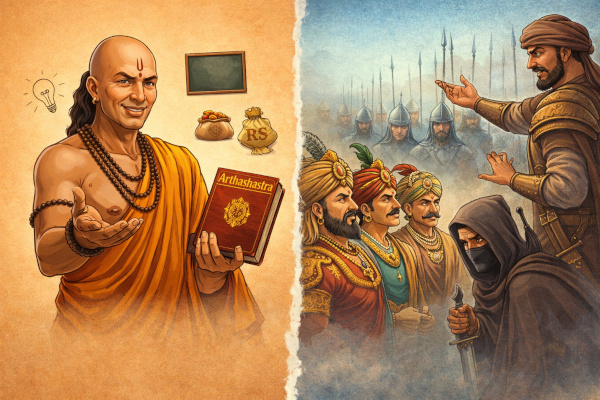
If ancient India had LinkedIn, Chanakya’s profile would have read something like this: Scholar. Economist. Political strategist. Dynasty remover. Specialist in fixing disasters created by overconfident men in jewelry.
Chanakya — also called Kautilya and Vishnugupta — was one of those rare human beings who looked at society, politics, greed, corruption, weak leadership, emotional stupidity, and general public nonsense, thought, decided, “Fine. I’ll do it myself.” While everyone else was busy participating in chaos, defending chaos, benefiting from chaos, or marrying into chaos, Chanakya was calmly studying it with the expression of a man who had already predicted the mess and was now being forced to watch it happen in real time in 4K format- real world.
He lived around the 4th century BCE and is remembered as the brilliant mind behind Chandragupta Maurya’s rise and the fall of the Nanda dynasty. Which is a very elegant historical way of saying that when the ruling order behaved like a badly managed family business with delusions of grandeur, Chanakya decided to intervene. Most people, when offended by power, sulk, complain, or write emotional poetry. Chanakya looked at the empire like a software project manager opening a legacy system and said, “This architecture is unstable, the leadership layer is bloated, accountability is missing, and the whole thing needs to be deprecated.”. He did it eventually,
He is often described as a philosopher, teacher, economist, royal adviser, and master strategist — a man of absurd range, though not in the Johnny Sins school of professional multitasking. All true. But none of those titles fully capture his energy, which was somewhere between “national emergency” and “I have had enough of you people.” He did not float through life dispensing vague inspiration about following the heart. Chanakya would almost certainly have considered that terrible advice, mainly because the human heart has an alarming habit of selecting the worst possible person, plan, alliance, or investment and then calling it destiny.
What made him remarkable was not just intelligence, but targeted intelligence. Plenty of people are clever in decorative ways. Chanakya was useful. He understood administration, revenue, law, power, war, diplomacy, espionage, trade, agriculture, governance, and that timeless political mystery: why idiots become unbearable the moment they get authority. He did not simply think deeply. He thought operationally. He was the kind of mind that could look at a kingdom and immediately identify the financial leak, the lazy minister, the corrupt official, the vulnerable border, the food problem, the internal conspiracy, and the fool who thought none of this required urgent attention.
Naturally, history needed him.
He is traditionally associated with the Arthashastra, that famously formidable text on statecraft, economics, administration, intelligence gathering, law, taxation, war, foreign policy, and all the other things that keep a state from becoming a ceremonial disaster in expensive fabric. Reading it today, one gets the distinct impression that Chanakya had very little faith in human beings left unsupervised. And honestly, he had a point. Give people wealth, ambition, opportunity, weak oversight, and a cousin in office, and within weeks the treasury is coughing blood.
Then there is Chanakya Niti, where he really lets the public have it. Here he does not write like a dreamy sage imagining a world healed by good vibes and fragrant thoughts. He writes like a man who has met people repeatedly and found the experience educational but disappointing. Fake friends, bad spouses, foolish students, treacherous servants, unstable wealth, rotten environments, reckless choices, social collapse — Chanakya walks through all of it with the cold efficiency of someone conducting an inspection at the factory where human error is mass-produced.
And what makes him so modern is that his complaints still work.
The names have changed, of course. Kings became politicians. royal courts became television studios and party headquarters. spies became “sources.” scrolls became phones. gossip became social media. fools, meanwhile, diversified beautifully and are now available in public office, private life, financial planning, relationship advice, and video form. Yet Chanakya’s basic diagnosis remains astonishingly fresh: people are impulsive, vanity is expensive, power attracts nonsense, and trust given without judgment is one of the fastest ways to become a lesson for others.
He also had the deeply unfashionable habit of being practical. Chanakya did not care whether a truth was emotionally soothing. He only cared whether it worked. This makes him difficult for people who prefer their wisdom soft, decorative, and impossible to apply. Chanakya was not in the spiritual wallpaper business. He wanted results. He wanted order, stability, competent rule, economic discipline, strategic thinking, and fewer fools making decisions with consequences. A very unreasonable standard, as the centuries have repeatedly shown.
At the centre of Chanakya’s life story sits one of history’s most deliciously overachieving revenge arcs. Tradition says he was insulted and humiliated at the court of the Nandas — and not in some small, forgettable, “someone failed to greet me properly” kind of way. No, this seems to have been the sort of insult that enters a man’s bloodstream, builds a furnished apartment there, and starts paying rent in long-term consequences. An ordinary person, after such a humiliation, would have gone home, narrated the incident seventeen times to increasingly tired friends, stared at the ceiling at night replaying alternate comeback lines, and then built an entire personality around “what really happened that day.” Chanakya, being Chanakya, chose not to journal. He chose regime change.
That is what makes him so spectacularly unreasonable in the best possible way. He did not merely feel offended. He operationalised the offence. He looked at a personal humiliation and somehow converted it into a multi-phase political project. Somewhere between rage and genius, he found Chandragupta Maurya — a young man with promise, ambition, and, most importantly, the willingness to participate in a plan significantly larger than sulking. What followed was the systematic construction of a new political order. Most people turn heartbreak into playlists. Chanakya turned insult into empire.
And one must really pause to admire the administrative discipline of that response. Imagine being so insulted that instead of sending one angry message, blocking two people, and eating something fried, you locate a future emperor, train him, build alliances, undermine a ruling dynasty, and contribute to the birth of one of the subcontinent’s greatest imperial formations. That is not pettiness. That is pettiness with infrastructure.
The beauty of the story is that Chanakya did not merely want the Nandas to feel bad. He wanted the entire failed system that produced their arrogance to be uprooted. His reaction was not, “These people embarrassed me.” His reaction was, “This governance model is trash, the leadership layer is bloated, the court culture is rotten, and the whole thing needs to be removed from production.” It is as if he took one personal insult, fed it protein, gave it strategic education, and released it into history.
What makes it even funnier is how wildly disproportionate it all feels. Most human beings are given insult and produce grievance. Chanakya was given insult and produced deliverables. Lesser men collect emotional scars; he collected outcomes. He did not spend six weeks posting philosophical sadness. He spent years helping engineer the fall of a dynasty. Frankly, that is such an aggressive level of follow-through that even history seems slightly alarmed by it.
So yes, at the core of Chanakya’s legend lies one of the most satisfying lessons ever delivered by an offended genius: if the world insults you, you may complain, you may brood, or — if you are Chanakya and completely unhinged in the most efficient possible way — you may calmly return later with a new emperor and a revised map.
So who was Chanakya really? He was a scholar with the temperament of a strategic thunderstorm. A teacher who did not merely wish to educate the world, but to stop it from behaving like a seduction with no supervision, no limits, and entirely too many eager hands. A thinker who understood that morality matters, but also that morality without planning gets pushed down the stairs by reality. A political mind so sharp that even now, centuries later, people still quote him whenever leadership collapses, alliances rot, or public life begins resembling a circus with taxation.
In simpler terms, Chanakya was what happens when genius gets tired of everyone’s nonsense and decides to become useful.
You may also like
-
When the Tongue Declares Victory and the Kingdom Quietly Shops Elsewhere
-
Chanakya Niti- Chapter 3
-
Matsya Nyaya: Or, Why Civilization Exists to Stop Large Idiots from Eating Smaller Ones
-
Matsya Nyaya from Chanakya: A Comprehensive Guide to Being Eaten with Professional Courtesy
-
Chanakya Niti- Chapter 2