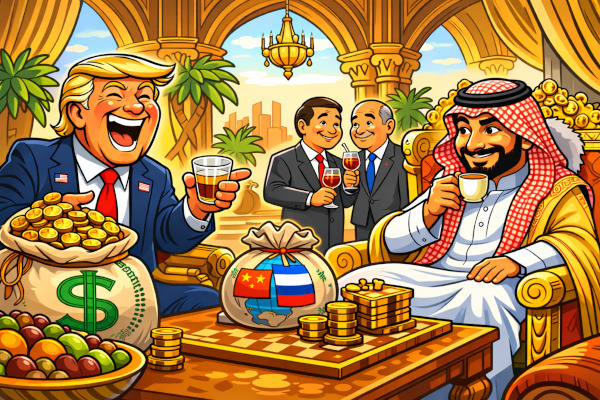
Chanakya would have loved this spectacle in the same way a physician loves a textbook case of self-inflicted poisoning. Donald Trump, that eternal trumpet with legs, reportedly bragged that Saudi Crown Prince Mohammed bin Salman was practically “kissing my ass.” It was one of those lines that arrives dressed as dominance and leaves dressed as a village idiot in borrowed armor. The remark was widely reported in late March.
Now Chanakya’s old statecraft, stripped to its bones, teaches a simple truth: a ruler who cannot govern his tongue will eventually serve his rivals. Trump, as always, speaks like a man who believes geopolitics is a casino floor where volume counts as strategy. Unfortunately for him, Saudi Arabia appears to be playing a much older game, one involving patience, oil, money, and the cold art of making several great powers compete for the privilege of being taken seriously.
This is where the comedy becomes delicious. Riyadh did not react like a soap-opera duchess hurling goblets across a marble hall. It did something much crueler. It remained outwardly composed and kept diversifying. Reuters reported that Saudi Arabia has been balancing its ties rather than chaining itself to Washington: keeping vital links with the United States while deepening economic relations with China, its largest oil customer. Reuters also noted Chinese investment in the kingdom had reached nearly $71 billion by mid-2024. That is the diplomatic equivalent of smiling at one suitor while quietly accepting flowers, jewelry, and property documents from another.
And while the American political circus was still inflating balloon animals out of ego, Saudi Arabia kept working with Russia inside OPEC+. Just days ago, Vladimir Putin and Mohammed bin Salman discussed Middle East tensions and continued OPEC+ cooperation, according to Reuters. Nothing says “thank you for your vulgar boasting” quite like calmly coordinating energy policy with another major power while the man who insulted you is still admiring his own reflection in the microphone.
This is the part Chanakya would underline with a sharp nail: the wise king does not answer every insult; he rearranges the board. Fools think revenge must be noisy. Masters prefer invoices, contracts, port access, market share, and alternative channels. Trump talks like a barstool Caesar. Saudi policy increasingly behaves like a banker-emperor who has seen many loud men come and go and has no intention of betting the kingdom on any one of them.
Even on BRICS, Riyadh has played the most aristocratic game possible: hesitation as leverage. Reuters reported that Saudi Arabia has held off formally joining BRICS while preserving room with Washington, even as it broadens its options elsewhere. That is not indecision. That is a kingdom lounging on a golden sofa while several empires audition for relevance.
Which brings us back to Trump, a man who often mistakes public crudity for private strength. In his imagination, a vulgar line proves he is feared. In reality, it often proves he is the only person in the room too excited to notice that the room has already moved on. Chanakya would have filed him under a very old category: the ruler who mistakes noise for power and praise for loyalty. Such men are useful mainly to their enemies, because they save everyone else the effort of sabotage.
The funniest part is that Saudi Arabia has not “cut America off” in the melodramatic way internet prophets love to announce. That would be too simple, too emotional, too middle-class. Riyadh has chosen something more royal: make the United States less central, make China more useful, keep Russia relevant in oil, keep everyone guessing, and never let one partner feel irreplaceable. That is not a breakup. That is a monarchy conducting strategic polygamy with a sovereign wealth fund the size of a myth.
So the Chanakyan moral is clear. A loose tongue can burn down years of diplomacy faster than an invading army. A clever adversary does not always strike back with thunder. Sometimes he simply becomes harder to own, harder to predict, and far more expensive to insult. Trump supplied the bluster. Saudi Arabia appears to be supplying the silence. In statecraft, silence from a rich kingdom is often the sound of someone moving the furniture while you are still giving your speech.
That is why the whole episode is so beautiful. One man barked. The other side adjusted trade, energy, and strategic options. One wanted applause. The other accumulated leverage. One performed masculinity for the crowd. The other practiced monarchy for the century.
Chanakya would have smiled very faintly at the ending. Then he would have written, in ruthless little letters: when the king cannot hold his mouth, the treasury must prepare to pay for it.
You may also like
-
Chanakya Niti- Chapter 3
-
Matsya Nyaya: Or, Why Civilization Exists to Stop Large Idiots from Eating Smaller Ones
-
Matsya Nyaya from Chanakya: A Comprehensive Guide to Being Eaten with Professional Courtesy
-
Chanakya Niti- Chapter 2
-
Chanakya: The Original Consultant for a Civilization Making Terrible Choices