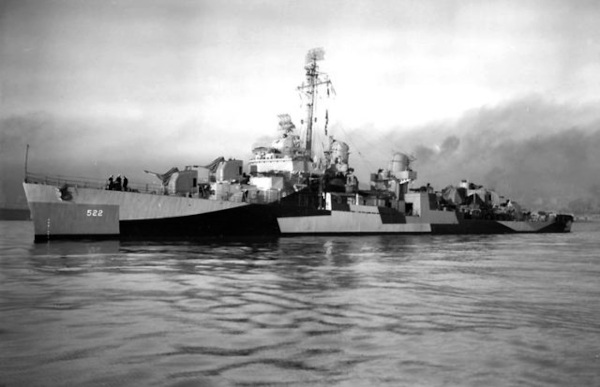
There are unlucky ships, there are accident-prone ships, and then there is USS William D. Porter, a vessel that seems to have been assembled in a naval yard directly over an ancient burial ground for common sense. Most destroyers go to war intending to menace the enemy. Willie Dee looked at that job description, nodded politely, and then spent its most famous day trying to torpedo the President of the United States by what can only be described as administrative enthusiasm.
Picture the scene. November 1943. The mighty battleship USS Iowa is carrying Franklin Roosevelt toward the Tehran Conference. This is one of those missions where everyone is expected to behave with exceptional professionalism, grim competence, and a minimum of accidental presidential homicide. Nearby, the William D. Porter is participating in a torpedo drill. A drill. This is the maritime version of a fire drill, except with more steel, more consequences, and ideally fewer active warheads. Then, because fate occasionally likes slapstick, a live torpedo actually leaves tube number two and heads straight toward Iowa. At that moment the ship ceased to be a destroyer and became a floating career-ending thought experiment.
Now comes the part that gives the whole story its rich, artisanal flavor of panic. Because of radio silence, Porter first tried to warn Iowa by signal lamp, which is already a difficult medium for communicating the message, “Good afternoon, sorry to report we have accidentally launched your murder.” Then the messages were wrong. First the torpedo direction was wrong. Then another signal wrongly suggested the destroyer was backing up. Finally, in the desperate tone of a man watching his own obituary typeset itself, Porter broke radio silence and yelled the naval equivalent of “MOVE, MOVE, MOVE.” Iowa turned hard, and the torpedo exploded astern instead of turning a diplomatic mission into the world’s worst press release. Roosevelt himself reportedly had himself moved to get a better look, which is an astonishingly presidential reaction to almost being torpedoed by his own side.
One of the great pleasures of this episode is how professionally the official records describe an event that, in human terms, was a full nervous breakdown in salt water. The deck log is almost offensively calm: torpedo accidentally fired, investigation being held, anti-aircraft practice resumed. That is the bureaucratic majesty of military paperwork. Somewhere between “oops” and “resume firing AA practice,” an entire ship had very nearly rewritten American succession law. Willie Dee did not so much make a mistake as briefly audition for the role of Axis asset without the inconvenience of switching flags.
By this point, the William D. Porter had achieved a rare kind of fame. It was no longer merely a destroyer. It was a destroyer around which rumor began breeding recreationally. The confirmed torpedo incident was already so gloriously stupid that later storytellers looked at it and thought, “This vessel deserves a cinematic universe.” So the internet started bolting extra disasters onto the ship like decorative antlers on a nervous goat. Naval historian J. M. Caiella’s review in Naval History says the real, documented fiasco was the live torpedo fired at Iowa; many of the additional “Willie Dee” classics are either unsupported or flatly contradicted by deck logs.
Take the famous scraping incident. In legend, Porter begins its career by departing Norfolk like a shopping cart with rank, dragging its anchor down another ship’s side and allegedly ripping off rails, life rafts, boats, and whatever else happened to be standing nearby. It is a beautiful story because it gives the ship the energy of a man tripping at his own wedding and taking half the catering with him.
Then there is the dropped depth charge incident, which is almost too perfect. In the internet version, Porter accidentally loses a live depth charge off the stern, the thing explodes in the sea, and the whole convoy begins antisubmarine maneuvers under the impression that war has arrived early and underwater. It has magnificent comic rhythm: one ship quietly escorting the President, another ship accidentally impersonating a German U-boat.
My personal favorite is the drunken shell into the commandant’s yard legend, because it sounds like the kind of story sailors would invent after midnight and historians would then spend decades trying to kill with documents. The tale goes that while in the Aleutians, some festive genius aboard Porter fired a 5-inch shell in port, sending it into the commandant’s front yard — or, in other versions, the back garden during a party. It is exquisite. It has everything: alcohol, artillery, domestic landscaping, and the irresistible possibility that a naval officer once had to look at a crater beside his begonias and say, with forced dignity, “I see.”
That is what makes William D. Porter so funny in the first place. Most ships get one story. This ship got a mythology. The confirmed record already includes accidentally firing a live torpedo at the battleship carrying Franklin Roosevelt and then later being fatally damaged when a shot-down Japanese plane exploded beneath her at Okinawa, though every crewman survived. That was apparently still not enough for posterity. History handed people one absurd destroyer, and folklore immediately said, “Excellent. Let us now garnish.”
Still, even with the exaggerations stripped away, Willie Dee retained a once-in-a-generation gift for chaos. In June 1945, off Okinawa, she was attacked by a Japanese Val dive bomber. The gunners shot it down close aboard, which is usually considered a good and healthy naval outcome. But the plane’s explosive load detonated beneath the ship anyway, lifting the destroyer and fatally damaging her. It is perfectly on brand that even when Porter did everything correctly, reality still found a way to file an incident report in her name. The crew fought to save her for hours before abandoning ship, and in one final insult to predictability, everyone survived. Even the ocean, it seems, looked at William D. Porter and decided the joke worked better if the witnesses lived.
So yes, USS William D. Porter remains one of the finest vessels ever to demonstrate that morale, firepower, and training all take a distant second place to destiny when destiny has chosen comedy. Other ships earned glory. Some earned battle honors. Willie Dee earned immortality as the only warship whose most famous enemy engagement involved almost sending a torpedo into the President’s ride and then having to explain itself with the panicked dignity of a dog sitting beside a destroyed sofa. Naval history is full of courage, sacrifice, and heroic seamanship. It is also, thank heaven, full of one destroyer that behaved as though it had been commissioned by a committee of gremlins.
You may also like
-
Savage French General Tells Trump Officials ‘Stop Snorting Cocaine’ Over Bonkers runway Plan
-
How to Lose a Battle Without the Enemy: The Karánsebes Method
-
Missiles, Mood Swings, and NATO’s Awkward Silence
-
The Empire vs. the Flying Toaster
-
F-35: The Flying Supercomputer That Occasionally Needs Psychiatric Support