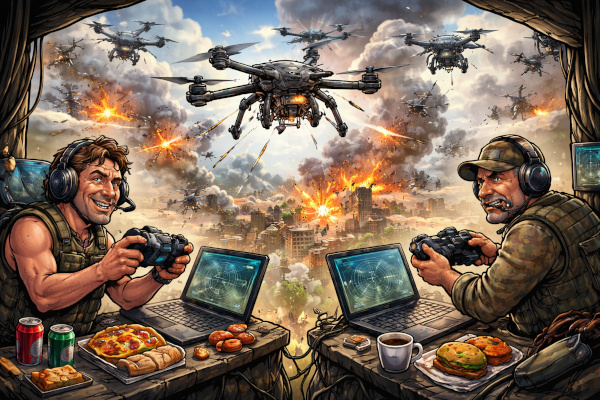
There was a time when American war planners could enter a room with the confidence of men who believed history had personally shortlisted them for dominance. They had maps, carrier groups, acronyms, lasers,jawlines so sharp and smooth they looked wind-tunnel tested for stealth, and PowerPoint decks so sophisticated they looked like those could invade a country by themselves. War, in this elegant imagination, involved sleek jets slicing through the sky, billion-dollar destroyers gliding like irritated sharks, satellites blinking overhead with divine surveillance, and someone in a polo shirt saying “kinetic options” as though he were ordering artisanal coffee. Then drone warfare arrived like a raccoon with a blowtorch and a RF connection.
This is the true insult of the drone age war. It has not merely changed war. It has vandalized the aesthetic of war like a public toilet wall. For decades, empires liked conflict to look expensive, masculine, and cinematic. They wanted thunderous takeoffs, glowing command screens, and grim-faced generals in the war room tossing around verbs like project, dominate, degrade, and neutralize as though the enemy might surrender out of respect for their vocabulary.What they did not want was some malnourished buzzing migraine made of plastic, fertilizer, GPS components, and entrepreneurial resentment drifting toward a billion-dollar asset like an airborne kitchen appliance with political intentions. Yet here we are. Somewhere inside the Pentagon, a man with four degrees and a security clearance is being professionally humiliated by something that sounds like a mosquito trapped inside a Tupperware box.
The old equation of war was emotionally satisfying. If you spent more, you won more. This was the imperial love language. Bigger budget, bigger bomb, bigger victory.
The drone age did not argue with the old logic of war spending; it simply hovered over it, beeped at it, and turned it into an accounting disorder. There are few things more offensive to a superpower than discovering that its majestic missile defence architecture, a thing funded by generations of patriotic taxation and contractor poetry, now exists partly to shoot at glorified DIY hobby projects assembled with the financial dignity of a one night stand. Nothing unsettles a strategic planner more than realizing he is defending Western civilization with interceptors that cost more than the homes of the people launching the drones.
This is where the madness becomes beautiful. Somewhere in a command center, an officer has to authorize the launch of a missile worth several million dollars to eliminate a flying object whose manufacturing budget was approximately “whatever was left after snacks.” Imagine the paperwork. Imagine the cold horror of the sentence: “Yes, sir, we successfully destroyed the hostile lawnmower from heaven using a missile that could have paid for a small hospital.” Generals do not age normally anymore. They now age in expressions. Every drone swarm adds another wrinkle shaped like a procurement scandal.
Drone warfare has also ruined one of the military establishment’s favorite psychological pleasures: hierarchy. Traditional war was very respectful of hierarchy. Massive nations fought other massive nations using expensive things produced by serious people in secure facilities. It had etiquette. Drones have brought the opposite energy. Drones are profoundly disrespectful. They are the street comedians of modern war. They arrive low, cheap, numerous, and smug. They do not care about prestige, doctrine, rank insignia, or the emotional needs of admirals. They simply appear in uncomfortable numbers and ask a devastating question: “You spent how much on your fleet again?”
And that, really, is the scream trapped inside every war-planning office. The planners are not merely fighting drones. They are fighting arithmetic. This is far more humiliating. It is one thing to lose to a formidable enemy with tanks, aircraft, and ideology. It is another to be stalked by financial asymmetry with wings. Drone warfare has turned conflict into a nightmare in which the enemy’s most dangerous weapon is your own procurement process. The drone does not even have to hit something important. Sometimes it merely has to exist in the wrong airspace long enough to force a hilariously expensive response. In this sense, the drone is less a weapon than a budgetary insult with rotors.
The psychological damage is extraordinary. American military culture spent decades building itself around overwhelming superiority. That is a very difficult mood to maintain when your destroyer, that floating cathedral of steel and self-esteem, must remain on alert because somewhere out there a flock of airborne plumbing parts may attempt to collide with it out of pure geopolitical spite. It is hard to project dominance when your main emotion is irritation. The empire wanted Top Gun. Instead it got pest control.
Naturally, the planners responded the only way great bureaucracies ever do: by creating more layers. More sensors. More integration. More doctrine. More briefings. More kill chains. More dashboards. More multi-domain architecture. More phrases like “scalable counter-UAS solutions” uttered by men whose souls left their bodies sometime around the sixth committee meeting. This is the bureaucratic instinct: if a cheap drone is causing distress, the answer is obviously a 417-page framework, three inter-agency task forces, and a contractor-built AI-enabled modular threat matrix that costs the GDP of a polite island nation. No one has ever looked at a $20,000 drone and thought, “Perhaps we should respond in a spiritually proportionate way.” No!!!.No No No!!!. They look at it and invent an ecosystem.
Meanwhile, the drone itself continues being offensively unserious. It does not gleam. It does not roar. It carries itself with the chaotic confidence of a college dropout who has learned just enough electronics to become a national security problem. It is the weaponization of inconvenience. A cruise missile feels like history. A stealth bomber feels like destiny. A cheap drone feels like your civilization is being mocked by electronics, as though abandoned recycled plastic had finally decided to become an active military participant. It is impossible to have a dignified military posture when the threat profile resembles an angry appliance on steroids.
The deeper tragedy for U.S. war planners is that drone warfare has democratized nuisance. Great powers once had a monopoly on theatrical violence. Now every moderately determined actor with enough parts, improvisation, and malice can participate in the disruption of economy. The battlefield has become the internet of things, if the things were furious. Somewhere, a planner who once dreamed of operational artistry now spends his afternoons discussing low-cost saturation vectors and terminal engagement economics, which is a very elegant way of saying, “How do we stop going bankrupt shooting at airborne junk?”
Even the vocabulary has become humiliating. The empire, which once spoke in majestic terms like deterrence, projection, escalation dominance, and strategic posture, must now frequently discuss swarms. Swarms. That is not a word from the age of grandeur. That is a word associated with bees, locusts, and biblical displeasure. It is difficult to preserve martial dignity when your planning assumptions can be defeated by a noun usually heard during a picnic emergency.
And then there is the spectacle of defence contractors, those magnificent poets of invoice-based patriotism, rising to the occasion with the joyous scent of opportunity in their nostrils. They see the drone problem and immediately produce brochures for anti-drone lasers, anti-drone microwaves, anti-drone nets, anti-drone AI, anti-drone command suites, anti-drone autonomous interceptors, and presumably anti-drone anti-drone systems in case the first anti-drone systems develop feelings. Every crisis in modern warfare eventually becomes a pilgrimage site for men selling solutions with names like SentinelX, SkyShield, or Falcon Dome, each accompanied by a logo that looks like it was designed by a eagle on Red Bulls. The United States may not always know how to simplify war, but by God it knows how to monetize panic.
Yet for all the absurdity, the threat is real, which makes the comedy even darker. That is the essence of drone warfare. It is ridiculous right up until it is not. It looks unserious right up until it destroys something expensive, strategic, or human. And that is what makes it such a magnificent torment for planners. It denies them the emotional convenience of contempt. They cannot laugh it off, but neither can they engage it without seeming faintly ridiculous. They are trapped in a tragicomedy of their own making, where the world’s most powerful military machine must continuously explain why it is spending fortunes to defend itself from the airborne descendants of RadioShack.
So…now we are at an age in which the mightiest war planners on earth sit beneath flickering lights, staring at screens full of tracks, costs, and probabilities, while somewhere overhead a cheap, buzzing irritant redraws doctrine one swarm at a time. The drone has done what rival superpowers, insurgents, and strategic theorists struggled for years to do. It has made American war planning feel less like imperial mastery and more like a luxury hotel trying to deal with a bedbug infestation using guided missiles.
That, in the end, is the perfect insult. Not that drone warfare has made the United States weaker. It has made it look annoyed. And for an empire, annoyance is far more undignified than fear.
“Drones are profoundly disrespectful. They are the street comedians of modern war.”– Sorcerer
You may also like
-
USS William D. Porter: The Warship That Treated Friendly Fire Like a Personality Trait
-
Savage French General Tells Trump Officials ‘Stop Snorting Cocaine’ Over Bonkers runway Plan
-
How to Lose a Battle Without the Enemy: The Karánsebes Method
-
Missiles, Mood Swings, and NATO’s Awkward Silence
-
F-35: The Flying Supercomputer That Occasionally Needs Psychiatric Support