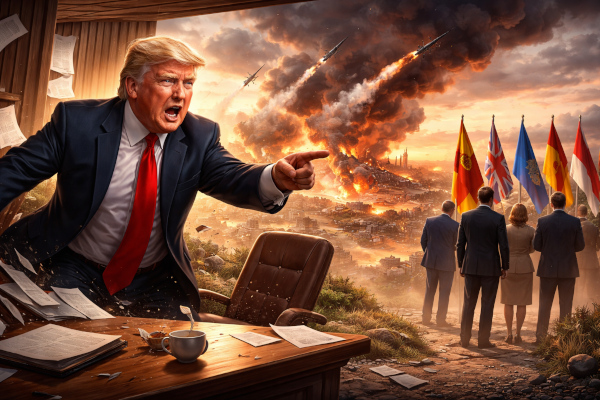
The Iran war, in its current absurd form, feels less like a carefully planned act of statecraft and more like a luxury tantrum that somehow acquired missiles, oil shock, and press briefings. It began while channels for indirect diplomacy were still alive through intermediaries such as Turkey, which has said it was relaying messages between Washington and Tehran even as the conflict widened after U.S.-Israeli strikes on Iran. That is the sort of timing usually associated with a man throwing a chair through the conference room window while the peace talks are still waiting for tea.
Donald Trump’s role in the affair has been especially impressive if one enjoys geopolitical management in the style of a casino owner arguing with a chandelier. He has veered between threats to smash Iran’s energy infrastructure, enthusiasm for bolder pressure, talk of new negotiations, and reports that he is now willing to end the war even without reopening the Strait of Hormuz immediately, which actually was open before the war. This is not a doctrine so much as a mood ring with air power. The overall effect is of a man trying to conduct war, diplomacy, extortion, improvisation, and cable-news performance art from the same swivel chair, with each sentence arriving before the previous one has located its trousers.
What makes the whole FUBAR even funnier, in the bleak and expensive way only foreign policy can be funny, is how many countries have reacted with the diplomatic body language of guests pretending not to make eye contact with the drunkest man at a wedding. Trump complained that European NATO members were not there for the United States in the Iran conflict, which Reuters reported had begun without prior consultation with many of those allies. That is a remarkable grievance: start an unwanted war during a negotiation phase, skip the courtesy call, then act wounded when the group chat responds with silence and one thumbs-down emoji.
Spain, to its credit, did not even bother with elaborate hypocrisy. Reuters reported that Madrid closed its airspace to U.S. military planes involved in attacks on Iran, after already refusing the use of jointly operated bases for the war. That is not subtle diplomacy. That is Spain looking at the conflict and saying, with admirable Mediterranean clarity, “Absolutely not, and please take your nonsense around the coast.” It is the alliance equivalent of hiding your car keys when your loudest friend announces he has had a brilliant idea.
Even in the Gulf, where some governments privately want Iran weakened, the enthusiasm has had the unmistakable aroma of people volunteering someone else’s face for the punch. AP reports that Saudi Arabia, the UAE, Kuwait, and Bahrain have pushed for continued pressure on Iran, while Oman and Qatar prefer diplomacy, but those same Gulf states have not actually joined the offensive themselves. Which is perfect, really: the strategic dream remains to have Iran humbled, America invoiced, somebody else bombed, and one’s own skyline left pleasantly uncratered. It is war support in the modern premium style like a spouse offering deep moral encouragement from the far edge of the bed with an excuse of headache and no intention of participating.
Turkey’s posture has been even more revealing. It has been trying to mediate, pushing de-escalation, passing messages, and at the same time having NATO defenses intercept missiles entering its airspace. So one NATO member is effectively saying, “Please stop this lunacy,” while also having to swat away its airborne consequences. That is less an alliance strategy than a regional stress disorder. It captures the whole absurdity beautifully: the people nearest the fire are busy looking for extinguishers, while the people farthest from it are still giving speeches about strength.
And then there is the money, because every reckless war eventually remembers arithmetic. Modern American war-making still has the tragicomic habit of answering cheap flying lawnmowers with missiles and air defense hardware priced like waterfront real estate. Egypt’s president warned oil could top $200 a barrel if the conflict keeps grinding on, and Reuters noted that about 20% of global oil used to move through the Strait of Hormuz before its closure. This means the war has achieved that rare modern-policy hat trick: strategic confusion, allied irritation, and the possibility of making fuel prices look like ransom notes. Nothing says “carefully considered intervention” quite like setting the global energy system on fire while pretending the adults are still in charge.
Trump, meanwhile, has reportedly toyed with ideas such as ending the war without reopening Hormuz immediately and even having Arab states help pay for it. The first idea sounds like the sort of victory announcement made by a man standing in the ashes, pleased that the sofa is gone but delighted the wallpaper still is holding on. The second sounds like a man ordering the most chaotic item on the menu and then asking the next table to split the bill. There is a deeply Trumpian elegance to this: begin with maximum swagger, continue with public improvisation, and finish by treating geopolitical catastrophe like a luxury event whose expenses should obviously be reimbursed by somebody nearby and solvent.
So the war now sits there in all its ridiculous glory: born in impatience, enlarged by ego, narrated through contradictory threats, and supported by just enough distant cheerleading to make it dangerous without ever making it dignified. NATO allies are wary, mediators are exhausted, oil markets are sweating, Spain has practically hung a “do not disturb” sign across its airspace, and Trump is still performing that uniquely theatrical blend of menace and improvisation that makes every crisis feel like it is being managed by a man arguing with his own reflection in a gold bathroom mirror. The tragedy is real, the costs are real, and the comedy is that so much of it still looks like an unwanted war begun in the middle of negotiation by people who mistook impulse for grand strategy.
You may also like
-
USS William D. Porter: The Warship That Treated Friendly Fire Like a Personality Trait
-
Savage French General Tells Trump Officials ‘Stop Snorting Cocaine’ Over Bonkers runway Plan
-
How to Lose a Battle Without the Enemy: The Karánsebes Method
-
The Empire vs. the Flying Toaster
-
F-35: The Flying Supercomputer That Occasionally Needs Psychiatric Support