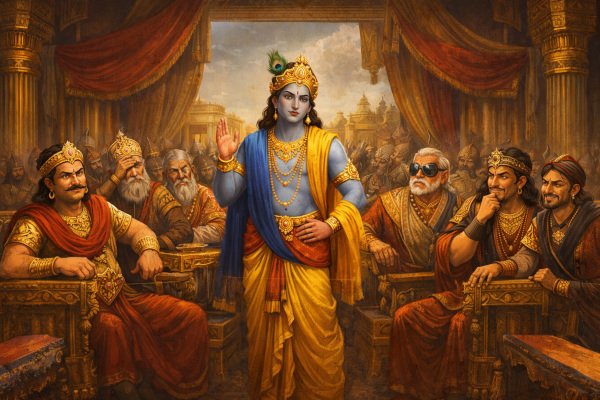
By the time Krishna went to the Kaurava court as a peace messenger, the Mahabharata had already developed the exact atmosphere of a family business that had been run for too long by vanity, inheritance, passive aggression, and uncles with strategic delusions. This was no longer a kingdom in the healthy sense. It was a collapsing corporate dynasty, where the founders were blind, the shareholders were armed, the legal department was made of sages, and one side had somehow convinced itself that greed was a form of policy. Into this fragrant pile of ego and ceremonial madness walked Krishna, carrying the last respectable offer before civilization switched to full battlefield mode. He came asking for peace. This was, in effect, the ancient equivalent of sending the only competent adult into a room full of overpromoted nephews and asking whether perhaps the company could avoid burning down before quarterly results.
Krishna’s proposal was almost offensively reasonable. The Pandavas were not demanding the moon, the stars, or even a decent apology for the public humiliation, attempted murder, cheating, exile, and general carnival of moral sewage that had already been inflicted upon them. At that stage, they were willing to settle for terms so modest that any functioning court with a pulse and a little shame would have signed immediately. They wanted peace, stability, and a way to avoid turning northern India into a giant obituary. This should have been easy. It should have been the kind of meeting that lasts fifteen minutes, followed by fruit, handshakes, and a statement to the press about “constructive dialogue.” Instead, Krishna found himself addressing men whose combined emotional maturity could have been carried in a spoon.
Duryodhana, of course, behaved exactly as one expects from a prince whose entire political philosophy was essentially, “I sat in the chair first, therefore reality belongs to me.” He had the confidence of a man who had mistaken stubbornness for statecraft and sulking for sovereignty. Krishna came to prevent a war. Duryodhana heard this and reacted with the offended dignity of a deeply mediocre executive being asked to share office space. Here was a man standing on a mountain of bad decisions, looking down at compromise as though it were beneath him, even though compromise was the only bridge left between him and mass cremation. He had already inherited power, privilege, armies, advisors, and repeated warnings from wiser people. Yet none of this produced wisdom. It merely produced deluxe arrogance with gold trim.
And the court around him was no better. The elders sat there like an expensive panel discussion on ethics hosted by people who had all failed ethics in practice. Bhishma knew what was right. Drona knew what was right. Vidura certainly knew what was right and had been saying it so consistently that one imagines him developing the exhausted facial expression of a man trapped in an eternal group chat with fools. Even Dhritarashtra, blind in body and catastrophically blurred in judgment, had enough fragments of conscience to understand disaster when it approached wearing diplomatic language. Yet the entire assembly had perfected that ancient and timeless art form: watching one terrible man steer everyone toward catastrophe while murmuring concerns in elegant language. It was governance by helpless nodding.
Krishna, meanwhile, had to perform the impossible task of explaining basic civilization to people who had converted spite into a constitutional principle. One can almost picture him standing there with that serene expression reserved for teachers, saints, and customer service professionals dealing with Deluxe nonsense. He laid out the consequences. He warned them of war. He pointed out the human cost. He gave them the last exit before history became a blood-soaked cautionary tale. This was not merely diplomacy. This was divine-level patience under conditions that would have made a lesser envoy request either exile or a chair to throw.
But the Kaurava side had long passed the stage where reason could enter the bloodstream. Duryodhana and his circle were operating on a more advanced toxin: the intoxicating belief that power already held can never be lost. This is the preferred drug of foolish rulers in every age. It turns negotiation into insult, humility into weakness, and restraint into something to be mocked by men who mistake immediate advantage for permanent victory. They had that classic boardroom disease in which everyone keeps using words like strength, legacy, and principle while quietly building a coffin for the organization. Duryodhana did not want peace because peace required recognition that the Pandavas had a claim. More importantly, peace required him to stop being the central worshipper at the temple of his own grievance.
Then came the truly magnificent flourish of idiocy: the idea of trying to seize Krishna himself. There are failures, there are strategic failures, and then there is attempting to arrest the cosmic nucleus of the universe because the meeting is not going your way. This was diplomacy being dragged outside, struck repeatedly with a ceremonial mace, and then blamed for poor teamwork. The thought process here seems to have been that if one cannot defeat truth in argument, perhaps one can handcuff it. That is the kind of plan produced only when arrogance has eaten the last surviving cell of common sense. It is the political equivalent of seeing a thunderstorm and deciding to file a complaint against the sky.
Yet even then, the tragedy of the scene remained intact. Because the point of Krishna’s mission was never that the Kauravas lacked information. It was that they lacked the character to act upon it. They were not ignorant of right conduct. They were allergic to it. Advice had been given. Warnings had been repeated. Conscience had spoken in multiple voices. Diplomacy had arrived in person, smiled, reasoned, pleaded, and then revealed the universe for emphasis. Still Duryodhana chose war. Some men see the abyss and step back. Duryodhana built a balcony.
It is ancient, yes, but also embarrassingly current. Every age has its Duryodhanas: men who inherit structures they did not build, harden themselves against correction, interpret every reasonable settlement as humiliation, and march toward disaster with the stiff-backed confidence. Every age also has its Viduras, who keep speaking sense into rooms that treat wisdom like a scheduling inconvenience. And every age, tragically, reaches moments when peace is offered with dignity, clarity, and one final chance, only for someone in tailored robes or tailored suits to reject it because surrendering ego feels worse to them than burning down the world.
So Krishna went as peace messenger to the Kaurava court and did everything that diplomacy, morality, intelligence, and divinity could possibly do. He negotiated with patience, warned with clarity, and stood among men who had confused possession with legitimacy and pride with greatness. The failure of that mission was not the failure of peace. It was the failure of people too swollen with entitlement to recognize salvation even when it arrived in person and spoke gently. Some courts deserve treaties. This one deserved a battlefield. And when the war finally came, it was less the beginning of disaster than the invoice for a long season of deluxe idiocy.