
Pingalaka was the kind of leader who looked excellent in profile and unstable in conversation. From a distance he was majesty: mane, posture, authority, the whole premium dictatorship package. Up close he was what many powerful men actually are — a large collection of appetites wrapped around a nervous system that could be hijacked by one unexpected noise and a bad whisper.
He was king of the forest, which meant everyone around him had agreed, for survival reasons, to treat his moods as weather and his insecurities as statecraft.
Then one day, while heading toward the river, Pingalaka heard a massive, booming sound rolling across the trees. Deep, resonant, unsettling. It belonged to Sanjeevaka, a bull who had not been born in the wild at all, but in the far less romantic world of human utility. He had once belonged to a merchant named Vardhamana, who used him, along with another bull, to pull goods and make commerce look dignified. But fate, which in old stories behaves like a drunken logistics manager, intervened. While travelling through the forest, Sanjeevaka was injured and left behind, written off as one more unfortunate loss in the grand accounting of profit. What was meant to be his end turned out to be an accidental sabbatical. Abandoned beside the river, he slowly recovered, fed on rich grass, regained his strength, and transformed from exhausted draft animal into a full-bodied, magnificent beast with lungs like ceremonial war drums. His bellow now rolled through the forest with the kind of authority that in any modern institution gets described as “threatening” by people who are really just startled by competence.

Pingalaka panicked immediately.
Not outwardly, of course. Men like him never panic in an honest shape. They panic through “strategic pauses,” mysterious withdrawals, sudden concern about “security implications,” and the urgent desire to ask subordinates what is happening while also making sure nobody notices they have no idea what is happening.
This is leadership in many ages, but especially in ours: a person with enormous formal power becoming emotionally disassembled by incomplete information.
Watching this were two jackals, Damanaka and Karataka, who were essentially what you would now call senior insiders, narrative fixers, and professional oxygen thieves. Karataka had the dead-eyed realism of someone who had watched too many ambitious idiots turn manageable situations into institutional trauma. Damanaka, meanwhile, had the defining quality of the dangerous operator: he was not powerless, merely insufficiently included. Which is worse.
There is no creature more destructive than a sidelined adviser with access and resentment. Give a fool a weapon and he may hurt one person. Give a manipulator partial exclusion and he will try to reorganize the emotional architecture of the whole kingdom.
Damanaka saw the king rattled and thought: My return begins now.
A decent courtier would have investigated, reported plainly, and calmed the situation. But decency is for people whose livelihoods do not depend on converting confusion into influence. Damanaka went, found Sanjeevaka, and realized at once that the so-called threat was not a threat at all. The bull was intelligent, articulate, steady, and entirely innocent of court politics — in other words, a perfect victim.
Because here is the thing about toxic systems: they do not only destroy enemies. Often they destroy the sane.
Damanaka introduced Sanjeevaka to Pingalaka. The lion, learning that the terrifying noise was merely one unusually self-possessed herbivore, relaxed at once. More than relaxed — he became attached. Sanjeevaka could think. He could speak. He had opinions not extracted from fear. Pingalaka, who had spent his reign marinating in flattery, discovered the narcotic pleasure of being around someone who did not sound like a trembling press release.
Soon the two were inseparable.
They were talking constantly. Strategy. Conduct. Governance. Philosophy. The kind of conversations that make mediocre courtiers develop stress rashes. Pingalaka started trusting Sanjeevaka directly, which is one of the few unforgivable sins in any ecosystem built on gatekeeping. Sanjeevaka had become that figure every rotten institution secretly hates: the competent outsider with influence but without having paid the proper tribute to the internal vermin.
And Damanaka watched this with the tightly smiling fury of a man who has just realized the boss has found a new favorite and that favorite does not require interpretation services.
This is where all modern palace filth begins: not with ideology, not with policy, not with principle — but with one sidelined parasite thinking, Why are they speaking without me?
Healthy trust is a direct threat to people whose careers depend on distortion. If Pingalaka and Sanjeevaka kept understanding each other clearly, Damanaka would become obsolete. And for certain classes of operator, irrelevance is more intolerable than evil.
So he did what modern political aides, media hatchet men, corporate whisperers, and elite gossip professionals have always done.
He framed the vibe.
Not facts. Never facts. Facts can be checked. He worked in implication, tone, emotional shading, interpretive fog. To Pingalaka he suggested that Sanjeevaka was becoming too comfortable. Too articulate. Too visible. Too calm in the presence of power. You know how this language works. People still use it today whenever they need to criminalize someone without evidence. “He’s overstepping.” “The optics are off.” “There’s a tone issue.” “He seems to think he’s indispensable.” It is the vocabulary of weak men preparing to become dangerous.
Then Damanaka went to Sanjeevaka and performed the inverse operation. The king, he implied, had changed. The warmth was cooling. The pauses meant something. The glances meant something. Leadership affection, after all, is often just appetite with a polite face. Was Sanjeevaka sure he understood the risks of being so close to power? Was he sure he was admired, and not merely being fattened emotionally before slaughter?
And just like that, trust began to rot.
This is how adults ruin each other in serious institutions. Not with open blows, but with controlled contamination. A sentence here. A suggestion there. A private concern. A confidential aside. A little “between us.” A little “I may be wrong.” A little “don’t quote me on this.” Soon two people are no longer relating to each other directly. They are relating through a fog machine operated by a jealous ghoul.
Pingalaka began interpreting confidence as ambition. Sanjeevaka began interpreting distance as danger. Every neutral gesture became charged. Every silence acquired teeth. Every conversation developed a second, imaginary conversation underneath it. That is the real violence of manipulators: they colonize perception. Once they enter the bloodstream of a relationship, the victims begin doing the rest of the damage themselves.
Damanaka did not need claws. He had narrative.
And narrative, in weak systems, is often deadlier than force. Because force is visible. Narrative lets everyone still call themselves civilized while they destroy one another over paranoia dressed as prudence.
Karataka, naturally, saw the whole thing unfolding and recognized it with the weary disgust of every person who has ever survived a committee, coalition, newsroom faction, or senior leadership team. He knew the script. He had seen this species of stupidity before. The insecure ruler. The useful newcomer. The excluded intermediary. The slow conversion of affection into suspicion. The inevitable blood on the floor followed by memos about stability.
And then it happened.
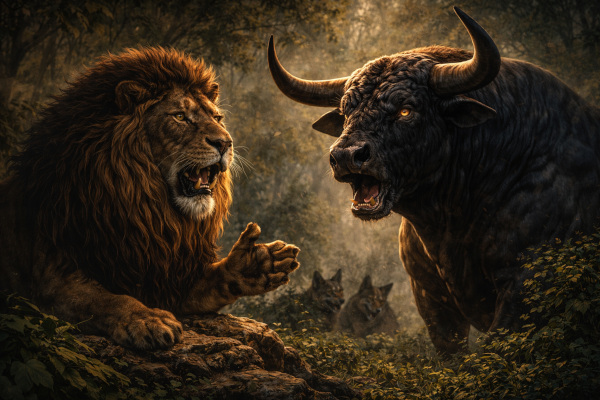
Pingalaka, by then fully poisoned by suspicion, no longer saw Sanjeevaka as a friend standing before him in the forest clearing. He saw a threat wearing a familiar shape. The bull’s strength, once admirable, now looked menacing. His steady posture seemed like defiance. Even the lift of his horns appeared, in the diseased theatre of the lion’s imagination, like the opening gesture of rebellion. And so the forest, which had once held the quiet of companionship between them, tightened into the charged stillness that comes just before violence. The air seemed to stop. The birds withdrew into silence. Sanjeevaka, sensing too late that the warmth in Pingalaka’s eyes had curdled into something darker, lowered himself into a defensive stance, hooves pressing into the earth, nostrils flaring, great chest heaving with confusion and alarm.

Then Pingalaka sprang.
He came not with the measured authority of a king delivering justice, but with the blind speed of panic disguised as power. His mane flew back, his claws tore into the ground, and his roar burst through the trees like something ripped out of madness itself. Sanjeevaka wheeled to meet him, horns forward, muscles coiling under his hide. The first collision was brutal. Horn met flesh, claw met shoulder, dust and leaves exploded upward, and the riverbank shook beneath the weight of two magnificent creatures suddenly reduced to raw survival. Sanjeevaka drove upward with the full force of his neck and chest, trying to throw the lion off, while Pingalaka raked at him with savage fury, his paws striking flank and back in bloody arcs.
The fight was not elegant. It was not noble. It was not the clean execution of fate. It was ugly, frantic, and thick with betrayal. Sanjeevaka bellowed, not now with the great booming confidence that had once echoed through the forest, but with the terrible sound of an innocent being trying to understand why trust had turned into death. He staggered, recovered, lunged again, his horns grazing Pingalaka’s side. For a moment it seemed possible that sheer strength might save him. But lions do not need innocence to win; they need only claws, teeth, and the willingness to finish what fear begins. Another roar, another desperate thrust of horns, another savage blow from the lion. Then the strength began to leave Sanjeevaka in visible waves. Sanjeevaka’s breath came raggedly, then faintly, then not at all. The same voice that had once filled the forest with life was gone. In its place remained only the heavy silence of the riverbank and the low, satisfied watchfulness of those who had engineered the whole disaster from the shadows.
By the time Pingalaka understood what lay before him, it was no longer an enemy. It was Sanjeevaka. His friend. Dead.
That is the endpoint of unmanaged ego in a manipulated hierarchy: the destruction of the one person who was actually good for you, because someone nearby made your insecurity feel like insight.
Sanjeevaka died for the oldest stupid reason in organized human life: he was valuable in a room where value is less important than choreography. He believed being useful made him safe. He believed sincerity could survive proximity to power. He believed personal trust outranked institutional jealousy. That is not innocence. That is practically a form of self-harm.
Damanaka, of course, got what he wanted. He regained influence. He was once again close to the throne, having successfully converted a stable bond into a corpse and calling it loyalty. This is why such people flourish. They are willing to do what healthier minds still find embarrassing. They will light a building on fire and then arrive carrying a water bottle and a title card.
And everyone, as always, pretends the lesson is about caution.
It is not merely about caution.
It is about the fact that many systems are structurally biased in favor of the most shameless interpreter in the room. The person willing to weaponize ambiguity, monetize insecurity, eroticize access, and frame sabotage as service will almost always have a competitive edge over the straightforward, the decent, and the competent. That is why institutions feel haunted. They are not haunted by ghosts. They are haunted by rewarded behavior.
Pingalaka is every leader who mistakes internal fragility for strategic intuition. Sanjeevaka is every capable person who enters a diseased ecosystem believing merit will be enough. Damanaka is every consultant, fixer, spin doctor, chief of staff, political aide, faction merchant, culture vampire, and whisper-based careerist who would rather see a thing destroyed than see it function without him.
The story survives because it remains disgustingly current.
Replace the forest with a corporate office, a startup, a media house, a university department, a party war room, or one especially narcissistic NGO, and nothing changes except the upholstery. The lion still needs reassurance. The bull still mistakes proximity for acceptance. The jackal still survives by fermenting distrust. The exhausted witness still mutters, “This was avoidable,” just before watching it become inevitable.
Civilization has upgraded its devices, its jargon, its fonts, its conference rooms, its surveillance capacities, and its PowerPoint templates.
But the ancient system remains the same:
an insecure man in power,
a competent outsider,
and a resentful intermediary
who would gladly turn affection into homicide
just to get cc’d again.
Corporate terms
In corporate terms, the story of Pingalaka and Sanjeevaka is what happens when leadership insecurity, poor communication, and politically motivated intermediaries are allowed to outrank trust, clarity, and competence. A capable outsider earns influence, a threatened insider panics at the loss of relevance, and a leader without emotional discipline mistakes manipulation for intelligence. The result is not merely the fall of one valuable employee or adviser, but the corrosion of the entire decision-making culture. Organizations rarely collapse because talent is absent; they decay because talent is made unsafe, access is weaponized, and whisper networks become stronger than direct conversation. The real lesson of the story is brutally modern: when leaders reward narrative management over truth, and proximity over integrity, the system eventually destroys the very people it most needed to survive.
You may also like
-
When the Last Peace Meeting Became a Premium-Grade Boardroom Disaster
-
Ashtavakra in the Boardroom: When Talent Threatens the Boss
-
Hanuman and the Perils of Being Too Obedient to Function
-
Matsya Nyaya: Or, Why Civilization Exists to Stop Large Idiots from Eating Smaller Ones
-
The Glorious Circus of Instagram