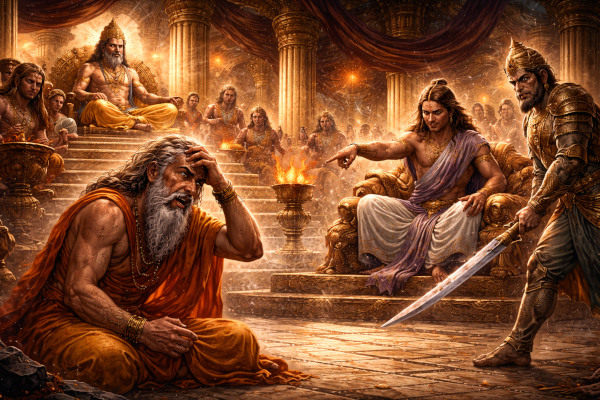
Rishi Ashtavakra entered the world with a name that sounds like an advanced yoga posture and a body twisted in eight places, all because his father could not handle being corrected by someone who technically had not even been born yet. It is one of the great opening acts in Indian wisdom literature. Most unborn children kick. Ashtavakra offered textual interpretation. From inside the womb, having apparently audited the Vedas ahead of schedule, he overheard his father Kahoda explaining sacred hymns to his mother and casually suggested an alternative meaning for the verse. Imagine the level of confidence. Not even born, not even having a PAN card, and already fact-checking a parent mid-lecture. One might think the father, being a man of learning, would pause and say, “Remarkable, my child appears to be a prodigy.” But no. Kahoda reacts the way insecure authority figures across history have always reacted when outperformed by fresh talent: with rage, wounded vanity, and a disciplinary overreaction so absurd it enters mythology. Instead of admiring the brilliance of the fetus, he curses him. That is the ancient version of a boss saying, “I don’t care if your idea is right, I don’t like your tone.”
And so Ashtavakra is born carrying the physical consequences of his father’s insecurity with eight deformed bends in his body. Which, frankly, is how many careers begin, just with fewer curses and more passive-aggressive email chains. Kahoda, meanwhile, continues to think very highly of his own intellect, which is often the first warning sign that disaster is approaching in scholarly robes. He goes off to King Janaka’s court to participate in a public debate where the loser must kill himself, which is a magnificently unreasonable format and proof that ancient intellectual culture had absolutely no patience for friendly disagreement. So..this was basically “TED Talk, but with execution.” Kahoda enters, confident as ever, and promptly loses to a sage named Bandi. Having risk-assessed nothing and overestimated everything, he is then forced to die. It is hard not to notice that the man who could not tolerate correction from his unborn son is immediately corrected by the universe in the harshest possible way.
Years later, Ashtavakra grows up, learns what happened, and heads to Janaka’s court himself. This is where the story becomes deeply satisfying. The son whom the father cursed for being too intelligent now walks into the same arena and does what the father could not. He debates. He wins. He defeats Bandi. In other words, the allegedly inconvenient child turns out to be the family’s only functioning recovery plan. But the story does not stop there. Ashtavakra does not merely avenge the insult. He asks for something better: bring my father back. And Bandi somehow manages it. So Ashtavakra accomplishes the rare mythological feat of simultaneously proving his brilliance, humiliating his father’s humbler, and resurrecting the very man whose ego misshaped his body in the first place. That is not just victory but with a re-spawn.
King Janaka, impressed, remarks that Kahoda is lucky to have such a brilliant son. And this is where Ashtavakra delivers the line that slices through the whole story like a blade wrapped in politeness: while Janaka appreciates that wisdom, his father had felt threatened by it. There it is. Clean, brutal, timeless. The real subject of the story is not deformity, debate, or even revenge. It is the ancient and very durable tragedy of senior men being unable to enjoy excellence in those beneath them. Kahoda is not merely a father here. He is every mentor who loves talent only until it becomes inconvenient. Every teacher who wants bright students, but not brighter than himself. Every coach who wants winners, provided they continue to bow low enough to preserve his self-image. Every boss who proudly says he is building the next generation and then quietly panics the moment the next generation begins to look genuinely better.
Ashtavakra, meanwhile, is that unusually brilliant subordinate who appears once in a while and ruins everyone’s emotional ego. He is the person a mentor should celebrate and often cannot. He does not merely learn. He absorbs too fast. He understands too early. He improves on the system before the people running the system are psychologically prepared for improvement. Such people are a gift in theory and a threat in practice. Organizations say they want them. Gurus say they bless them. Managers say they are looking for this exact kind of spark. And then the spark arrives, says something incisive in the meeting, and suddenly everyone develops a concern about attitude.
So yes, the story is ancient. But its emotional mechanics are painfully current. Every field has its Kahodas: people who like mentoring in the abstract but dislike being surpassed in the concrete. And every once in a while it produces an Ashtavakra: twisted perhaps in body, but straighter than everyone else in mind.