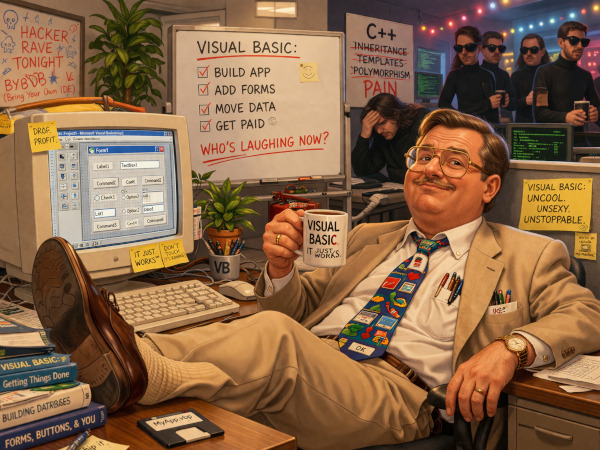
Visual Basic was the language that looked at programming, watched C and C++ swagger around like shirtless machos with anger issues, and said, “This is all very impressive, but Brenda from Accounts would like a button.” It did not enter the software world like a gleaming techno predator forged in the underground furnace of elite engineering. It walked in like an overfriendly office administrator with a laminated badge, a smile of dangerous optimism, and the unmistakable energy of someone about to replace complexity with clip-art practicality. Other languages wanted to be seductive in the dangerous way: aloof, difficult, emotionally withholding, the kind of systems that make developers feel brilliant right before ruining their weekend. Visual Basic had a different kind of appeal. It was the programming equivalent of a flirt who skips the foreplay and just says, “Come here, I’ve already made the bed form.”
And for this, it deserves both ridicule and a strange kind of affection.
Visual Basic was the office microwave of programming languages. Because nothing enrages the priesthood of programming more than the idea that ordinary people might create software without first spending six years in a cave developing tendon pain and contempt. C had already established that coding should feel like defusing a bomb with a fork. C++ then arrived and said, “That’s good, but what if the bomb had inheritance and could explode polymorphically?” Java came in wearing a lanyard and speaking exclusively in corporate nouns. Then Visual Basic waddled in like a man bringing potato salad to this arms race and announced that perhaps one could simply draw the interface first like some kind of shameless practical person.
That was the great genius of Visual Basic. It did not try to seduce computer scientists. It seduced offices. It whispered to organizations that had no intention of becoming modern but did want a better way to print labels. It told entire generations of semi-terrified professionals that they, too, could “develop software,” which in practice meant creating a majestic, unpredictable window full of text fields, command buttons, and a color scheme last approved by a municipal clerk. Visual Basic democratized programming in the same way karaoke democratized music.
Visual Basic believed in events. It believed that when a button is clicked, something should happen. This was its worldview. This was its politics. A button, a click, an action. Cause and effect. No nihilism. No abstraction so advanced it resembled theology. No fifteen-page debate about memory ownership conducted by men who looked undernourished and furious. Just a button called Command1, and somewhere inside it, a line that said MsgBox "Hello" with the triumphant simplicity of a child discovering electricity.
Naturally, serious programmers despised it.
There is nothing a certain species of programmer hates more than accessibility. If a tool appears too usable, too welcoming, too devoid of ritual humiliation, a portion of the computing priesthood immediately suspects witchcraft. Visual Basic offended them by allowing ordinary mortals to create working things without first passing through twelve circles of compiler error. It suggested, rather rudely, that software could be assembled by people who did not wish to spend their youth arguing about pointers in rooms that smelled of pizza and virginity. This was unforgivable. So Visual Basic became the butt of jokes like the suburban uncle at the hacker rave.
And yet the jokes always carried a note of fear, because Visual Basic worked. Not beautifully in a way that would make a software architect place a hand on his chest and whisper “sublime.” But it worked. It built applications. It got forms on screens. It hauled data from one place to another with the sturdy, unembarrassed determination of a municipal van.
That, in the end, may be what made it so embarrassing. Visual Basic exposed one of the ugliest truths in software culture: much of programming is not wizardry. It is the duet with validations. Behind all the swagger, many systems exist to record shipments, calculate taxes, print invoices, update stock, or stop Gary from entering letters into the invoice number field. Visual Basic understood this with the resigned maturity of a man who has seen the back office and lost all romantic illusions. It knew that civilization is upheld not only by cutting-edge innovation, but also by hideous little internal tools with names like InvoiceEntry_Final2_UseThisOne.exe.
Its visual designer was especially scandalous because it removed so much of the theater. Instead of conjuring interfaces from pure code like some sleepless monk of silicon, you could simply drag and drop. This horrified chronic nerds, who felt programming should require at least some suffering, preferably artisanal suffering. Visual Basic, meanwhile, was over there casually producing user interfaces like it was setting up a community-center raffle. Want a label? Put it there. Want a textbox? There you are. Want a button? Have one. Soon the screen would fill with controls placed in the sort of alignment that the Visual Basic application looked like a railway reservation form had achieved consciousness.
And then there was the code itself, whose tone was wonderfully direct. Visual Basic named things in the spirit of a man labeling drawers in a garage. Text1. Label3. Command2. It had the naming conventions of an exhausted parent packing school lunch. Serious languages wanted you to think in systems. Visual Basic wanted to know what should happen when Janet presses Enter.
Its greatest triumph, it gave birth to a generation of accidental programmers. These were not people who had set out to become software engineers. These were people who one day had a problem, and then another employee said, “You know, there’s a way to automate this.” Three months later they were maintaining a Visual Basic application that had metastasized from one button into a departmental nervous system. They did not speak of “object-oriented paradigms.” They spoke of “that form which crashes if the quarter is locked.” They were not coding for glory. They were coding because the monthly report had to go out and the printer was behaving like a haunted accordion.
This is why Visual Basic still occupies such a peculiar place in collective memory. It is easy to laugh at because it represented the exact opposite of cool. It was the language of office blocks, procedural optimism, and software with beige energy. It felt deeply Microsoft in the oldest sense: practical, clunky, eager, and slightly overconfident, like a man selling multifunction printers at a trade expo. It dreamed of making the world slightly more manageable through forms, macros, and a reliable If...Then...Else.
But it also represented an era when software still believed it should be useful in an obvious way. Click this. Save that. Print this. Close form. Exit application. It was software that respected the idea that a person might want to finish a task instead of entering a lifelong relationship with a framework. Modern development, by contrast, often feels like assembling a cathedral out of package managers, transpilers, container images, authentication layers, and a build process that experiences the same internal volatility as a goat in a fireworks factory. Visual Basic would have looked at all this and asked, very reasonably, why the invoice screen now requires 1,200 dependencies and three senior engineers.
It was never the rock star of programming languages. It was not sexy nor even remotely dressed for the occasion. But it worked that made it more useful than the geniuses, more durable than the trends, and vastly more dignified than the people who laughed at it.