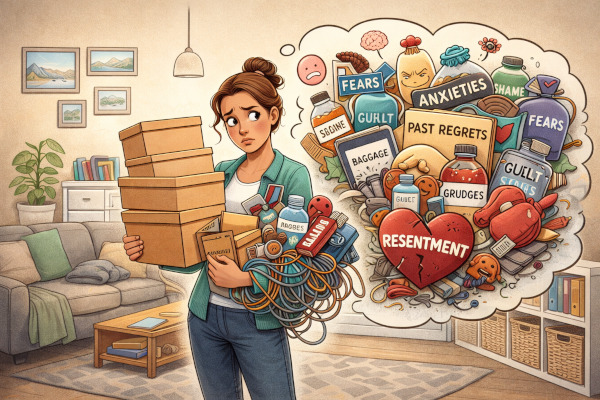
Decluttering has become one of civilization’s favorite self-improvement pageants. It begins with a drawer and ends, if all goes according to Instagram, with transcendence. A woman folds three beige T-shirts into geometrically improbable rectangles, lights a candle that smells like Scandinavian forgiveness, and announces that she has removed chaos from her life. This is inspiring right up until one notices that the chaos has not been removed at all. It has simply been alphabetized, decanted into glass jars, and hidden inside matching baskets purchased from Amazon specifically to manage the clutter produced while trying to reduce clutter.
This is the first miracle of modern decluttering: it promises spiritual rebirth through storage solutions. The human being remains anxious, avoidant, overcommitted, mildly resentful, and one WhatsApp notification away from collapse, but the cables are now in a labeled pouch. We are told this is healing.
Decluttering culture speaks in the tone of a kindly cult leader. Keep only what serves you. Release what no longer aligns. Edit your life. Curate your space. Remove what no longer sparks joy, which sounds lovely until you realize that almost nothing in adult life sparks joy. Tax forms do not spark joy. Extension cords do not spark joy. Insurance papers do not spark joy. The third bedsheet you never use does not spark joy. Adulthood is not built on joy. It is built on constipated grimace, backup chargers, expired coupons, one mysterious key, and an emotional support plastic bag full of smaller plastic bags.
The decluttering gurus always make it sound so clean. You hold an object. You feel your truth. You release it. Real life is standing over a box of tangled chargers, broken spectacle cases, birthday gift bags, and a single curtain ring, whispering, “There may yet be a future for us.” Human beings do not keep useless things because they are irrational. They keep useless things because experience has taught them that the exact object they throw away at 11:40 a.m. will become essential by 4:15 p.m.
And sentimental clutter is even worse, because now the battlefield is psychological. A normal spoon can be discarded. But what about the chipped mug from a dead aunt? The concert wristband from 2017? The T-shirt from a company retreat nobody enjoyed but everybody survived? Suddenly one is not cleaning a shelf but negotiating with memory itself. The object sits there quietly, radiating emotional blackmail. Throwing it away feels less like tidying and more like betraying your own biography. So naturally you keep it, which is how half the nation ended up with cupboards full of commemorative nonsense and enough emotional residue to start a museum of unresolved attachment.
The most impressive lie in all this is the phrase “decluttering your life.” Your life is not a linen closet. You cannot remove your commitment issues by donating six bowls and a yoga mat. You cannot clear your fear of confrontation by throwing away old jeans. You cannot look into a bag of expired cosmetics and say, “Today I release scarcity thinking,” unless scarcity thinking happens to be stored in a travel-size conditioner bottle. A person can absolutely declutter a kitchen and still remain spiritually arranged like a garage after a cyclone.
But modern people adore symbolic action because it gives the body the satisfying sensation of progress without the horror of actual transformation. It is easier to sort winter clothes than examine why you say yes to people you dislike. It is easier to reorganize spices than address the long-term emotional architecture of your terrible choice in relationship. It is easier to throw away cracked containers than admit that you are exhausted, lonely, and briefly considering a life in which nobody can reach you after 6 p.m. Hence the genius of decluttering: it allows people to cosplay psychological renewal while mostly handling cardboard.
This is why decluttering content is so seductive. It turns private disorder into a solvable montage. Before: chaotic drawer, frayed nerves, low-grade shame. After: bamboo dividers, folded socks, redemption. The message is clear. You were not overwhelmed. You were merely unbinned.
Minimalism then arrives like decluttering’s colder, more smug cousin. Decluttering says, “Let’s get rid of what you don’t need.” Minimalism says, “Let’s interrogate why you own four forks you emotionally cannot justify.” Minimalism is less a lifestyle than a facial expression. It looks at your decorative cushions the way a tax auditor looks at offshore accounts. It has the severe energy of a person who owns three bowls, one chair, and an opinion about your moral decay.
The problem begins when tidiness becomes moral theater. Then every drawer is a referendum on character. Suddenly the messy person is not merely busy or tired or temperamentally chaotic. No, now they are spiritually blocked. Energetically stagnant. Resistant to abundance. Somewhere a woman with six identical ceramic jars is implying that your inability to sort cables is the reason the universe has withheld peace.
Meanwhile the truly dangerous clutter remains untouched. The grudges. The guilt. The absurd standards. The ancient humiliations preserved in acid-free emotional folders. The mental scripts that have not sparked joy since 2009 but are somehow still taking up premium RAM space in your memory. Nobody makes dramatic videos about this kind of decluttering because it is much harder to monetize crying on the floor over your abandonment issues than it is to stack matching storage cubes.
So people do what people have always done. They clean the visible parts first. They throw away the duplicate colander and keep the fear of intimacy. They donate seven scarves. They clear the pantry, wipe the counters, and continue carrying enough unprocessed emotional debris like an iceberg to sink a midsize ferry. Then they step back, inhale the citrus scent of purchased order, and say, “I feel lighter.” Which is true. They do feel lighter. They are just not yet free.
That, perhaps, is the final comedy of decluttering. It is not useless. It helps. A cleaner room can absolutely calm the mind. A cleared shelf can create breathing space. A home can feel kinder when it is not trying to kill you with falling Tupperware. But let us not become mystical about it. Rearranging your environment is not the same as repairing your interior. Sometimes a drawer is just a drawer, basket is only a basket. Sometimes what no longer serves you is not the old lamp, but the idea that one more weekend of tidying will somehow turn you into the kind of person who answers emails on time and has closure with their parents.
Decluttering your life, then, is a respectable beginning. Throw out the broken blender. Release the jeans that have become a hope rather than a garment. Let the dead cables go to their reward. But do not flatter yourself that the removal of physical objects has automatically upgraded the soul. A neat hallway and a complicated psyche can coexist very comfortably. Human beings are perfectly capable of living in a pristine apartment while internally resembling a junk drawer full of grief, vanity, old crushes, panic, and three mystery batteries.
The shelf may be clear. The spirit, however, is still available in assorted, unlabeled boxes.
You may also like
-
Morning Routines Of Successful People: A Sacred Performance In Several Luxurious Acts
-
Digital Detox Weekends: Logging Off Heroically, Then Checking Instagram in the Loo
-
Journaling Your Way to Inner Peace: Writing “felt weird today” in a ₹2,400 Notebook Like a Melancholy Aristocrat
-
Cold Showers: How to Be Attacked by Water and Call It Character
-
The Gospel of Warm Lemon Water