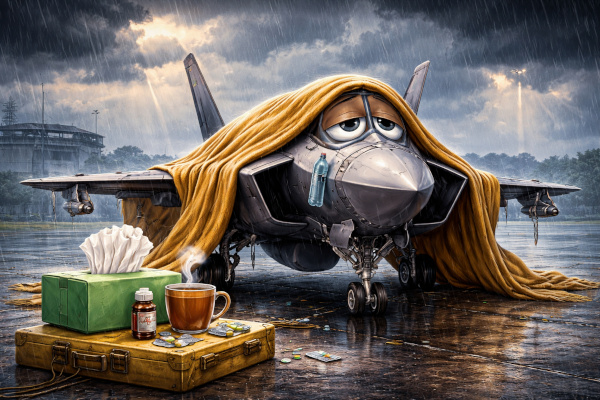
The F-35 is what happens when a fighter jet, a luxury gaming PC, a government spreadsheet, and a nervous breakdown are all asked to become one product. It was built to dominate the skies, terrify adversaries, reassure allies, and justify PowerPoint presentations with gradients. On paper, it is stealthy, networked, sensor-fused, lethal, and next-generation. In practice, it sometimes feels like the world’s most expensive reminder that just because something is futuristic does not mean it won’t eventually throw a fault code at the exact wrong moment. Lockheed markets the F-35 as the most advanced fighter in the world, while GAO reports have repeatedly flagged late deliveries, modernization delays, and massive costs.
Its name, of course, is Lightning II, which is already a bold choice for an aircraft that spent years with restrictions related to lightning. For a period, the F-35A could not fly within 25 miles of lightning or thunderstorms because of problems tied to its onboard inert-gas system meant to protect the fuel tanks. That restriction was only lifted in March 2024 after fixes were implemented. So yes, there really was a stretch in which the aircraft called Lightning had to treat thunderstorms the way a Victorian aunt treats public dancing: with alarm, distance, and written guidance.
Which is why the joke that the F-35 “gets flu in the rain like a toddler” lands so well. Strictly speaking, the better-supported real-world gag is not that rain itself disables it, but that the program’s history with storms, lightning restrictions, and weather-adjacent embarrassment has been so gloriously on-brand that the aircraft sometimes comes across less like a cold-blooded apex predator and more like a gifted child whose mother still sends a scarf in July. “No, darling, you can’t go near the thunderclouds yet, your systems are delicate.” That is not the image one wants for a fifth-generation strike fighter, but it is the image history kindly provided.
And then came Kerala, because apparently the gods of comedy were not done.
In June 2025, a British Royal Navy F-35B made an emergency landing at Thiruvananthapuram International Airport in Kerala after diverting from HMS Prince of Wales. The Indian Air Force publicly confirmed it had detected and assisted the recovery of the jet. Then the aircraft stayed there. And stayed there. Reports said it had suffered a hydraulic issue or failure, British teams had to be brought in, and the stranded jet became a minor celebrity and meme generator. Reuters even reported that Kerala tourism leaned into the moment online. One of the most advanced stealth fighters on Earth had become, for a while, a very expensive long-stay guest in India.
This is where the F-35 story becomes impossible not to enjoy. It is always introduced like a silicon god of airborne dominance, a machine so advanced that it probably knows your blood group. But every few years reality grabs the cape and yanks. One moment it is the centerpiece of future warfare; the next it is a stealth aircraft stuck on the ground in Kerala while the internet gives it a local nickname and speculates whether it now qualifies for Aadhaar. That is not a technical assessment. That is just history being funny. Reuters and Indian outlets documented the meme wave, and later reports said the jet finally departed in July 2025 after repairs and checks were completed.
So the fairest summary of the F-35 is this: it is not a useless jet. It is an astonishingly ambitious jet trapped in a long, committed, expensive relationship with complexity. It wants to be remembered as the future of airpower. Instead, it is sometimes remembered as the stealth fighter that had lightning anxiety, maintenance drama, and an unscheduled Kerala residency.
You may also like
-
USS William D. Porter: The Warship That Treated Friendly Fire Like a Personality Trait
-
Savage French General Tells Trump Officials ‘Stop Snorting Cocaine’ Over Bonkers runway Plan
-
How to Lose a Battle Without the Enemy: The Karánsebes Method
-
Missiles, Mood Swings, and NATO’s Awkward Silence
-
The Empire vs. the Flying Toaster