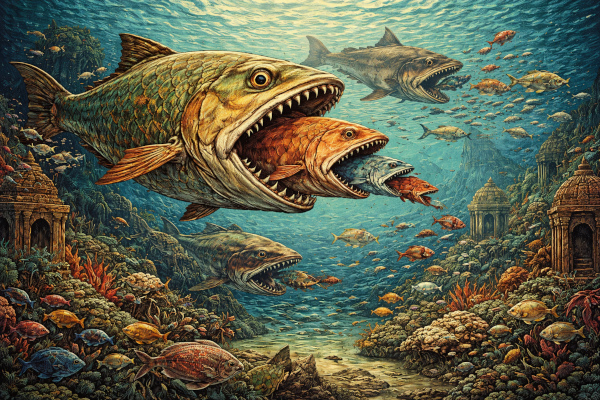
There are many noble ideas in the history of human thought—justice, equality, compassion, universal brotherhood, that one friend who says “I’ll pay you back” and sometimes actually does. And then there is Matsya Nyaya, which looks at all of that, sighs deeply, and says: “That’s cute. Now watch this fish eat that fish.”
The principle is simple, elegant, and profoundly disrespectful to your optimism: in the absence of order, the big fish eats the small fish. Not negotiates. Not collaborates. Not sends a polite calendar invite titled “Exploring Synergies.” It eats. Directly. Efficiently. With the confidence of something that has never attended a workshop on empathy.
And the truly unsettling part is this: it works.
The ocean, if we are being honest, is the most transparent system humanity has ever failed to replicate. There are no mission statements floating gently in coral reefs. No fish pauses mid-chomp to say, “We believe in creating value for all stakeholders.” The shark does not issue a sustainability report. It simply opens its mouth, and the gulp.
Chanakya, observing this, did not faint. He did not write poetry about the tragedy of existence instead he said, “Yes, this is what happens when there is no governance. We should probably do something about that before someone important gets eaten.”
Humanity, on the other hand, looked at the same phenomenon and said, “What if we did this… but in suits?”
The Modern Workplace, A.K.A. the Glass Colosseum
Take the modern workplace, that glittering aquarium of ambition where everyone pretends they are not circling each other.
You arrive, fresh-faced, full of hope, armed with talent, sincerity, and the naive belief that good hard work will be recognized. You are, in ecosystem terms, a mid-sized fish with excellent intentions and absolutely no understanding of predatory behavior.
Across the conference room sits someone who has transcended work entirely and entered the realm of strategic consumption.
This individual does not produce ideas. He harvests them. He listens to your presentation with the focused attention of a creature deciding whether you are a threat or lunch. He nods. He asks a few clarifying questions. He says, “Interesting perspective.”
Two days later, your idea returns to you, wearing a suit, carrying his name, and speaking in bullet points.
He presents it to senior leadership with the calm authority of a man who has just invented gravity. You sit there, watching your own thoughts march past you in formation, wondering if you should clap or file a missing person report.
This is not theft. This is Matsya Nyaya with corporate training.
How Great Powers Eat with Table Manners
Politics, of course, is where Matsya Nyaya receives its honorary doctorate.
A small nation wakes up one morning and decides it would like sovereignty. A charming idea. It has resources, a location, perhaps a coastline that looks suspiciously useful to someone else.
Enter the big fish.
The big fish does not arrive screaming. That would be gauche. It arrives with agreements, partnerships, development projects, and the gentle assurance that everything is being done for mutual benefit.
“Let us help you build infrastructure,” it says, with the warmth of a creature building a very comfortable dining table.
Loans are extended. Ports are constructed. Advisors arrive. Policies are adjusted. Years pass. And one fine morning, the small nation realizes that it owns its territory in the same way one owns a rented apartment where the landlord also has a spare key and strong opinions.
No invasion. No war. Just a slow, courteous digestion.
Diplomacy, at this level, is not about avoiding Matsya Nyaya. It is about practicing it with better vocabulary.
How to Become Emotionally Organic Content
Even relationships, those sacred temples of emotion, occasionally resemble a marine documentary narrated by disappointment.
Two people meet. There is chemistry, laughter, shared playlists, and the intoxicating belief that this is something rare and meaningful. For a while, everything is balanced. Conversations flow. Effort is mutual. Life feels like a well-scripted film.
Then, gently, one person begins to invest more. The other begins to… evaluate.
One writes paragraphs. The other replies with “hmm.” or “k”
One shows vulnerability. The other shows availability—occasionally.
One builds. The other optimizes.
At this point, Matsya Nyaya has entered the relationship, removed its shoes, and made itself comfortable.
No one is being eaten loudly. There is no dramatic confrontation. Instead, there is a slow, elegant shift where one person becomes the ecosystem and the other becomes… content.
You don’t even notice when it happens. One day you are partners. The next day you are a being savored without you even noticing you getting devoured .
Overcoming Matsya Nyaya
What makes Matsya Nyaya so deeply offensive to our moral sensibilities is not just that it exists, but that it is extremely efficient.
It does not require committees. It does not wait for consensus. It does not pause for ethical reflection. It simply identifies advantage and acts on it.
And this is where Chanakya, in his magnificently practical wisdom, delivers the real punchline. He does not say, “Let us abolish this.” Because he knows that is like asking gravity to consider alternative lifestyles.
Instead, he says: build order strong enough to suppress it.
Create systems. Enforce rules. Establish authority. Make sure that the big fish cannot casually turn lunch into policy.
Because if you don’t, Matsya Nyaya does not remain theoretical. It becomes… operational.
The modern world, of course, has done an excellent job of pretending we have moved beyond all this.
We have international law. We have trade agreements. We have diplomacy, institutions, summits, and leaders who stand at podiums and use phrases like “shared vision” and “collective progress.”
And all of that is real. It matters. It holds the line.
But every now and then, something cracks.
A crisis. A vacuum. A moment where the rules hesitate.
And suddenly, beneath the carefully constructed language of civilization, you can hear it again—the ancient sound of the ocean.
Quiet. Relentless. Efficient.
A big fish noticing a small one.
The true genius of Matsya Nyaya is that it does not need to announce itself. It does not arrive dramatically. It does not say, “Hello, I am here to destroy your assumptions.”
It simply waits.
For confusion.
For weakness.
For the moment when order looks away.
And then it acts, with the calm confidence of something that has been correct for thousands of years.
So what do we do with this delightful piece of wisdom?
Do we panic? Do we become sharks? Do we swim nervously in circles, checking over our shoulders every five seconds like paranoid goldfish?
Not necessarily.
The real takeaway is far more inconvenient.
Understand the water you are in.
Recognize that beneath every polished system lies a more primitive logic waiting patiently for an opportunity. Speak directly. Build trust carefully. Question narratives that arrive too neatly packaged. And when someone says, “I’m only telling you this for your own good,” consider the possibility that you are about to become… strategically useful.
Because Matsya Nyaya is not evil. It is simply honest in a way we find deeply uncomfortable.
It tells us that power, left unattended, will behave exactly as expected.
That strength, unchecked, becomes appetite.
And that survival, in the absence of structure, is rarely a fair competition.
In the end, Matsya Nyaya is not a story about fish.
It is a mirror.
And like all good mirrors, it does not lie.
It simply reflects a world where, if you are not paying attention, you may suddenly discover that you are no longer part of the conversation—
but the menu.
“Matsya Nyaya is the art of discovering, too late, that you were never in the discussion — only on the menu.” – Sorcerer
You may also like
-
When the Tongue Declares Victory and the Kingdom Quietly Shops Elsewhere
-
Chanakya Niti- Chapter 3
-
The Lake, the Crane, and the Ancient Indian Version of “Please Read the Instructions Before Dying”
-
The Camel, the Lion, the Leopard, and the Jackal: A Corporate Tragedy in the Jungle Division
-
Matsya Nyaya: Or, Why Civilization Exists to Stop Large Idiots from Eating Smaller Ones