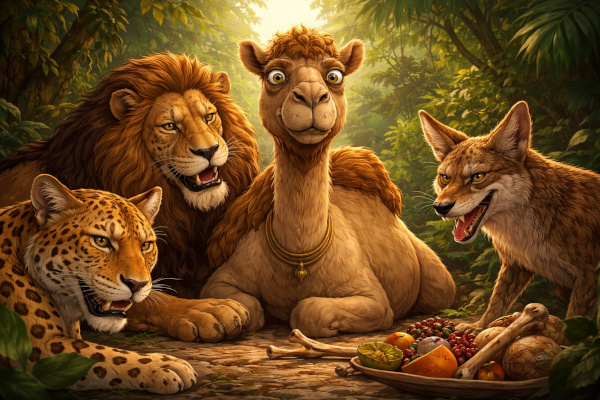
There was once, in that magnificently dangerous world of the Panchatantra where every animal behaves like a courtier, a criminal, or a management consultant, a lion who ruled the forest with the sort of unquestioned authority usually enjoyed by kings, tyrants, and senior executives who mistake volume for leadership. His name was Madotkata, and he had around him the usual ecosystem of power: flatterers, enforcers, and specialists in surviving near teeth. Among his closest attendants were a leopard and a jackal, two creatures who understood the ancient science of staying useful to a predator without accidentally becoming lunch. The leopard represented action, efficiency, and the kind of loyalty that always looks heroic until one notices it is mostly attached to self-preservation. The jackal, on the other hand, was one of those beings gifted with language in the most dangerous possible way. He could turn appetite into argument, cruelty into necessity, and treachery into policy. If the leopard was the knife, the jackal was the memo explaining why the stabbing aligned with long-term strategic goals.
Into this forest, by one of those absurd accidents on which all great tragedies depend, wandered a camel. He had been separated from a caravan, lost his way, and drifted into the jungle with the touching innocence of someone who still believed that being harmless counted as protection. He was large, awkward, soft-eyed, and radiated the sort of trusting sincerity that in fables always means two things: first, that he is morally decent, and second, that he is in grave danger. The lion saw him and, in a rare fit of royal generosity, declared that the camel would be spared and protected. It was one of those grand speeches rulers make when they are full, comfortable, and feeling theatrical. The camel, being new to court life and apparently unfamiliar with the instability of carnivorous promises, was overwhelmed with gratitude. He bowed, pledged loyalty, and began living under the lion’s protection with the serene confidence of a man who has just received verbal assurance from a system he does not yet understand.
For a while, everything was splendid. The camel grazed peacefully, the lion ruled magnificently, the leopard prowled with professional menace, and the jackal continued doing whatever it is that jackals in royal service do when they are not actively rearranging someone else’s life. Then, as it so often does in stories and empires, fortune developed a sense of humor. The lion was injured in a fight with an elephant and found himself unable to hunt. This was inconvenient for everyone, but especially for the lion, who belonged to that category of ruler for whom hunger quickly becomes a constitutional crisis. A fasting sage may discover enlightenment. A starving lion discovers irritation. Soon the entire forest court was vibrating with tension. The king was weak, his stomach was empty, and the usual food supply had become uncertain. The leopard and the jackal, who depended on the lion’s strength for their own comfortable existence, understood at once that this was no longer simply a dietary problem. It was an administrative emergency.
Now the difficult thing about serving a hungry lion is that one must appear loyal while remaining available for future loyalty. Heroism is a lovely concept, but only from a survivable distance. So the leopard and the jackal went out in search of prey, but found none. The forest, in its usual uncooperative way, refused to provide a convenient victim. They returned empty-handed, and the lion, increasingly unwell and in no mood for excuses, looked upon them with the kind of royal displeasure that turns subordinates philosophical about mortality. It was then that the jackal, whose mind was a workshop of well-dressed treachery, noticed the camel.
The camel was, from a practical standpoint, an outstanding solution. Large, edible, unsuspecting, and already emotionally invested in the institution. The only complication was the lion’s earlier promise of protection. But to a creature like the jackal, a promise was not a barrier. It was merely an obstacle requiring better phrasing. So he began to think in that special way manipulative beings think: not in terms of right and wrong, but in terms of how to arrange events so that the victim collaborates with the disaster.
The plan was exquisite in its wickedness. The jackal proposed that they all offer themselves to the lion as food. The king, noble and formal, would reject each offer in turn. This would create an atmosphere of overwhelming devotion. The camel, eager to prove his loyalty and too innocent to detect choreography when it was tap-dancing in front of him, would then feel morally obliged to offer himself as well. At that point, the lion would simply accept. It was not murder, you see. It was voluntary sacrifice, assisted by staging, peer pressure, and a catastrophic lack of situational awareness. Entire civilizations have been run on less elegant logic.
So the theatre began. The jackal stepped forward first, all solemnity and trembling devotion, and offered his own body to sustain the king. It was a magnificent performance, delivered with the emotional grandeur of a man absolutely certain he would not be taken up on it. The lion refused, as expected. The jackal was too small, too thin. Then the leopard stepped forward with equal drama and offered himself as food for the monarch. Again the lion refused. The leopard was useful, dangerous, and—one imagines—too sinewy for a convalescing appetite. The room, as it were, was now fully set. Loyalty had been displayed. Sacrifice had been modeled. Nobility had been theatrically established.
And then the camel, watching all this with the doomed sincerity of someone who has mistaken court ritual for moral reality, did the one thing everyone except him knew he was supposed to do. He stepped forward and offered himself to the lion.
There are moments in literature so painful in their inevitability that one wants to reach into the page and shout. This is one of them. Because the camel is not foolish in the ordinary sense. He is not vain, malicious, or absurd. He is simply sincere in an environment where sincerity is raw meat. He sees apparent loyalty and responds with genuine loyalty. He hears public virtue and assumes private virtue exists behind it.
He has not yet learned that in courts, offices, and political systems, symbolic gestures are often symbolic only for those with power. For everyone else, they can become binding.
The lion, whose hunger had by now stripped his ethics down to essentials, accepted at once. The leopard and the jackal fell upon the camel, and that was the end of him. His gratitude, loyalty, and trust all went the same way: into the digestive tract of the state.
And there, in all its brutal hilarity, is the genius of the story. Because the Panchatantra does not offer soft moral comfort. It does not say kindness is always rewarded, that rulers always honor promises, or that sincerity protects the good. It says, with unnerving calm, that one must understand the nature of the world one inhabits. The camel’s tragedy lies not in wickedness, but in innocence unsupported by judgment. He believed protection was permanent. He believed rituals were honest. He believed that because others had offered themselves without consequence, he could do the same. In short, he committed the oldest error in political and social life: he assumed the system meant what it said.
The wise lesson, therefore, remains as sharp as ever. One must never place blind trust in power merely because power once spoke kindly. One must never imitate the actions of the cunning without understanding the conditions that protect them. One must never volunteer for sacrifice in a room full of professionals. And above all, one must remember that in times of crisis, promises made in comfort are often revised by evolving situations.
In that sense, the story is not merely about a camel being eaten. It is about the lethal gap between how institutions describe themselves and how they behave under pressure. It is about the danger of confusing inclusion with security. It is about the way clever people stage morality so that the innocent volunteer for ruin. It is about the timeless fact that if a person like jackal starts talking about duty in a hungry kingdom, someone gentle is about to have a terrible day.
And yet the story endures because it says all this without preaching. It gives us a lion, a leopard, a jackal, and a camel, and then lets appetite, fear, performance, and naivety do the rest.
You may also like
-
The Lake, the Crane, and the Ancient Indian Version of “Please Read the Instructions Before Dying”
-
Matsya Nyaya from Chanakya: A Comprehensive Guide to Being Eaten with Professional Courtesy
-
Savitri, Satyavan, and the Day Death Met a Better Lawyer
-
The Mahabharata’s Most Elegant Case of Profile-Based Love
-
Fear, For Sale – The Business Model of Fear