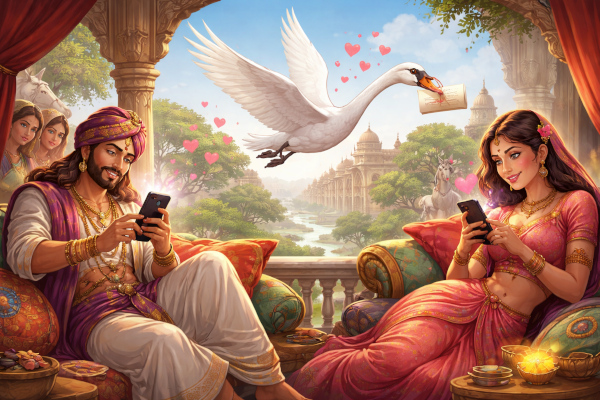
Nala, king of Nishadha, had everything an epic king is expected to have: beauty, valor, refinement, skill with horses, and that polished heroic radiance which in old literature tends to mean a man was handsome enough to create taxation difficulties among maidens. He was one of those royal specimens at whom destiny had clearly spent money. Its that sort of reputation that in today’s world would have given him a dangerously overperforming Instagram page run by three loyal attendants and one emotionally invested cousin. He was exactly the kind of man whose official portraits would have looked candid despite strategic side-lighting. Damayanti, daughter of Bhima, king of Vidarbha, was equally celebrated — graceful, luminous, noble, and so astonishingly beautiful that language itself must have developed lower-back pain carrying the descriptions. If she existed in the age of social media, entire kingdoms would have followed her with devotional weakness. Courtiers would have posted blurry sighting videos. Men with no realistic access to her would have been writing things like “queen energy” beneath moonlit balcony images and behaving as though appreciation were a civic duty.
Nala, having heard enough glowing descriptions of Damayanti, began the ancient equivalent of social-media obsession. Since there was no app available, he had to suffer the old-fashioned way — through imagination, insomnia, and the repeated replaying of information that had never once been fact-checked against lived experience. He had not met Damayanti. He had not spoken to Damayanti. He had not yet enjoyed the clarifying realism of discovering whether she chewed too loudly, interrupted stories, or had strong opinions about curtain fabric. He possessed only the reputation of Damayanti, which, as history has shown repeatedly, is more than enough to ruin a man’s peace.
Meanwhile Damayanti heard of Nala, and the descriptions were so favorable that she too surrendered with the majestic efficiency of someone falling in love with a brochure. This was a romance built on premium rumor. One may sneer, of course, but society continues to run on the same fuel — profiles, impressions, reputations, and that ancient human willingness to become emotionally available to a carefully narrated possibility. In a modern setting, they would already have been stalking each other through mutuals, silently liking old content, overreading captions, zooming in on insignificant details, and discussing one another with the grave intensity of diplomats handling a border crisis. Every line of information would have been treated as sacred intelligence. “He likes horses” would become “He understands freedom.” “She is kind” would become “She has healing energy.” This is how romance behaves when imagination is allowed to drink heavily.
Nala and Damayanti merely conducted the whole business with swans and cosmic supervision instead of mobile phones and preventable embarrassment.
So.. came the hamsa.
The hamsa in this story deserves every garland, pension, and diplomatic posthumous honor available in three kingdoms, because it accepted a task that would have made most civil servants develop chest pain. Here was a bird, minding its elegant avian affairs, when suddenly the emotional infrastructure of two upper-tier royals collapsed onto its feathers. The hamsa became, in effect, an airborne matchmaker, a winged publicist, a matrimonial consultant with a beak, a flying department of romantic communications. Ancient India, seeing a problem that could have been solved by basic human initiative, naturally assigned it to waterfowl. In essence, the ancient world’s answer to a mutual friend, verified relationship intermediary, elite DM courier, and overqualified social-media algorithm all fused into one graceful bird.
One imagines the hamsa landing near Nala, hearing the king’s lovesick condition, and realizing with the silent resignation of a seasoned professional that this was now going to be a project. Nala, king though he was, had apparently reached that stage of infatuation where a man begins outsourcing his dignity. The hamsa then traveled to Damayanti and spoke of Nala in terms so glowing that the bird effectively turned itself into a deluxe campaign brochure with feathers. This was no casual recommendation. This was immersive branding. The bird described Nala’s virtues, beauty, prowess, nobility, and kingliness until Damayanti’s heart, which had already been leaning toward surrender, folded like silk under ceremonial pressure.
The hamsa did not merely introduce Nala.It launched him.
One must pause here to appreciate the old-world grandeur of this arrangement. Today people exaggerate themselves through photographs, captions, filtered cheekbones, and biographies that read like grant proposals. Nala and Damayanti simply had better poetry and superior wildlife. There is something almost touching about it. Why lie with your own mouth when you can hire a swan?
And Damayanti, receiving this avian dispatch of excellence, did what many intelligent people have done before and since: she mistook eloquence for evidence. The heart, after all, is a notoriously decorative organ. It hears one beautiful account, adds a little internal embroidery, drapes the whole thing in moonlight, and by evening has converted a stranger into destiny. Nala became for Damayanti that most dangerous of creations — a man assembled partly from truth and mostly from imagination. Which is, in fairness, the basic recipe of romance.
From there the matter ripened into one of those stately emotional catastrophes. Damayanti’s svayamvara approached, and her beauty by then had acquired such fame that even the gods developed an interest. Indra, Agni, Yama, and Varuna all decided that this princess of Vidarbha was worth entering the matrimonial arena for, which says something either about Damayanti’s excellence or about the gods requiring better hobbies. Thus what began as a delicate aristocratic exchange of bird-assisted infatuation suddenly escalated into an inter-realm bride race. It has all the structure of modern viral attention. Once enough people begin talking, the gods themselves enter the comments.
Then the gods, in one of mythology’s finer acts of majestic cheek, encountered Nala on the road and enlisted him as their messenger to Damayanti. Imagine having a long-distance crush become emotionally serious, only to be ordered by divine upper management to contact the woman yourself and recommend four more successful rivals with better lighting and eternal life.
This is the ancient equivalent of being forced to help your own competition optimize their dating profile.
Imagine being Nala: already fevered with longing, already curated by a hamsa into romantic distress, and then being asked by Indra, Agni, Yama, and Varuna to go tell the woman you adore that she should consider marrying one of them instead. It is the sort of task that could make a saint take up swearing. Nala effectively became the customer-service representative for his own emotional destruction. Destiny, in this phase, had the manner of a smiling bureaucrat asking him to sign his grief in triplicate.
Yet Nala, because epic heroes often combine majesty with astonishing compliance, did as he was asked. He went to Damayanti as the envoy of the gods, carrying divine proposals in the trembling basket of a human heart. Here again the tale acquires its special flavor. The man arrives to advocate for his rivals, and the rivals happen to be death, fire, rain-law, and heaven’s management. This is less romantic competition than celestial extortion in courtly dress. A lesser man might have collapsed under the irony. Nala instead behaved with the grave nobility of someone whose emotional life had been taken over by a committee.
But Damayanti, to her credit, possessed both passion and preference. She had heard of Nala, imagined Nala, chosen Nala, and the gods, however radiant, arrived as overqualified distractions.T he gods, radiant though they were, had entered too late. The hamsa had already done the work. The emotional algorithm had already locked onto its preferred king. Prestige, divinity, and celestial résumé strength all stood there glittering uselessly before the simpler force of a woman who had become committed to the version of a man she had already installed in her private mythology.
The svayamvara itself then ripened into a masterpiece of theatrical confusion. The gods assumed Nala’s appearance in order to perplex Damayanti. There they stood: multiple Nalas, a full bouquet of king-shaped difficulties, all waiting for the princess to identify the correct beloved in a room where reality had been briefly outsourced to divine mischief. This is one of the Mahabharata’s loveliest touches. Ordinary lovers must navigate mixed signals and bad timing but this is ancient romance at its most visionary: even the final selection process turns into a catfishing crisis engineered by heaven.
Fortunately the gods, for all their power, retained certain tells. Divine feet do not gather dust. Divine garlands do not fade. Divine bodies do that annoying polished thing where they remain suspiciously exempt from the usual burdens of atmosphere. Damayanti, with admirable focus under pressure, read the signs, recognized the mortal Nala, and chose him. It is a beautiful moment, though one also wishes to applaud the sheer endurance of a princess whose marriage ceremony had somehow turned into a supernatural spot-the-difference puzzle.
And so Nala and Damayanti were united, which in romance is the point where musicians swell, flowers surrender, and readers with poor judgment assume happiness has become permanent. The Mahabharata, however, maintains a stern opinion about prolonged peace. It gives love, and then, with the sly face of an uncle introducing cards after dinner, it introduces Kali. The darker catastrophes of Nala’s story belong to another phase — dice, exile, ruin, separation, serpentine complications, and the great old epic truth that marriage may begin in swan-assisted glamour and still end in administrative devastation.
But that later sorrow only makes the earlier comedy shine more brightly. Because the opening of the Nala–Damayanti story remains one of the most elegantly ridiculous courtship arrangements in literature. A king and a princess fall in love through premium hearsay. A hamsa runs an elite-level communications campaign. The gods themselves arrive to compete. The hero is forced to advocate against his own interests like a dignified fool in ceremonial distress. The princess identifies the right man through clues that amount to: “those ones look a little too moisturized for mortality.” And through it all, everyone behaves as though this is perfectly reasonable, which is perhaps the most ancient and aristocratic element of the tale.
The hamsa, in particular, deserves renewed admiration. That bird carried an empire’s worth of emotional cargo with more competence than most human intermediaries manage in a lifetime. It did not merely deliver a message. It launched a romance, lubricated destiny, outperformed courtiers, and made itself indispensable in the matrimonial supply chain of epic India. Without the hamsa, Nala and Damayanti might still have become legendary. With the hamsa, they became unforgettable in a richer, stranger, and much funnier way — a love story feathered by publicity, polished by vanity, and lifted gracefully into absurdity by a bird who probably deserved better clients.
In the end, perhaps that is why the episode remains so elegant. It understands something enduring about human beings: that many people fall in love long before they fall in acquaintance; that reputation can intoxicate more quickly than reality; that beauty and longing make fools bloom like spring flowers.
You may also like
-
The Lake, the Crane, and the Ancient Indian Version of “Please Read the Instructions Before Dying”
-
The Camel, the Lion, the Leopard, and the Jackal: A Corporate Tragedy in the Jungle Division
-
Matsya Nyaya from Chanakya: A Comprehensive Guide to Being Eaten with Professional Courtesy
-
Savitri, Satyavan, and the Day Death Met a Better Lawyer
-
Fear, For Sale – The Business Model of Fear