That evening, I returned home with a plan so modest, so harmless, it practically deserved government protection. I wasn’t trying to reinvent myself, start a revolution, or become one of those suspiciously organized people who light scented candles and journal about gratitude. No, my ambitions were gloriously ordinary: eat dinner, read a few pages of The Arctic Event, and fall into bed with the serene confidence of a man.
Because the universe loves confidence the way a cat luvvrrsssss a glass of water sitting near the edge of a table. The moment you think, Ah yes, peace at last, some unseen cosmic clerk jerk stamps your file with: “Activate disorder with no further notice.”
And it came like a burp..abrupt.
I took off my spectacles to clean them. That was it. That was the whole action. A harmless little domestic ritual performed by millions every day without incident. But my spectacles, evidently tired of this arrangement, chose that exact moment to defect. They slipped out of my hand with the enthusiasm of a political leader switching parties before an election. One second they were in my fingers. The next they were airborne, hurtling toward the floor with the conviction of a martyr.
Then came the sound,a brutal, soul-puncturing crack — the kind of sound that tells you instantly that the day has made a decision and did not consult you.
I looked down.
They were broken.
Not bent. Not scratched. Broken. Snapped. Two separate nations now, with no hope of reunification.
And let me be clear: these were not antique spectacles made of delicate glass and held together by sentiment and colonial nostalgia. These were modern fiber lenses. Plastic. Advanced. Scientific. The sort of spectacles that salesmen describe with words like “flexible,” “durable,” and “sir, this is imported.” Imported from where, I do not know. But apparently from a country where the floor is made of marshmallow.
I stood there frozen, holding the remains of my visual future, and cycled through the emotional stages of sudden eyewear bereavement.
First came disbelief.
Then anger.
Then a level of profanity so creative it deserved literary funding.
Then philosophical despair.
Then, finally, acceptance — or, more accurately, surrender to the only explanation that ever truly fits moments like this:
Murphy had entered the chat.
Murphy, that smug invisible landlord of human misery, that patron saint of badly timed nonsense, that bald prophet of inconvenience. I could practically hear him adjusting his tie in the corner of the room and saying, with great satisfaction, “Ah, yes. Right on schedule.”
Because Murphy’s Law is not just a principle. It is a lifestyle. It is the deep and abiding truth that the universe is not content merely to inconvenience you; it wants to inconvenience you artistically.
So I went to bed mildly blind, deeply offended, and with the distinct feeling that my spectacles had not broken by accident, but in protest.
The next morning around ten, I dragged myself to a nearby eye clinic carrying the broken frame like the body of a fallen comrade. The clinic was one of those neighborhood establishments that always look as though they could either restore your health or accidentally register you for a welding course. There was a faded board outside, a few chairs inside, and a general atmosphere of medical optimism held together by tape.
At the reception sat… a man.
Now this may seem like an ordinary detail, but in my imagination the reception desk of an eye clinic had always been occupied by an aunty of formidable energy — a woman who could locate your file, judge your life decisions, and shout your token number across three districts without taking a breath. Instead, here sat a fellow who looked like he had lost an argument with destiny and been sentenced to customer interaction.
He looked at me as if I had personally caused inflation.
“What do you want?” he asked.
Not “Good morning.” Not “Please sit.” Not even “How can I help you?” Straight to “What do you want?” It had all the charm of being interrogated by a customs officer over one suspicious banana.
What I wanted to say was: “I came for the disco, obviously. I heard eye clinics are where the party crowd gathers.”
What I actually said was, “I broke my glasses. I need an eye test and a new pair.”
He asked for my name, age, address, phone number, and, I suspect, my blood group and ancestral migration pattern. I answered all of it while trying to look like a responsible adult and not a man one minor inconvenience away from joining a monastery.
Then he said, “You are number nine.”
Number nine.
He announced it with all the warmth of a prison warden assigning a cell.
I nodded solemnly and sat down beside a man who was clutching one eye as though it had attempted escape and he had barely caught it. His face suggested that he had seen things. Bad things!!! Perhaps shampoo in the eye!!! Perhaps a domestic argument about shopping bill that ended with an airborne cutlery. Perhaps simply life throwing lemonade, which life is so good at. Whatever the cause, he sat there in the heavy silence of a man who had recently lost an argument with pain.
Naturally, I became curious. Human beings are terrible, and I am no exception. My mind immediately began manufacturing stories.
Maybe he was in a dramatic love triangle.
Maybe he got punched defending someone’s honor.
Maybe he just tried to cut onions with commitment and ego.
Murphy, meanwhile, was whispering from the ceiling fan: “The man seated next to you will always look like he has a better story than you.”
Since I had no desire to make eye contact with anyone in a place where people were already having eye trouble, I took out my phone and began playing a game. Nothing says “I value my remaining vision” like staring intensely at a glowing rectangle while waiting for an eye doctor.
Half an hour passed.
Then the clinic door opened, and destiny arrived in a Maruti 800.

Now the Maruti 800 is not merely a car. It is a national emotion on wheels. It is a small box of memories, ambition, and old upholstery smell. It does not arrive. It appears, like a relative at a wedding who brings no gift but many opinions.
The car stopped outside, and I naturally assumed an elderly doctor would emerge — perhaps a seasoned gentleman with silver hair, thick lenses, a pen in his pocket, and the weary patience of someone who has spent decades staring into the eyes of people who say, “Just one more doubt, doctor.”
Instead, out stepped a woman.
And not just any woman.
A spectacularly attractive woman.
The kind of attractive that makes time slow down and your brain forget the purpose for which it was issued. She entered that tiny clinic with the calm confidence of someone who had never once in her life walked into a room and failed to rearrange its atmosphere.
She smiled at the receptionist.
He sat up like a schoolboy meeting the principal and said, “Good morning, Doctor.”
Doctor?
Excuse me?
This elegant, movie-scene, slow-motion, suspiciously well-composed human being was the doctor?
I straightened in my chair so fast I nearly corrected my posture for the rest of the year.
Murphy immediately appeared in judicial robes inside my head.
“If it seems too good to be true, it probably is.”-Murphy
I should have listened.
Instead, I waited for my number with the emotional discipline of a golden retriever at a steakhouse.
“Patient number one.”
Fine.
“Patient number two.”
Acceptable.
“Patient number three.”
This was taking too long.
Four. Five. Six. Seven. Eight.
By the time they called, “Patient number nine,” I rose so quickly I’m fairly sure my soul stood up half a second before my body.
Inside, the clinic was absurdly advanced. Outside it had looked like the sort of place that might test your vision using a torch and optimism. Inside it was full of sleek machines, glowing screens, adjustable lenses, and equipment that looked capable of detecting emotional weakness.
At the center sat the doctor, calm, composed, and dangerously professional.
“Good morning, madam,” I said.
Internally, my brain was less articulate. Internally, it was mostly static, panic, and one small man running around pulling emergency levers.
She asked me how long I had worn glasses.
“Eight years,” I replied, in the tone of a man answering a question on a visa application while trying not to look stupid.
Then came the eye chart.
She asked me to read the numbers.
Now this was fortunate, because if that chart had contained poetry, philosophy, or even one sentence requiring critical thought, I would have failed both medically and morally. But numbers I could manage.
Then she placed that gigantic trial frame on my face — that monstrous contraption eye doctors use, which always makes you look like a failed science experiment from 1987.
“Which is better?” she asked.
And so began the great dance of lenses.
This one?
Or this one?
Better now?
Worse now?
Clear?
Blur?
Clearer?
More blur?
Less blur but emotionally confusing?
It felt less like a medical procedure and more like being interrogated by optics.
At one point, she adjusted another machine and asked me to place my chin on the stand and look into the lens.
Inside was a tiny image of a distant house.
“Focus on the house,” she said. “Don’t wink.”
Don’t wink.
For one catastrophic second, my brain completely malfunctioned.
Don’t wink?
Madam, I am already fighting for my life in here. My face is trying to behave like a respectable citizen while my inner world has become a badly written romantic comedy.
I stared at it with all the focus of a man trying to earn a passing mark in composure.
She continued the examination, calm and efficient, taking notes, switching lenses, checking both eyes with the detached authority of someone who had seen every variety of human foolishness and was no longer surprised by any of it.
Then she said, “You have a cylinder issue.”
Now medically, that was surely accurate.
But the problem with the human brain is that it should never be left unattended. Mine immediately wandered off and began constructing a completely unrelated fantasy in which the doctor and I were now on a remote tropical island, living a simple, sunlit life free from prescriptions, awkwardness, and civilization. We were walking barefoot on white sand, swimming in blue water, discussing literature beneath palm trees, and generally behaving like two people in a travel advertisement for terrible decisions.
Reality returned when she said, “You should eat two raw carrots with breakfast.”
That snapped me back so suddenly I nearly said, “What’s up, Doc?” like in the Bugs Bunny cartoon.
A smile crept onto my face before I could stop it. Honestly, I really wanted to say that out loud.
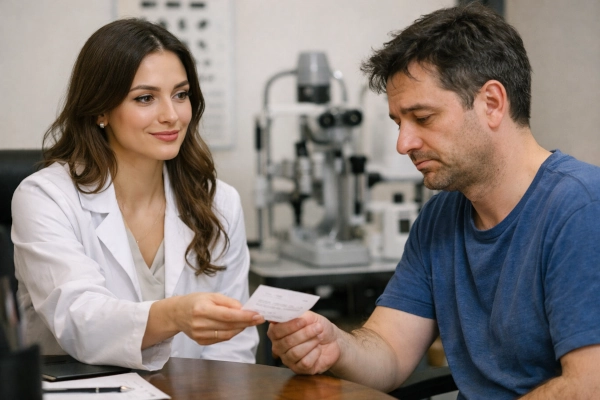
Then she asked for my broken spectacles so she could check the power.
I handed them over.
And that is when I saw it.
A ring.
A ring on her finger.
A small, shining, devastating piece of metal with the emotional impact of a court verdict.
Not merely a ring. The ring. The sacred circular announcement that says: “Thank you for your interest. The management regrets to inform you that this fantasy has already been acquired by another party.”
Inside my head, alarms began to sound.
A stern military commander appeared somewhere in my subconscious and began shouting through a megaphone.
“Stand down!”
“Abort mission!”
“Retreat immediately!”
“This is not a drill!”
“Repeat, this is not a drill!”
And just like that, every ridiculous castle my mind had built, collapsed into a heap of shame, carrot advice, and corrected lens power.
I sat there nodding like a civilized man while my imagination packed its bags and left through the back door.
She finished the prescription, explained the lens details, and handed me the paper with the gracious indifference of a competent professional who had no idea she had just overseen the rise and total destruction of a pointless internal love story.
I thanked her, took the prescription, and walked out of the clinic with the solemn air of a man returning from war.
Outside, everything was normal. The sun shone. Traffic moved. People bought snacks and argued into phones and continued their little lives, unaware that I had entered that clinic as a victim of broken glasses and exited as a victim of corrected vision in every possible sense.
And as I walked away, I could almost hear Murphy applauding from somewhere beyond the clouds, delighted with himself once again.
“All the good ones are already taken.”- Murphy.
And really, by then, all I could do was accept the ruling.