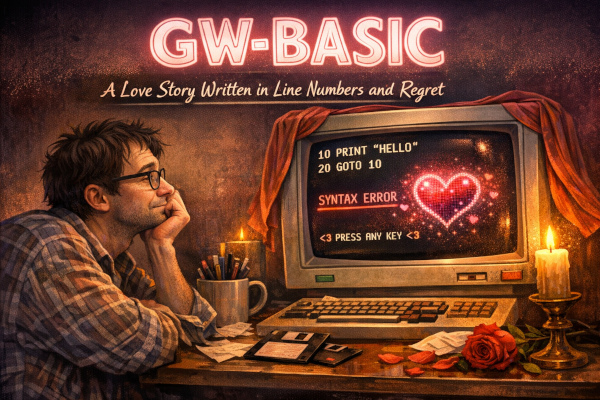
There was a time when computers did not ask you what you wanted to do. They did not offer apps, icons, or friendly buttons. They simply stared at you… like a strict school principal who had already decided you were a disappointment. And in that cold, blinking void existed one of humanity’s most formative relationships: GW-BASIC.
GW-BASIC wasn’t just a programming language. It was a life decision made on your behalf by a committee you never met. It came bundled with MS-DOS in the early 1980s and just… stayed there—like a relative who arrived for a weekend and began critiquing your life choices. You didn’t install it. You didn’t download it. It simply existed—like gravity, taxes, and that one subject you failed twice for no clear reason.
You would open it, and there it was: a black screen, a blinking cursor, and absolutely no instructions. Modern software welcomes you. GW-BASIC simply acknowledges your existence and waits for you to fail.
Naturally, the first thing any human did was type something heroic like:
10 PRINT "HELLO"
20 GOTO 10
And just like that, you had created an infinite loop — your first program, your first success, and your first irreversible mistake. GW-BASIC taught you early that progress is often indistinguishable from running in circles with confidence.
The language had rules. Strict ones. Every line had to be numbered. Not for convenience, but because GW-BASIC believed that even your thoughts should be indexed and filed like government paperwork. If you forgot a number, your program didn’t crash — it simply refused to acknowledge your creativity. This was not programming. This was bureaucracy.
And then there was GOTO—the most dangerous word ever handed to a beginner with confidence and no supervision. GW-BASIC didn’t just allow it—it practically pushed it into your hands and said, “Go ahead, ruin your life.” You could jump anywhere, anytime, for absolutely no reason other than curiosity and poor judgment. It was less a programming feature and more a teleportation device powered entirely by bad decisions. Programs didn’t just become spaghetti—complete with tangled logic, emotional damage, and no clear way out. Structured programming may have existed somewhere in the world, but GW-BASIC looked at it, laughed, and chose chaos.
Speaking of attitude, GW-BASIC was not fast. It was an interpreted language, which means it executed your code one line at a time, slowly, thoughtfully, like a teacher grading your paper while losing faith in humanity . This gave you time to reflect on your mistakes as they happened. Real-time regret was part of the user experience.
Memory? Ah yes. GW-BASIC gave you about 64 KB of it. Not 64 MB. Not 64 GB. Just 64 KB — so little it feels almost deliberate, like she was testing how much you were willing to give up to stay close. Modern software uses more memory just to breathe, but here, every byte felt personal. You had to take your ideas, your logic, and, occasionally, your dignity, and press them down gently, reshape them, coax them into fitting her impossibly tight boundaries.It humbled you.
And yet, despite all this cruelty, GW-BASIC could do magical things. It could draw shapes. It could play sound. It could even make music using the PLAY command, which produced melodies that sounded like a microwave attempting classical training . But at the time, this was revolutionary. You typed commands, and the machine beeped back at you. It was like communicating with a very obedient, slightly confused robot.
Saving your work was an emotional gamble. You could save your program. But you probably didn’t. And when the power went out — which it inevitably did — everything vanished. No autosave. No recovery. Just silence. GW-BASIC didn’t crash. It simply erased your existence and moved on. That’s when you learned your first real lesson in computing: trust nothing, especially electricity.
Error messages were another masterpiece of emotional minimalism. Modern systems explain things. GW-BASIC simply said:
“Syntax error.”
That’s it.
No explanation. No hint. No sympathy. Just two words and a blinking cursor, as if to say, “Fix yourself.”
And yet, somehow, people loved it.
Because GW-BASIC didn’t make things easy. It made them possible. It was bundled with nearly every DOS machine, which meant it became the first programming language for thousands of people . It didn’t hide complexity behind shiny interfaces. It exposed it. Brutally. Honestly. Without apology.
It was the kind of teacher who threw you into the deep end and said, “You’ll figure it out.”
And you did.
Or you drowned slightly and then figured it out.
Eventually, GW-BASIC was replaced by QBasic, a kinder, gentler version that offered things like structure, friendliness, and emotional stability . But by then, the damage was done. A generation had already been shaped by blinking cursors, line numbers, and the quiet terror of unsaved work.
Today, GW-BASIC is mostly gone. A relic. A fossil from a time when programming was less about frameworks and more about survival. But its spirit lives on — in every programmer who still double-checks their work, in every irrational fear of losing data, and in every piece of code that starts simple and somehow turns into chaos.
Because GW-BASIC didn’t just teach programming.
It taught discipline.
It taught patience.
It taught suffering with syntax.
And most importantly, it taught us that sometimes, the greatest love story you’ll ever have……is with a machine that refuses to care.
“GW-BASIC taught you early that progress is often indistinguishable from running in circles with confidence.” – Sorcerer