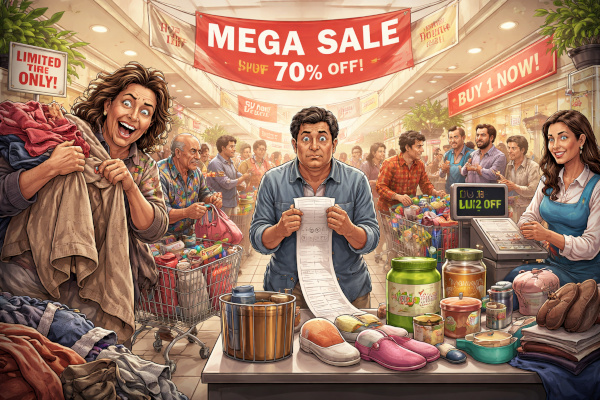
Shopping is the only activity in which a fully grown adult can walk into a building with money, self-respect, and a shopping list, then walk out two hours later carrying six bags, one iced coffee, a scented candle called Moonlit Linen, and the faint spiritual fatigue of a man who has been seduced, robbed, and thanked for it. Retailers call it experience. Credit card companies call it foreplay. The rest of us know it for what it is: an elegant public ritual in which reason is strangled by discounts while soft music plays in the background.
The great lie of shopping begins with the sentence, “I’m just going to have a look.” This is the civilian equivalent of saying, “I’ll just invade for three days.” Nobody ever “just has a look.” The moment a person enters a shop, the building begins working on them like a professional con artist with air-conditioning. The lighting says you are prettier than reality suggests. The mirrors say your posture has improved morally. A sales associate appears from nowhere to tell you that a jacket which makes you look like a divorced magician is “actually very you.” At this stage the shopper is no longer making decisions. The shopper is no longer making decisions. The shopper is being spiritually upholstered into a bespoke retail delusion.
Shopping also has its own fake mathematics, which is among the greatest comic achievements of capitalism. Observe the logic carefully. A thing you did not need at ₹4,000 becomes irresistible at ₹2,799 because a red sign has informed you that civilization is offering you mercy. At no point do you ask the central question: “Why am I spending money to celebrate spending less money on something that was unnecessary five minutes ago?” No. The brain has already entered festive corruption. It now begins producing phrases like “worth it,” “good deal,” “investment piece,” and the immortal war cry of the financially doomed: “I saved by buying.”
This is what makes shopping so magnificent. It is theft performed with your cooperation and a loyalty program.
Malls, meanwhile, are cathedrals built in honor of this strategic confusion. They are designed so that a person cannot simply buy socks and leave with dignity. No, no. First you must drift past perfume so strong it feels like being mugged by flowers. Then you pass the clothing section, where mannequins stand around with the dead-eyed confidence of people who have never paid EMI. Then there is a home décor store, where suddenly you are considering whether your life is incomplete without a bowl full of decorative stones. Humanity once crossed mountains for survival. Now we purchase pebbles in ceramic trays because some glossy book convinced us this counts as “earthy.”
And let us talk about the sales staff, those beautifully trained emotional assassins. They do not sell products. They sell alternate futures. You are not buying shoes; you are buying a more disciplined version of yourself who goes to brunch and owns opinions on linen. You are not buying a lamp; you are buying an apartment in which your life appears to have narrative coherence. You are not buying skincare; you are buying revenge against time, pollution, poor hydration, and two exes. The item is secondary. What matters is the hallucination.
Then come the shopping bags, those glossy little diplomas in impulsiveness. Nobody carries shopping bags casually. People carry them with the silent grandeur of emperors returning from campaign. Even if one bag contains nothing but a scented soap and emotional overreach, the body language changes completely. The shopper now walks like a person who has negotiated with fate and come away with upholstery, moisturizer, and a deeply unnecessary pair of beige sandals.
Online shopping, of course, removed the last remaining barriers of shame and replaced them with temptation in soft lighting. In the old days, a person had to get dressed, leave the house, maintain posture, and suffer the indignity of being seen making bad decisions in public. Now one may lie under a blanket, half-fed, half-conscious, fingers greasy with snack residue, and still engage in financial self-sabotage with the lazy intimacy of a secret affair. The phone glows. The offers whisper. The algorithm watches with the patience of a practiced seducer. person can be one moment away from sleep and yet fully capable of purchasing seventeen items because a website has whispered, “Only 2 left.” This is retail’s version of jungle panic. Only 2 left? Of what? Of this absurd spiralizer? Of this Bluetooth neck massager? Of this collapsible silicon lunch box that looks like failed camping equipment? Suddenly it feels irresponsible not to buy it. Shopping has weaponized scarcity the way medieval kings weaponized religion.
And the algorithm is worse. The algorithm watches you with the calm patience of a stalker who also has your size. You search once for a shirt and for the next ten days the internet behaves as though your torso has become a matter of national importance. Every page is like, “Since you briefly glanced at one navy overshirt, perhaps you would also like loafers, cologne, a watch, a couch, and a personality renovation.” Shopping no longer waits to be invited. It follows you around digitally, waving products at your insecurities like a maître d’ at a restaurant for poor decisions.
Then there are couples shopping together, which is not commerce so much as diplomacy under fluorescent duress. One person says, “I’ll be quick,” and the other ages visibly near a bench. The shopper enters ten stores, rejects fourteen identical tops on the grounds that the fabric “lacks intention,” and emerges triumphant with a candle, a notebook, and a cushion cover. The accompanying partner, who entered with hope and adequate blood sugar, now has the haunted stillness of a man who has heard too many opinions about off-white. He has said “nice” to seven things, “very nice” to four things, and “wow, that’s actually elegant” once, purely out of panic.
The true brutality of shopping lies in its ability to transform ordinary adults into treasure hunters with very strange prey. Suddenly someone is elbowing through a sale section as if the last medium-sized cardigan contains the last medical intervention for a species clearly losing the plot. Calm people become textile archaeologists. Respectable citizens begin digging through piles of discounted fabric with the glazed intensity of raccoons near a buffet. The phrase “last piece” has ended more moral systems than war.
And yet the receipt remains the funniest document in human society. It begins as proof of purchase and ends as a confession. There, in black and white, lies the full poetry of the event: one practical item, three aspirational items, two things bought because they were near the counter, and one object whose purpose is no longer understood even by the buyer. You stare at the total for a few seconds, nodding like a hostage who has decided that understanding is now optional and place the receipt carefully into a bag you will never open again.
Shopping is theatre for the vain, cardio for the indecisive, and financial surgery performed without anesthesia. It is the only sport where the scoreboard is your bank balance and the winner is whoever looks most composed while carrying the most regret.
” Shopping is theft performed with your cooperation and a loyalty program.“- Sorcerer
You may also like
-
Decluttered House, Same Emotional Hoarder
-
The Ride She Would Remember
-
Wife: The Domestic Institution That Turned One Man’s Opinions into a Regulated Sector
-
Software Engineering: Professional Guesswork With Version Control
-
Medical School: A Prestigious Multi Year Experiment in Turning Sleep Into Mythology