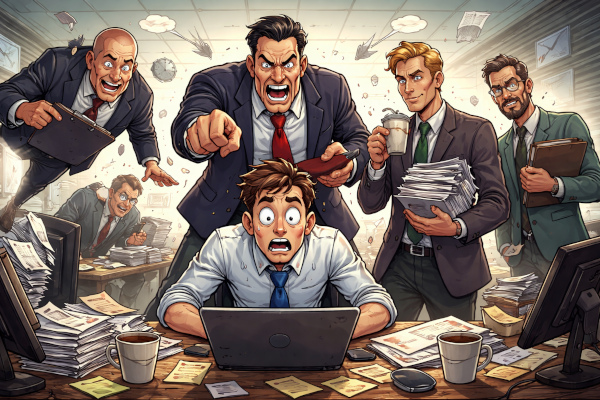
Managers are proof that evolution sometimes takes a coffee break. A normal human being joins the corporate world with a face full of hope, a laptop bag full of cables, and the touching belief that hard work leads to peace. Then, after a few promotions, several meetings, and one mysterious PowerPoint certification, the same human transforms into a creature who says “circle back” with the emotional warmth of a parking ticket. Thus is born the manager: part scheduler, part weather event, part ceremonial obstacle placed between labor and lunch. Their natural habitat includes glass cabins, conference rooms with dry air, and any place where ideas go to acquire bullet points before dying.
The average manager resembles a video-game boss designed by accountants department. They appear when morale is low, deadlines are close, and somebody has almost finished the work. Music changes. Air thickens. A shadow falls across the cubicle wall. Someone says, “He wants a quick sync.” Ancient civilizations feared eclipses. Modern employees fear calendar invites with no agenda. The ordinary office worker hears “Can we chat for two minutes?” and experiences the same internal chemistry as a pigeon realizing the statue has moved.
In the wild, managers come in distinct species. The first is the Meeting Necromancer, who can raise dead topics from the grave with a single sentence. “Just reopening this discussion” is their ritual chant. A problem solved in May can return in August wearing a tie and demanding alignment. These managers treat time as a natural resource that replenishes automatically if stolen from subordinates. Give them one innocent update and they will summon a 90-minute meeting, two breakout calls, one action tracker, and a follow-up deck that says nothing with the confidence of a prophet.
Then there is the Spreadsheet Peacock, a magnificent office bird who displays brightly colored cells to establish dominance. The Spreadsheet Peacock has not touched actual work since the Delhi Commonwealth Games, yet can produce seventeen tabs proving that others have. Every sheet contains filters, pivot tables, conditional formatting, and one hidden column full of malice. Their natural cry is, “The numbers tell a different story,” which usually means the numbers have been kidnapped, hypnotized, and forced to testify.
The most feared species remains the Ambush Manager. This creature smiles too much. A smiling manager is one of nature’s great warnings, like bright frogs, rip currents, or relatives who begin a sentence with “Don’t take this the wrong way.” The Ambush Manager opens with compliments. “You’ve been doing some really great work.” This is how villagers in folklore get eaten by handsome strangers. By the third sentence, you have inherited two dead projects, one impossible deadline, and a fresh responsibility called “leadership exposure,” which means stress with better branding.
Then comes the Buzzword Cobra, who survives entirely on nouns that sound strategic but dissolve on contact with reality. Synergy. Alignment. Leverage. Agility. Ownership. Visibility. Bandwidth. Roadmap. This manager can speak for forty minutes and leave behind nothing except dehydration and resentment. They use language the way squids use ink: to create confusion and escape accountability. A simple request like “Please send the file” becomes “Let’s leverage shared visibility on the latest draft artifact to ensure stakeholder readiness.” Somewhere, grammar seppuku quietly under a potted plant.
A separate and deeply studied variety is the Calendar Warlord. These managers rule through scheduling. Their true dream is not profit, innovation, or team happiness. Their true dream is for every minute of your day to appear as a colored rectangle. Empty space offends them. Free time looks suspicious. Thought requires silence, which to them sounds dangerously close to freedom. They pepper the day with stand-ups, catch-ups, touch-bases, quick connect sessions, and one “informal brainstorming” ambush that somehow includes twelve people and a screen share. By evening the employee has attended enough meetings to qualify as a witness in a federal inquiry and completed exactly eight minutes of actual work.
The Bad Manager, often communicates in a small set of ritual phrases: “Are we clear?” “Send me the report.” “ASAP.” “Expectation.” “Low.” “FYI.” “Call me.” “Just checking.” “Let’s discuss.” These phrases form the Gregorian chant of modern suffering. The Bad Manager adores reports the way medieval kings adored tribute. Results are good, effort is invisible, and formatting errors are moral collapse. Such managers possess a supernatural ability to ignore living human complexity while noticing that the font on page four feels “slightly off.” Their brain can miss the collapse of a project and detect a misaligned bullet point from across districts.
Then we must speak of the Ugly Manager, not in face but in spirit—the workplace volcano in formal wear. This manager shouts to establish truth, interrupts to establish philosophy, and mistakes intimidation for intelligence. Their emotional range runs from annoyed to theatrical. They love control because control is the only thing standing between them and the terrifying discovery that other people may actually know more. An Ugly Manager enters a room with the air of a person arriving to suppress a peasant uprising, only to discover the peasants wanted printer toner and one working extension cord. They thrive on decibel level, confusion, and the belief that being louder is a substitute for being correct.
Managers also have their own combat styles. Some are Hovercrafts: they glide above the actual work like decorative surveillance drone, dropping vague insights from a safe altitude before drifting toward another conference room with biscuits. Some are Pouncers: they appear relaxed for hours, then suddenly spring across six layers of process and land directly inside your inbox with fifteen questions and a face full of urgency. Some are Barricades: broad, immovable, and positioned exactly where momentum was beginning to look promising, as though their true KPI is preventing oxygen from reaching progress. Some are Hydras: solve one concern, and three newer concerns rise from the same neck wearing compliance language and a copied email chain. And perhaps the most deeply corporate species of all is The Rebranded Sequel—the new manager who arrives marketed as transformation, only to reveal himself by week two as the old manager in a cleaner shirt, armed with sharper buzzwords, updated templates, and the same ancestral talent for delaying simple things.
The true genius of management, however, lies in performance art. Managers have mastered the reversible statement. “This is urgent” can become “Why did we rush this?” within six hours. “Please take ownership” can become “Why was I not consulted?” by lunch. “I trust your judgment” can become “Let’s have a quick review of every atom involved” before sunset. A manager’s opinion has the shelf life of coriander in summer and the confidence of a Roman emperor naming horses to cabinet posts. They issue direction, revise direction, clarify direction, and then ask why the team seems confused, as though confusion arrived independently by cab.
Lunch itself is another vital ritual. A manager can miss birthdays, deadlines, context, and the complete emotional collapse of three employees, yet will materialize with prophetic accuracy when free food enters a ten-meter radius. They can smell catered sandwiches through reinforced walls. A project may burn like Troy, but the manager will still ask whether the biryani coupon applies to contractors. This is because management, at its highest level, is about priorities. Those priorities are optics, updates, and surviving until the next quarter without becoming visible to larger predators.
There is also the manager laugh. This is a special acoustic event heard when they crack a joke in a meeting and then laugh first, longest, and hardest, like a man attempting to jump-start an old wagon. Everyone else performs the corporate half-smile: teeth displayed, soul absent. The joke itself usually concerns traffic, weekends, coffee, or the idea that “we all need to work smarter,” which in management dialect means “you will work later while I use the phrase strategic oversight.” Entire office cultures have been built on the ruins of jokes like these.
And yet, in fairness to biology, a few managers are decent. These are rare and mysterious beings, glimpsed mainly in legend, like honest landlords or airport trolleys with all four wheels functioning. The good manager removes obstacles, protects the team, absorbs nonsense from above, and allows work to happen in peace. People speak of such individuals in hushed tones, as sailors speak of green islands after months at sea. Some employees have seen one briefly through frosted glass and spent years trying to convince others they exist.
The survival strategy, therefore, is ancient and simple. Never trust a compliment that arrives before a deadline discussion. Fear the phrase “quick question.” Respect silence, because a silent manager is usually drafting something catastrophic. If a manager begins nodding too enthusiastically, begin notifying loved ones. If a manager says, “It’s alright,” pack lightly and prepare for impact. If a manager says, “I need your help with something high visibility,” understand that visibility refers mainly to your suffering.
In the end, managers are the natural predators created by corporate ecosystems to ensure that no straightforward act remains straightforward. They turn simple tasks into campaigns, campaigns into dashboards, dashboards into governance, and governance into a meeting about why the dashboard colors feel misaligned with strategy. They are the mini-bosses between you and 6 p.m., the human loading screens of adult life, the roaming dungeon creatures of payroll civilization.
“A smiling manager is one of nature’s great warnings, like bright frogs, rip currents, or relatives who begin a sentence with “Don’t take this the wrong way.”- Sorcerer