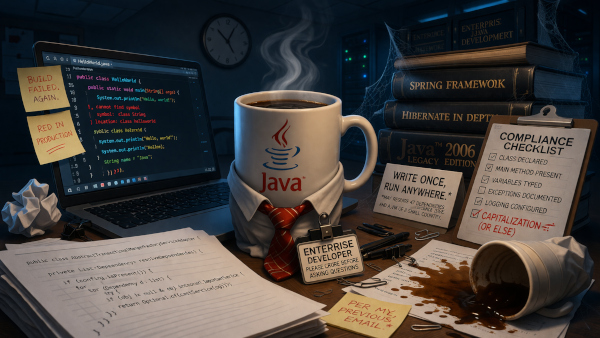
Java is what happens when software engineering gives up on romance and marries procedure.
Other languages flirt. Python winks at you from across the room, buys you a drink, and by midnight you’ve built something useful. C is dangerous, smells faintly of solder and bad decisions, and may either change your life or set your apartment on fire. Java, meanwhile, arrives in a tucked-in shirt with a compliance certificate, asks whether you have reviewed the onboarding deck, and insists that before anything intimate can happen, you must first meet its interfaces, abstract classes, annotations, dependency injection framework, build tools, logging libraries, and seventeen jars whose purpose no one fully understands anymore. That is Java’s idea of foreplay.
Java does not seduce. Java initiates a formal process.
You do not simply write Java. You submit an application to it. Every idea must clear customs before it is allowed into the country. In other languages, if you want to say hello, you say hello. In Java, if you want to say hello, you first declare a class, then a method, then a main method, then a string array nobody asked for, and then, with the exhausted dignity of a clerk stamping forms in a collapsing district office, you may finally print one line. Java does not believe in spontaneity. Java believes that even a greeting should come with documentation, identity proof, and two passport-size photographs.
That is the first great joke of Java syntax: it treats every tiny thought as though it has arrived for a visa interview.
Its syntax is so formal that even simple actions look like they are attending a board meeting. Variables must be declared with types, methods must be defined with ceremony, classes must stand upright and introduce themselves properly, and everything has the emotional warmth of a legal affidavit. In Java, you do not casually make a thing. You instantiate it. You do not just write logic. You architect a compliance-approved behavioral framework for it. By the time Java finishes saying “good morning,” Python has already automated a company, learned jazz, and disappeared to Lisbon.
And yet Java insists this is professionalism. Java has spent decades convincing developers that boilerplate is maturity and that joy is for unserious people.
It is a language built on structure, and not the sexy kind of structure. Not the structure of good design or elegant architecture. No. The structure of government furniture. Java is class-based and object-oriented, which means almost everything happens inside classes, through objects, with inheritance, interfaces, encapsulation, and other words that sound less like programming concepts and more like reasons someone’s marriage is failing. Nothing in Java can simply exist. It must belong somewhere. It must come from a respectable family. It must obey hierarchy. It must extend or implement something older, grumpier, and probably badly named.
Somewhere in every Java codebase there is a class called something like AbstractTransactionalManagerFactoryServiceAdapter, and nobody knows what it does except that removing it would crash a hospital, delay pension payments, and possibly open a portal to another dimension.
Java’s functionality, to be fair, is broad and frighteningly competent. It can do conditionals, loops, arrays, methods, exceptions, files, networking, concurrency, collections, database access, enterprise services, web backends, Android legacy, distributed systems, and enough corporate infrastructure to keep civilization mildly functional and spiritually unwell. Java is like an overworked government contractor: deeply unsexy, but somehow responsible for half the plumbing of modern life. Banks use it. Telecom companies use it. Insurance giants use it. Government systems use it. If there is a large, expensive digital machine somewhere processing human despair at scale, there is a strong chance Java is under the hood, sweating through its shirt and asking whether the logs have been archived.

That is Java’s real superpower. It is not glamour. It is persistence. It is the software equivalent of a man with bad posture and excellent attendance.
Its famous slogan, “write once, run anywhere,” has always sounded like a pickup line delivered by a photocopier. Technically impressive, spiritually devastating. Yes, Java will run anywhere, but it does so with the heavy dignity of a king-size mattress being dragged upstairs. It is portable in the same way a refrigerator is portable: with effort, noise, and several people questioning their life choices. The JVM, of course, is always there in the background, panting heavily like an overqualified chaperone. Java never travels alone. It brings the whole extended family — runtime, libraries, dependencies, build tools, configuration files, and one mysterious memory issue that appears only in production and only on Tuesdays.
Then comes the syntax again, because with Java the syntax never really leaves. It lingers. It hangs in the air like cheap office perfume.
Java writes like a man who says “per my previous email” during foreplay.
Every statement has to dress properly. Every method arrives in a tie. Every class introduces itself as though it is testifying before Parliament. A function cannot simply do a thing. It must first explain its access modifier, its return type, its name, its parameters, its exceptions, and its general attitude toward your remaining patience. Even the humble main method sounds less like the beginning of a program and more like the title of a highly restrictive government policy.
And then there is Java’s glorious, almost vindictive case sensitivity.
Java is unbelievably sensitive to capital letters. Not emotionally — though it does radiate the wounded pride of a bureaucrat who has been addressed incorrectly — but syntactically. In Java, String and string are not cousins. They are strangers who refuse to make eye contact. main is not Main. System is not system. Count, count, and COUNT are three completely different entities, each capable of ruining your afternoon in their own special way. One accidental caps-lock incident and Java behaves like you have entered the wrong name on a royal birth certificate.
This is one of the language’s more charmingly psychotic qualities. You can write ninety-nine percent of a program correctly, but capitalize one letter like a tired monkey, and Java will look at you coldly and say, in effect, “I’m sorry, I don’t know her.” It will not help. It will not infer. It will not say, “Perhaps you meant this.” No. Java believes suffering builds character. If you wrote string when it wanted String, it treats that the way a Victorian aristocrat would treat someone arriving to dinner in beachwear: with horror, contempt, and immediate exclusion.
It is a language of precision, yes, but also of pettiness. Java does not merely care about details. Java weaponizes them.
The developers who live inside this world are a fascinating species. Java developers have the thousand-yard stare of men and women who once loved invention and now troubleshoot dependency injection. They speak gently, as if loud noises might awaken the legacy code. Their souls are held together by build automation, caffeine, and the dim ancestral memory of a weekend not spent reading stack traces. Ask one what they do and they will say something like, “Mostly backend services,” with the tone of a war veteran explaining weather damage.
They have accepted things ordinary people should never have to accept. That a project may take several minutes to start. That one missing semicolon may waste an hour. That a single letter in the wrong case can trigger compiler outrage. That forty-seven dependencies are somehow required to build a service whose main responsibility is to tell another service that a button was clicked. That there are at least six ways to configure logging, all of them ugly. That a “lightweight microservice” may still consume enough memory to embarrass a medium-sized farm animal.
Java’s ecosystem, meanwhile, is less an ecosystem and more a bureaucratic empire. Frameworks sit on top of frameworks like badly stacked wedding cakes. Spring, Hibernate, Maven, Gradle, servlets, annotations, interfaces, factories, repositories, services — the whole thing feels like someone tried to automate paperwork and instead created a religion. Somewhere in the middle of all this, a junior developer is just trying to read a file, but the project insists on building a cathedral first.
And still — still — Java refuses to die.
People have been predicting Java’s death for years with the optimism of cultists awaiting a comet. Every few seasons a younger language appears, all sleek syntax and emotional availability, promising to free us from verbosity, boilerplate, and old enterprise misery. For a while everyone falls in love. Articles get written. Conference speakers begin saying “paradigm” too often. Startups pretend they have discovered the future. Then, inevitably, the new language acquires complexity, ego, factions, unstable tooling, and a cult of insufferable men on the internet. Meanwhile Java is still sitting in the corner, ugly but employed, like an uncle who does not understand fashion trends but somehow owns four buildings.
Because that is the dark secret: boring things run the world.
The internet worships sexy tools. Real life worships the thing that does not collapse when payroll is due. Civilization, sadly, is not maintained by elegance. It is maintained by systems that work, more or less, under fluorescent lighting and emotional duress. Java is the language of this grim compromise. It is not beautiful. It is not exciting. It is not liberating. It is stable, extensive, absurdly widespread, and too deeply embedded in the organs of modern infrastructure to be removed without international grief counseling.
That does not make Java noble. Let us keep our standards low, but not subterranean.
Java is still ridiculously verbose. Its syntax still makes simple ideas sound like legal settlements. Its object model still encourages class hierarchies that resemble royal bloodlines. Its applications still warm your laptop like a tandoor. Its build systems still behave like suspicious uncles. Its case sensitivity still punishes caps-lock accidents with Old Testament severity. And somewhere, right now, a developer is staring at an error caused entirely by the fact that they wrote Public instead of public, wondering whether humanity truly deserved language.
And then, of course, there is Java’s sacred summoning ritual: public static void main(String[] args). This is not a line of code; this is a bureaucratic incantation recited before the language agrees to acknowledge your existence. Every word in it feels like it was chosen by a panel of stern elders who believed simplicity led to moral decline. public so the universe may witness it, static so it may exist without human warmth, void to remind you that nothing meaningful comes back, main because all roads in Java must pass through official channels, and String[] args because even at birth the program must be prepared to receive paperwork. Other languages let you start casually; Java makes you open the ceremony by reading aloud from its constitution. It is less “beginning a program” and more “petitioning the empire for runtime permission.”
But perhaps that is why Java is so funny and so immortal. It is a monument to adulthood in the least erotic sense imaginable. It is loans, meetings, passwords, tax forms, office shoes, infrastructure reviews, and the dead-eyed phrase “this is good for maintainability.” It is not the wild affair of your youth. It is the long, salaried marriage of enterprise computing — expensive, exhausting, strangely durable, and impossible to escape because the children are named Production, Compliance, Legacy, and Integration.
So yes, laugh at Java. Laugh at the boilerplate, the syntax, the pomp, the frameworks, the memory appetite, the endless hierarchy of classes, and the fact that it treats uppercase letters like matters of state security. Laugh at the way it makes you work so hard just to say something simple. Laugh at the way it confuses ceremony with dignity.
But laugh carefully.
Because while the cooler languages are still flirting, Java is already in the server room, sweating steadily, filing your transaction, validating your input, handling your exception, and rejecting your code because you wrote system instead of System.
And in the bleak corporate wasteland of modern computing, that joyless, caps-sensitive tyrant still signs the paycheck.
“Boring things run the world.”- Sorcerer