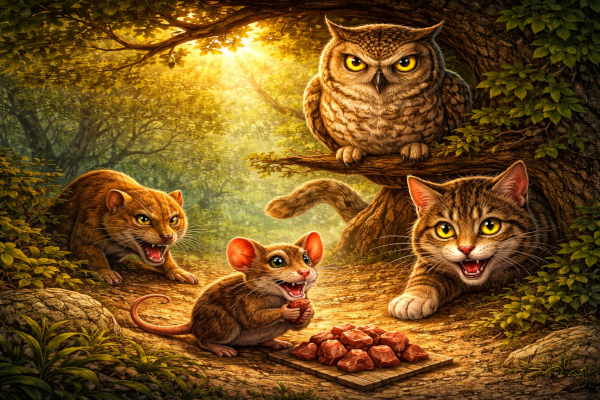
There stood, in the middle of a vast forest, a magnificent banyan tree — the sort of tree that looked as though it had witnessed generations of bad decisions and had long since stopped judging. At its foot lived a wise mouse named Palita, small in size but dangerously overqualified in survival. On one of the branches above resided a cat named Lomasa, who, like many creatures gifted with claws and self-confidence, had an inflated opinion of his place in the food chain.
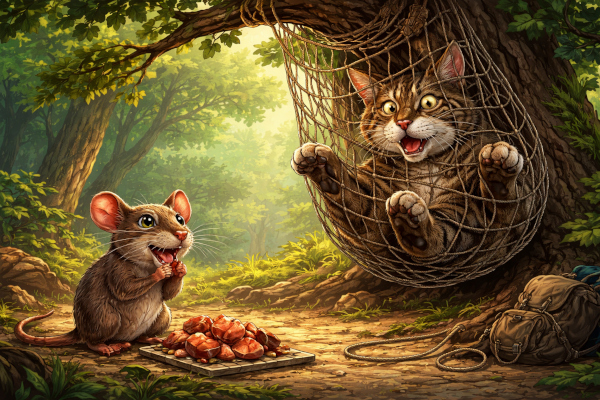
One day, fate — assisted by a hunter named Parigha and his net — decided to remind Lomasa that arrogance often travels without insurance. The cat was caught in a snare. The mighty predator, terror of small mammals, defender of branches, was now hanging in a net like a badly packed vegetable sack. Seeing his natural enemy trussed up so beautifully, Palita emerged from his hole with the wicked cheer of a schoolboy who had just seen the head bully hauled into the principal’s office. For the first time in a long while, he walked about freely and even began nibbling the bait meat the hunter had left behind, with the cheerful recklessness of a man eating free snacks at the scene of an ongoing disaster.
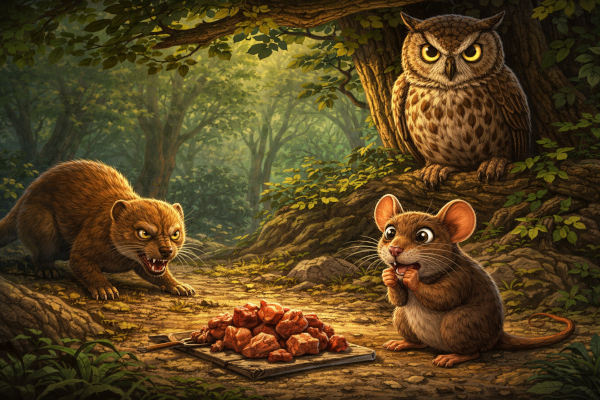
Naturally, the universe did not approve of his happiness. While enjoying his stolen feast, Palita noticed a mongoose named Harita preparing to turn him into a side dish. As though this were not enough, he also saw an owl named Chandrak perched above, staring at him with the grim patience of a tax audit waiting for midnight. In one glorious moment, Palita understood that he had somehow graduated from “small creature having a lucky morning” to “portable buffet attracting premium predators.”
Being an intelligent mouse and not one of those theatrical fools who panic first and think later, Palita paused to reflect. Death stood before him from all directions, like an overenthusiastic event manager who had booked too many performers for the same slot. There was the cat above, should he be freed. The mongoose below, eager and practical. The owl above, silent and sinister. It was, in short, the sort of strategic situation that turns ordinary beings into philosophy. Palita, however, was a mouse of diplomacy. He understood a truth that most kings, ministers, and committee chairmen learn only after several disasters: when surrounded by enemies, it is often useful to temporarily reorganize them.
So the mouse concluded that the cat — yes, the cat, his sworn enemy, the creature most likely to convert him into breakfast under normal conditions — was, under present circumstances, the least inconvenient option. After all, a trapped cat was not a mobile cat, and a desperate cat was often more reasonable than a free one. Thus Palita decided to attempt that most delicate and exhausting of all political exercises: friendship based entirely on mutual distrust.
Approaching the entangled Lomasa, the mouse spoke with all the polished courtesy of a diplomat negotiating with a man who has previously attempted to eat him.
“O cat,” he said in effect, “how fortunate that we meet in such improved circumstances. Let us not dwell on ancient misunderstandings such as predation, panic, and the long history of your species trying to turn mine into protein. You are trapped, I am endangered, and together we may perhaps form that most noble of alliances: one born entirely out of immediate necessity. If you solemnly promise not to kill me, I shall cut the net and save you. You save me from the mongoose and owl by your mere threatening presence, and I save you from becoming the hunter’s afternoon accomplishment. In short, let us trust each other just enough to remain alive.”
Now Lomasa, being in no position to negotiate from strength, responded with touching enthusiasm. A trapped cat becomes philosophical very quickly. He called the mouse dear friend, noble comrade, savior, and almost certainly several other titles he would never have used had he not been hanging in a net like laundry. He assured Palita of everlasting gratitude, undying loyalty, and future service — all the standard promises made by those whose immediate problem requires someone else’s teeth.
Palita, being wise, accepted the speech without accepting the sentiment. He slipped beneath the cat’s body, where the mongoose and owl, seeing the two apparently united, immediately lost interest. Predators, like opportunists everywhere, prefer easy arrangements; once complexity enters the scene, enthusiasm declines sharply. The mongoose and owl withdrew, disappointed, no doubt muttering about the decline of standards in woodland dining.
Then Palita began to gnaw through the strings of the net.
Slowly.
Very slowly.
So slowly, in fact, that Lomasa, who had just rediscovered an appreciation for urgency, became impatient. The cat demanded to know why his “dear friend” was working with the urgency of an office memo awaiting seventeen signatures. Could he not gnaw a little faster, or had this suddenly become a lesson in decorative restraint?
Palita, who understood timing better than most married men, explained with calm precision that every action had its proper moment. If he released the cat too soon, the cat, suddenly free and no longer desperate, might remember that mice are edible and friendship is often just panic wearing a polite face. No, no. Better to wait until the hunter himself approached. Then the cat’s first thought would be escape, not lunch. A liberated enemy with a hunter at his heels is a far safer proposition than a liberated enemy with leisure.
This, incidentally, is the kind of insight that separates the living from the sincere.
The cat protested, invoking honesty, loyalty, gratitude, mutual promises, and all the noble principles creatures discover when powerless. But Palita replied with the cool wisdom of one who had read the world correctly. Friendship, he said, is very often a temporary business arrangement decorated with emotional language. Men, beasts, kings, and opportunists unite for gain. Magnanimous friendship may exist in poetry, but in practical life one should keep one eye open and the other on the exit.
He explained further that a weak creature making terms with a strong one must remain cautious, because once the strong party is safe, memory returns very selectively. He had already cut almost every strand of the net, leaving only one. That last thread would be severed only when the hunter appeared. Then the cat would have more pressing matters than chewing on diplomatic partners.
At dawn the hunter Parigha arrived with dogs, and suddenly Lomasa’s appetite for philosophical reassurance was replaced by a very immediate interest in velocity. The cat asked, in essence, “Well? Is this your moment?” Palita cut the final strand at once. Freed, Lomasa shot up the tree with the speed of a creature who had briefly glimpsed accountability. Palita darted into his hole. The hunter, deprived of both cat and entertainment, returned home disappointed — proof that in this world efficiency is often most visible when it ruins someone else’s plans.
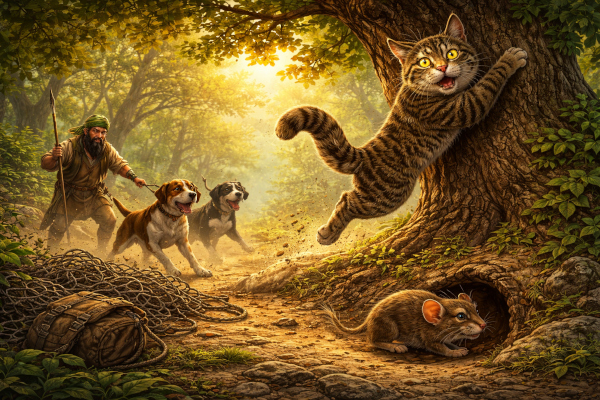
Once safe, Lomasa attempted the oldest move in politics, diplomacy, and social climbing: extending an alliance past its expiration date. From the branch above, he called sweetly to Palita, showering him with gratitude and praise. He declared the mouse his friend, father, counselor, benefactor, and perhaps, if encouraged, chairman emeritus of feline affairs. He offered hospitality, honor, wealth, and affection. The speech was extremely moving, particularly if one ignored the fact that the speaker was still a cat and the intended audience was still a mouse.
Palita, however, was not a fool. He answered sweetly, but with the merciless clarity of one who has no intention of being flattered into becoming lunch. He explained that the world runs not on pure affection but on interest. Friends and enemies are often merely temporary job titles assigned by circumstance. One is dear when useful, dangerous when inconvenient, and forgotten when no longer necessary. The affection between them had existed for one reason only: mutual peril. That reason was now gone. Therefore so was the friendship. To pretend otherwise would be less noble than idiotic.
He pointed out — with the kind of honesty that ruins many charming speeches — that Lomasa now found him “dear” precisely because he wished to eat him. That was the true poetry of the situation. The old enmity had not disappeared; it had merely taken a tea break while the hunter was around. The moment danger passed, nature resumed office.
Palita went on with great intelligence and no small amount of sarcasm. Why, he asked, should a sane rat place himself within reach of a hungry cat just because the cat had recently discovered gratitude? Why should a weak creature remain in the neighborhood of a stronger one once the common danger had passed? No sensible being surrenders safety to sentiment. Property, wealth, dominion — all can be sacrificed for life. But life itself is not to be exchanged for flattering speeches from a former predator hanging on the fumes of convenience.
Lomasa tried once again, swearing he meant no harm, claiming noble intentions, loyalty, gratitude, perhaps even moral reform. But Palita remained unmoved. He thanked the cat politely, as one thanks a dubious salesman while firmly keeping the door closed. A wise creature, he said, does not place himself under the power of his enemy, nor does the weak trust the strong merely because the strong are speaking softly. The foundation of treaties is not blind trust but careful distrust. That, unpleasant though it may sound, is often what keeps the weak alive.
At the mention of the hunter, Lomasa abruptly remembered that self-preservation was still his strongest principle. He fled. Palita returned peacefully to his hole, having survived not by strength, nor by sentiment, but by the rare and undervalued art of knowing exactly when to cooperate, when to delay, and when to refuse to become emotionally available to a carnivore.
Thus Bhishma told Yudhishthira that the weak can survive among the powerful not by loudness, virtue-signaling, or emotional optimism, but by intelligence, timing, and a healthy disrespect for appearances. Two enemies may indeed unite in the face of common danger, but each does so with one eye on survival and the other on future advantage. One should appear fearless while being cautious, agreeable while calculating, and trustful only with the suspicion properly folded beneath it. Such is the science of diplomacy, whether among mice and cats, kings and ministers, or people smiling across polished tables while secretly measuring one another for metaphorical coffins.
The story of the cat and the mouse, then, is not merely a woodland anecdote. It is a full political education disguised as animal drama. It teaches that peace may be made with an enemy when necessary, but necessity should never be mistaken for affection. It teaches that danger sharpens intelligence better than comfort ever does. And above all, it teaches that when a cat calls you “my beloved friend” immediately after failing to die in a net, the correct response is not emotion. It is distance.
You may also like
-
The Lake, the Crane, and the Ancient Indian Version of “Please Read the Instructions Before Dying”
-
The Camel, the Lion, the Leopard, and the Jackal: A Corporate Tragedy in the Jungle Division
-
Matsya Nyaya from Chanakya: A Comprehensive Guide to Being Eaten with Professional Courtesy
-
Savitri, Satyavan, and the Day Death Met a Better Lawyer
-
The Mahabharata’s Most Elegant Case of Profile-Based Love