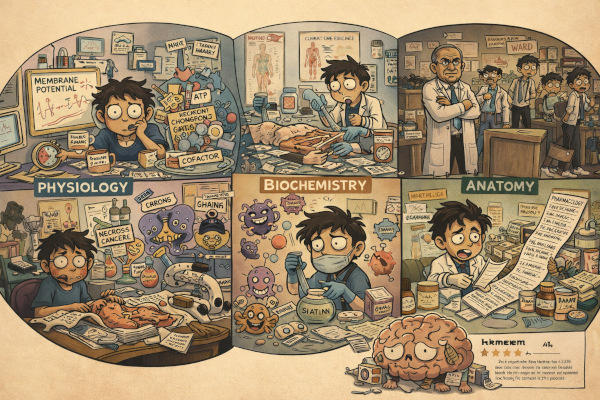
Medical school is often advertised as a noble calling. This is adorable. In reality, it is a beautifully accredited psychological experiment in which high-achieving adults are locked in a fluorescent building and slowly taught that the human body contains two hundred bones, nine hundred muscles, twelve cranial nerves, several thousand pathways, and absolutely no mercy. It is less “journey of healing” and more “four-to-six-year hostage situation conducted by PowerPoint, cortisol, and the brachial plexus.”
On the first day, everybody arrives with ambition, fresh notebooks, and the tragic confidence of people who still believe hard work will be enough. By the third week, Physiology has slapped them across the face with Starling forces, action potentials, acid-base balance, and enough membrane transport to make them question whether sodium itself is running the college. You start med school thinking the body is a marvel of divine engineering. You leave Physiology convinced it is an overcomplicated group project held together by ATP and lies. Every organ is doing something rude. The kidney alone behaves like a moody accountant with a chemistry degree and a personal vendetta against your happiness.
Then Anatomy enters, dressed like a war crime.
Anatomy is where the institution takes your remaining innocence, places it on a stainless-steel tray, and labels it “specimen.” The syllabus is essentially: here are all the structures in the human body; memorize them all before Thursday; try not to cry into the cadaver. Nothing humbles a person faster than spending six hours elbow-deep in fascia looking for a nerve the size of dental floss while someone beside you casually says, “Oh, there it is,” like they’ve spotted a friend at the airport. Anatomy lab smells like formalin, fear, and the death of hobbies. Somewhere in every dissection hall is one cheerful lunatic identifying branches of the external carotid artery like a sommelier discussing notes of oak, while the rest of the class is hovering nearby in emotional septic shock.
And the terminology. Dear sweet God, the terminology. Nothing in medicine is allowed to be called “the bendy bit near the shoulder.” No, it must be named something like the sternocleidomastoid or the coracobrachialis, as though every muscle was christened by a Roman senator with a grudge. Anatomy is the one subject where a student can stare straight at a human structure and still say with complete sincerity, “I have no idea what that wet noodle is.” It is the educational equivalent of being mugged by Latin.
Then comes Biochemistry, that greasy little goblin.
Biochemistry is what happens when chemistry and betrayal have a child. It arrives carrying glycolysis, the Krebs cycle, beta oxidation, purine metabolism, urea cycles, enzyme deficiencies, and enough arrows to map the collapse of an empire. Medical students spend months memorizing pathways that look like subway maps designed by cocaine. Every reaction has a substrate, an enzyme, a cofactor, a deficiency syndrome, and a professor who asks about it like this is normal dinner conversation. You tell yourself you are learning the molecular basis of life. In truth, you are being chased through the forest by acetyl-CoA.
Microbiology, meanwhile, is just Pokémon for the sleep-deprived and the clinically doomed.
At first it seems innocent. Tiny organisms. Interesting diseases. Charming little cocci and bacilli. Then suddenly there are gram-positive cocci in clusters, gram-positive cocci in chains, gram-negative diplococci, acid-fast bacilli, spirochetes, toxins, exotoxins, endotoxins, capsules, spores, vectors, virulence factors, culture media, and 3,000 ways to die because somebody forgot to wash their hands in 1847. Microbiology teaches you that the world is not full of beauty and wonder; it is full of microbes waiting politely for your immune system to blink. Every lecture is basically: here is a bacterium shaped like a comma; it causes diarrhea, shock, rash, organ failure, and a question worth five marks. Best of luck.
And then Pharmacology arrives like a drunken pharmacist in a trench coat and starts hurling drug names at your skull.
Pharmacology is not a subject. It is a revenge fantasy. It takes one simple concept — medicine treats disease — and turns it into 800 compounds, 600 adverse effects, 90 contraindications, 40 black-box warnings, and one tutor who says, “Don’t memorize, just understand,” before unleashing a list of drugs named as if someone headbutted a keyboard: ceftriaxone, hydrochlorothiazide, phenoxybenzamine, glycopyrrolate, carbamazepine. Every drug has a mechanism, an indication, a metabolism pathway, an interaction, and at least one side effect severe enough to qualify as an act of terrorism. By the end of Pharmacology, students no longer think of receptors as proteins. They think of them as doors through which suffering enters.
Pathology is where the faculty drops all pretence and says, “You know that beautiful body you studied? Here is everything that can go wrong with it.”
Pathology is medicine’s goth phase. Gross specimens. Necrosis. Caseation. Gangrene. Hyperplasia. Metaplasia. Dysplasia. Neoplasia. Things that should not be enlarged are enlarged. Things that should not rupture have ruptured. Things that should not be black are black. This is the subject in which every tissue slide looks like moldy lasagna and everyone nods solemnly while a pathologist says, “Observe the pleomorphism,” as if the rest of us are not fighting to keep our lunch inside the correct anatomical compartment. Pathology teaches you that the body is less a miracle and more a highly flammable apartment building with excellent PR.
Then Forensic Medicine steps in like an underpaid detective with a scalpel and a cigarette.
Suddenly the course is discussing postmortem changes, rigor mortis, poisoning, blunt force trauma, sharp force trauma, firearm injuries, legal procedures, suspicious deaths, and the approximate enthusiasm with which society can destroy itself. It has the general atmosphere of a true-crime documentary written by a coroner. One minute you are learning medicine; the next you are calmly revising the color changes of bruises over time like this is a perfectly acceptable use of your twenties.
Community Medicine, of course, is where public health tries to save civilization using statistics, vaccination, sanitation, epidemiology, and the patience of saints. It is also where students discover that one disease can be measured using incidence, prevalence, morbidity, mortality, case fatality rate, sensitivity, specificity, positive predictive value, and the exact rate at which their soul leaves the body during biostatistics. Community Medicine is important, noble, and absolutely capable of making a room full of future doctors look like they are being strangled by confidence intervals.
Then clinical postings begin, and the comedy turns feral.
The hospital is where medical school stops merely insulting your memory and begins attacking your circadian rhythm. Clinical begin at an hour when only bakers, regret, and surgery departments are awake. You show up at dawn in a white coat carrying a stethoscope like a decorative amulet and pretending you belong there, while inside your brain the hypothalamus is filing a human rights complaint. Surgery rotation in particular has a special talent for making students feel like decorative coat stands with debt. You wake at 4:45 a.m., arrive before sunrise, hold a retractor for four geological eras, and are rewarded with a cryptic comment such as, “Read more.” Read what, exactly? The patient? The room? The Old Testament? Public guidance on surgery rotations really does describe them as intense, fast-paced, and physically exhausting, which is a lovely professional way of saying the day starts before dignity and ends after cartilage.
Medicine rounds are their own form of performance punishment. A consultant asks a question in a mild tone, and thirty students experience immediate catecholamine surge, sinus tachycardia, dry mouth, pupillary dilation, and the complete evacuation of the cerebral cortex. You knew the answer five minutes ago. You knew it in the hostel. You knew it while brushing your teeth. But now, in front of the patient’s bed, with everyone watching, your hippocampus has packed its suitcase and fled the country. You stand there smiling faintly while your medulla oblongata performs the only remaining function available: not dying in public.
And the hierarchy! Magnificent. Everybody in the hospital is exhausted, but in different pathological patterns. The first-years are anxious. The interns are delirious. The residents look like they were grown in a laboratory on a diet of cold coffee and pager trauma. The consultants have transcended normal fatigue and now exist as a separate endocrine state. Somewhere in every unit is one registrar who can teach brilliantly, terrify efficiently, and destroy self-esteem with the sentence, “You should know this by now,” which, medically speaking, causes acute fulminant ego necrosis.
Medical school feedback deserves to be studied by Psychiatry.
It is always vague enough to be useless and sharp enough to wound. “Needs confidence.” Ah yes, confidence, that naturally abundant resource in a person who has just been publicly humiliated over the differential diagnosis of jaundice before breakfast. “Should improve clinical acumen.” Wonderful. Shall I purchase some from the bookstore? “Reads, but lacks depth.” I’m sorry my knowledge of portal hypertension did not satisfy your erotic standards. Educational literature regularly notes how much medical training depends on active learning, clinical exposure, and supervision; what it should add is that some of this “feedback” lands like a psychiatric assault with a clipboard.
And let us not forget the white coat itself: the ceremonial tablecloth of impending burnout. Society sees a white coat and thinks competence, prestige, and sacrifice. The student wearing it is thinking about coffee, constipation, ward attendance, whether the pulse was radial or brachial, and if missing one more meal will finally convert their bloodstream into intravenous caffeine. In med school, coffee is not a drink. It is a vasopressor. It is maintenance fluid. It is the unofficial eighth vital sign.
Physiology teaches you that the body runs on pressure, gradients, and a terrifying amount of electrical confidence.
Biochemistry teaches you that life is basically enzymes frantically passing molecules to one another like smugglers at a border.
Anatomy teaches you where everything is hidden.
Pathology teaches you all the creative ways it can go wrong.
Microbiology introduces the microscopic criminals trying to colonize the situation.
Pharmacology hands you a chemically aggressive list of substances and says, “Here, improvise.”
And clinical medicine teaches you that after learning all of this, you will still be publicly interrogated about something obscure on an empty stomach.
There is also the charming educational tradition of making students memorize facts they will promptly forget the second the exam ends. Public med-school is full of exactly this theme: embarrassing knowledge gaps, forgotten anatomy, and the sense that whole sections of learning briefly visited and then evacuated the premises. Medical school turns the brain into an Airbnb for information: cranial nerves check in, make a mess, and leave without paying.. Yesterday you knew the branches of the facial nerve. Today you know only pain.
Then there are the exams — the true apex predators of the ecosystem. Medical school exams are not written to assess knowledge. They are written by people who seem personally offended that students continue to experience serotonin. The question stem is always three pages long and begins with a 57-year-old diabetic hypertensive smoker with fever, rash, edema, hepatosplenomegaly, altered sensorium, marital issues, questionable water intake, and a family history of something unhelpful. The actual question is, “Which receptor is most likely indirectly involved?” At this point, the examinee is no longer solving medicine. They are negotiating with God.
And still, somehow, med students become funny.
Friendships in med school are forged under conditions that would qualify as military bonding if everyone involved weren’t carrying flashcards instead of rifles. Nobody else will understand the intimacy of sharing a samosa outside the lecture hall after both of you have just failed to identify a heart sound and an emotion. Nobody else will understand why hearing “There will be a short quiz” causes an endocrine storm more violent than dengue season. Nobody else will understand the romance of someone wordlessly handing you notes, a pen, and half a caffeine tablet like a battlefield transfusion.
So let us speak plainly. Medical school is not education. It is a prolonged, institutionally respected form of organ-specific torment. It is a grand cathedral of overwork in which bright young people are slowly transformed into pale, sarcastic creatures who can identify murmurs, recite mechanisms of action, discuss gram stains over lunch, and fall asleep standing upright during a Pharmacology lecture. It is where weekends go to die, where Latin comes back for revenge, where the pancreas is somehow both endocrine and exocrine just to show off, and where one missed capital letter in an answer can cost more marks than an actual clinical insight.
It is glorious. It is ridiculous. It is faintly criminal. It is one of the only places on Earth where a person can spend twelve hours learning the clotting cascade, the cranial nerves, beta blockers, nephrotic syndrome, malaria, and the anatomy of the inguinal canal — and still go home feeling unqualified to diagnose a fever in a houseplant.
And that, perhaps, is the essence of medical school: a prestigious educational labyrinth in which everybody is overqualified, underslept, underfed, overexamined, and one viva away from cardiovascular collapse. It does not build character. It performs repeated blunt trauma on character until something clinically interesting remains.
So yes, salute the medical student. Salute the brave, overcaffeinated goblin in a white coat who can explain the renin-angiotensin-aldosterone system, list the side effects of aminoglycosides, identify a murmur, classify shock, and still forget where they left their own phone. Salute the future doctor whose sympathetic nervous system has been permanently activated by the phrase, “Any volunteer to present this case?”
Because if laughter truly is the best medicine, then medical school is the only place arrogant enough to prescribe it while simultaneously causing the disease.