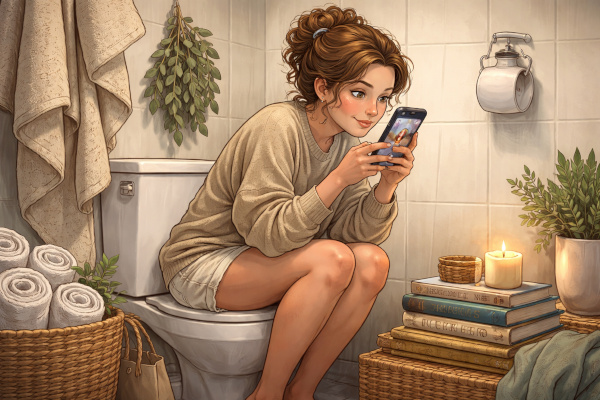
Digital detox weekends belong to that glorious class of modern rituals where the packaging arrives first and the wisdom catches the next train. The concept is magnificent. You, a person spiritually sandblasted by notifications, step away from your devices for forty-eight holy hours and rediscover life’s forgotten textures: bird calls, sunlight on wood, the sound of your own joints, the existence of spoons, perhaps even your spouse. Somewhere in the hills, a kettle whistles. A wool blanket drapes itself over your aspirations. Your phone rests in a drawer like a disgraced courtier. Civilization, you announce, has had enough access to your nervous system.
By Saturday 9:12 a.m., you are in the bathroom checking who viewed your story from Friday.
This is the great opera of the digital detox weekend. It begins as philosophy and ends as plumbing by the cheapest bidder. The vision is transcendence. The execution is a grown adult crouched near a sink, brightness at 12%, scrolling reels in the posture of a fugitive accountant.
The modern detox enthusiast always starts with a speech. There is a little declaration, half monk, half lifestyle influencer. “This weekend, I am choosing presence.” “This weekend, I return to myself.” “This weekend, I release digital dependency.” like a sentence with eucalyptus in it. Then comes the practical side. The same person spends forty minutes informing everyone online that they will be offline. They post a farewell carousel. They upload a moody black-and-white photo of coffee, socks, and a windowsill. They write, “Gone inward.”
The funniest part lives in the preparation. A digital detox requires gear. There is always gear. A tote bag. A journal with pages thick enough to survive flood damage. A pen that glides like inherited wealth. Three books selected more for moral appearance than readability. Granola with aggressive confidence. A candle named something like Forest Silence or Cedar Sabbath. The entire retreat starts to feel like a kidnapping with excellent lighting and neutral tones.
Then the detox begins, and the body enters negotiations.
The hand twitches. The pocket receives ceremonial taps. The mind develops a rich fantasy life about emergencies of “What ifs “in cascade effect. What if somebody texted? What if there is news? What if the world suddenly requires your opinion on an actor’s divorce, a brand apology, or a seven-second clip of a raccoon washing grapes? Entire empires have collapsed with less emotional drama.
Morning proceeds in stages. First comes courage. Then restlessness. Then the discovery that time, when unassisted by apps, expands like old dough. A ten-minute tea break acquires the scale of a geological era. You look out a window and realize trees contribute almost zero plot. Leaves move. A bird arrives. Another leaf moves. This, apparently, is peace. Peace has very little editing.
By noon, detox people begin touching objects as though they are archaeologists in their own homes. A bowl. A cushion. A key. “Interesting,” they think, having fully entered the sensory phase. They read six pages of a novel and reward themselves by walking in a circle. They become deeply invested in water. Water is suddenly excellent. Water becomes a chapter.
Then comes the bathroom relapse, the crown jewel of the entire system.
Because the bathroom offers what the detox weekend desperately needs: privacy, plausible deniability, and tile. A person can vanish into that room with dignity and emerge spiritually moisturized. “Just freshening up,” they say, while inside they are inhaling ten reels, two outfit breakdowns, one geopolitical explainer, three memes about avoidant attachment, and a golden retriever video carrying enough emotional nutrition to power a village.
This moment deserves respect. It is the secret confessional of the digital age. One sits on the closed toilet seat like a guilty duke and opens Instagram with the reverence of someone lifting a forbidden relic. The thumb moves immediately. The body remembers. The algorithm, loyal as a hound, throws open the gates: recipes, gym advice, fake productivity, celebrity skin, a man restoring a sword, a woman explaining cortisol, one deeply committed duck. The soul drinks like a traveler in a desert.
Five minutes later, the person returns to the living room and says, “This break is helping me reconnect.”
Digital detox weekends also reveal a truth about human character: nobody wants silence as much as they want to imagine themselves as a person who enjoys silence. The fantasy is aristocratic. The reality is a citizen of the attention economy wondering whether anyone reacted to the photo of focaccia uploaded on Friday night. This gap between self-image and thumb behavior fuels the whole comedy. We dream of transcendence and conduct ourselves like raccoons in a vending machine.
There is also a charming class element to the detox weekend. The phrase itself sounds expensive. “Digital detox weekend” suggests a cedar deck, stone mugs, and perhaps a woman named Anya teaching breathwork near a lake. It carries the energy of curated suffering. A regular person hiding from WhatsApp has stress. A person in linen hiding from WhatsApp has a reset.
Every detox article promises revelation. You will rediscover creativity. You will feel your nervous system soften. You will notice the sky. You will hear your own thoughts with startling clarity, like a plate hitting the kitchen floor. This all sounds lovely until your own thoughts actually arrive, at which point many people make a rapid emotional sprint back toward the phone. Human beings spent centuries building distractions with enormous ingenuity. Turning away from them for two days can feel less like healing and more like being locked in a room with an unedited committee.
This is why detox weekends generate such inventive substitute behavior. People bake with the intensity of frontier settlers. They fold laundry as though restoring constitutional order. They make lists. They sharpen pencils. They stare at houseplants with forensic attention. Some journal. Some stretch. Some read ingredient labels on shampoo. Some walk into the kitchen seventeen times to check whether an emotion might be hiding in the fridge.
And throughout all of this, one small bright thought keeps floating up like a guilty bubble from the swamp: “I wonder what’s happening online.”
That sentence has the power of prophecy. It leads to “I’ll just check the time.” Which leads to “I’ll just see whether Mom called.” Which leads to “I’ll just open messages.” Which leads to “Why is my ex in Portugal.” Which leads to “Who is this Pilates woman and why does her breakfast look expensive.” Which leads to full social re-entry in under ninety seconds. Rome took longer to fall.
Detox culture thrives because it flatters both halves of the modern personality. One half wants wellness, depth, restoration, and maybe a better relationship with attention. The other half wants content, self-awareness as branding, and the thrilling private vice of a secret bathroom scroll. The detox weekend lets both sides eat. You get to declare spiritual reform and still conduct covert diplomacy with the algorithm behind a locked door.
And honestly, that is the true genius of the whole thing. The weekend becomes a tiny moral theatre where a person can feel noble, weak, reflective, ridiculous, and seen, often within the same hour. You read a page of philosophy, inhale a candle called Moss Province, hide in the bathroom with Instagram, emerge with a face like a monastery bell, and tell everyone lunch tastes more intentional.
Which, in a way, it does.
So yes, take your digital detox weekend. Light the candle. Stack the books. Walk slowly on purpose. Touch bark. Gaze at steam. Whisper words like restore and regulate. Then vanish into the bathroom check whether the reel you posted Friday has crossed ten thousand views. Inner peace comes in many forms and this is one among it.
You may also like
-
Morning Routines Of Successful People: A Sacred Performance In Several Luxurious Acts
-
Decluttered House, Same Emotional Hoarder
-
Journaling Your Way to Inner Peace: Writing “felt weird today” in a ₹2,400 Notebook Like a Melancholy Aristocrat
-
Cold Showers: How to Be Attacked by Water and Call It Character
-
The Gospel of Warm Lemon Water