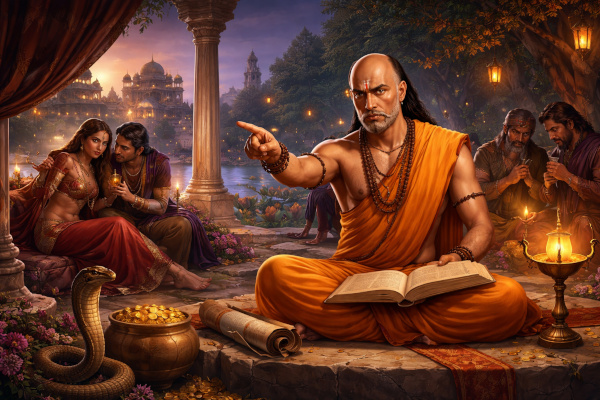
Chapter 1 of Chanakya Niti begins politely enough. Chanakya bows to Lord Vishnu, the supreme lord of the three worlds, like a man who knows that before discussing politics, survival, betrayal, money, fools, and domestic disasters, it is better to first greet the cosmic management. It is a wise move. If you are about to explain how human beings repeatedly ruin their own lives, divine backup is not a bad idea.
And then, after the respectful opening, Chanakya basically says, “Now listen carefully, because people are foolish and life is dangerous.”
That, more or less, is the mood of Chapter 1.
This chapter is not a soft spiritual hug. It is an ancient survival guide written by a man who clearly had no patience for stupidity dressed as innocence. Chanakya does not waste time telling you that everyone is wonderful, the world is fair, and all you need is positive thinking and some warm lemon water. No!!! He tells you to protect your money, test your friends in hard times, be careful where you live, and never trust dangerous things just because they are standing still for the moment.
In modern language, Chapter 1 is basically: How not to ruin your life by mistaking red flags for romance, bad company for destiny, and soft feelings for sound judgment.
Chanakya has opinions on everything. Bad wife? Problem. Crooked friend? Problem. Arrogant servant? Problem. House with a snake? Big problem. Place with no respect, no income, no relatives, no education, and no decent social structure? Leave immediately. Don’t stand there calling it “a growth opportunity.” If Chanakya would have been there with you, he would probably drag you out himself without any background music.
One of the wickedly funny things about this chapter is Chanakya’s complete refusal to be seduced by appearances. He is not impressed by honeyed smiles, velvet voices, or dramatic declarations of loyalty delivered with perfect eye contact. For him, charm is cheap; pressure is the real undressing. A servant is known when given work, relatives when trouble arrives, friends when crisis knocks, and a spouse when the money slips out of the silk purse. In simpler terms, everyone looks divine in candlelight and comfort. Character is revealed when the mood goes cold, the cushions flatten, and life starts removing the makeup in the drizzle.
The chapter also keeps repeating one important lesson: protect what matters in the right order. Save wealth for emergencies. Use wealth to protect family. But protect yourself above all, even if money and comfort must go. It sounds harsh, but Chanakya is simply saying that a ruined person cannot rescue anything. You cannot save the kingdom if you yourself are lying flat like a badly folded cot.
Another sharp idea in this chapter is that wisdom can come from anywhere. Take nectar even from poison, gold even from dirt, good conduct even from an enemy, and wise words even from a child. That is classic Chanakya — practical, ruthless, and completely uninterested in your ego. If truth comes wearing ugly clothes, take the truth anyway.
Chapter 1 is Chanakya grabbing the reader by the shoulders, splashing cold water on their face, and saying, “Yes, pray first. Excellent. Now stop drifting through life like a decorative pillow with emotions.” Bow to God, certainly. But once the prayer is over, kindly switch on the brain. According to Chanakya, people are rarely destroyed by dramatic movie villains with evil laughter. Most of the time, they are ruined by certified idiots, discounted wisdom, suspiciously charming people, blind trust, rotten judgment, and the ancient human tradition of seeing twelve red flags and calling it “a complicated situation.” By the time most people realise disaster has arrived, it has already taken off its shoes, eaten the snacks, and asked where the extra pillows are.
Chapter 1 – Sloka 1
प्रणम्य शिरसा विष्णुं त्रैलोक्याधिपतिं प्रभुम्।
नानाशास्त्रोद्धृतं वक्ष्ये राजनीतिसमुच्चयम्॥ ०१-०१
Pranamya shirasa Vishnum trailokyadhipatim prabhum,|
nana-shastroddhrtam vakshye rajaniti-samucchayam.|| 01-01
Meaning
“First, let me bow respectfully to Lord Vishnu, the supreme boss of all three worlds. After greeting the ultimate universal management, I shall now present this grand collection of political wisdom gathered from many scriptures — not from gossip, guesswork, or half-baked confidence.”
Exaplanation
Chanakya begins very wisely. Before saying anything about politics, power, strategy, manipulation, kings, ministers, and the general circus called public life, he first bows to Lord Vishnu — the supreme ruler of all three worlds. This is actually very sensible. If you are about to discuss politics, the first thing to do is pray. Deeply. Ofcourse…with both hands folded.
He is basically saying, “Let me first salute the ultimate boss of the universe. After that, I will begin my lecture on how human beings behave when given power, money, ego, poor judgment and the swagger of a puffed-up turkey in mating season.”
It is a brilliant opening. Chanakya does not start with, “Hi guys, welcome back to my channel.” No. He starts with reverence, dignity, and the spiritual version of legal protection. Because once he begins talking about politics, deceit, strategy, enemies, fools, and survival, things are going to get messy.
Then he adds that what he is about to say is collected from many shastras. In modern terms, he is clarifying: “This is a researched presentation, not a random rant I came up with after overhearing two ministers gossip near a mango tree.”
So the mood of the verse is:
“First, respect the divine. Then sit down properly. Class is starting. Today’s subject: how the world really works, and why trusting idiots is a bad long-term strategy.”
Chapter 1 – Sloka 2
अधीत्येदं यथाशास्त्रं नरो जानाति सत्तमः ।
धर्मोपदेशविख्यातं कार्याकार्यं शुभाशुभम्॥ ०१-०२
Adhityedam yathashastram naro janati sattamah,|
dharmopadesha-vikhyatam karyakaryam shubhashubham.||01-02
Meaning:.
“A noble person, by studying this properly according to the scriptures, understands what is right and wrong, what should be done and what should not be done, and what is auspicious and inauspicious.”
Explanation
Chanakya is basically saying, “Read this properly and you will finally learn the difference between a wise decision and a spectacularly stupid one.” To shorten it he is saying ‘how not to be your own worst investment.’
This verse is his way of promising value before the course begins. He is saying that this is not just decorative wisdom to make you sound deep at dinner parties. This is practical knowledge. The kind that helps you tell the difference between dharma and drama, between a good move and a headache wearing lipstick.
In simple terms, if you study this well, you will know:
what to do, what not to do, what will help you, what will ruin you, what looks shiny but is actually foolish, and what may seem difficult now but will save your skin later.
Chanakya knows most human beings are not destroyed because life is mysterious. They are destroyed because they keep confusing:
- impulse with courage,
- temptation with opportunity,
- flattery with friendship,
- and terrible ideas with “following the heart.”
So here he says, “Study this properly, and perhaps you might finally stop walking into trouble as if it personally invited you for a private party hosted by later regret
Chapter 1 – Sloka 3
तदहं सम्प्रवक्ष्यामि लोकानां हितकाम्यया ।
येन विज्ञातमात्रेण सर्वज्ञात्वं प्रपद्यते ॥ ०१-०३
Tadaham sampravakshyami lokanam hitakamyaya,|
yena vijnatamatrena sarvajnatvam prapadyate.||01-03
Meaning
“So now I shall explain this for the welfare of people — by knowing which, a person gains the understanding of many things.”
Explanation
Chanakya is basically saying, “Let me make one thing clear: I am not sharing this wisdom because I was bored and needed a hobby. I’m sharing it for your benefit, so you may finally stop roaming through life like a missile with a faulty guidance system.”
What he means is that this knowledge is not small. If you truly understand it, a great many things in life begin to reveal themselves. Not because you instantly become some glowing all-knowing sage with divine Wi-Fi, but because once you understand how greed works, how fools operate, how power corrupts, how loyalty bends, and how danger usually arrives smiling, the rest of human behaviour becomes embarrassingly easy to decode.
This is Chanakya doing what every brilliant teacher does before dropping hard truth on your head: he is telling you why you should pay attention. He is saying, “Sit up. This is not ornamental wisdom for sounding profound near trees. This is practical knowledge. The sort that helps you spot a trap before stepping into it, identify an idiot before taking advice from him, and detect disaster before you start calling it fate, love, or a bold new chapter.”
Chapter 1 – Sloka 4
मूर्खशिष्योपदेशेन दुष्टस्त्रीभरणेन च ।
दुःखितैः सम्प्रयोगेण पण्डितोऽप्यवसीदति ॥ ०१-०४
Murkha-shishyopadesena dushta-stri-bharanena cha,|
duhkhitaih samprayogena pandito’py avasidati.||01-04
Meaning
“By teaching a foolish student, by supporting a wicked woman, and by constant association with miserable people, even a wise man sinks.”
Explanation
Chanakya is basically saying that even the wisest man can be reduced to spiritual rubble if he keeps wasting himself on the wrong people. You may be intelligent, composed, insightful, and glowing with noble intentions — but spend enough time whispering wisdom into the ears of a certified fool, throwing your peace and purse at a beautifully packaged menace, and marinating daily in the company of people who treat misery like an art form, and eventually even your inner sage will collapse dramatically onto a chaise longue and ask for wine.
This verse is Chanakya’s ancient way of saying, “Be careful where your mind goes, where your money goes, and where your heart foolishly loosens its robes.” A fool does not become profound just because you explain things slowly with patience, poetry, and eye contact. A wicked person does not turn virtuous because you keep feeding their chaos, flattering their tantrums, and confusing their toxicity for irresistible fire. And chronically miserable people — ah, they can drain the life out of a room faster than hand sanitizer on a surgeon’s palm.
The wicked genius of this verse is that Chanakya is not insulting wisdom. He is warning that wisdom, too, can be seduced, drained, and worn thin. Not by great enemies alone, but by endless foolishness, exhausting drama, and emotional quicksand dressed in compelling form. Even a learned man can sink if he keeps offering pearls to people who want confetti, devotion to people who weaponize affection, and sympathy to those who cling to sorrow as if it were their most intimate lover.
To summarize, Chanakya is saying: you can be brilliant, but if you keep undressing your energy before idiots, villains, and professional sufferers, do not act shocked when your soul ends up flat on the bed, staring at the ceiling, wondering where all its strength went.
Chapter 1 – Sloka 5
दुष्टा भार्या शठं मित्रं भृत्यश्चोत्तरदायकः ।
ससर्पे च गृहे वासो मृत्युरेव न संशयः ॥ ०१-०५
Dushta bharya shatham mitram bhrityash chottaradāyakah,|
sa-sarpe cha grihe vaso mrityur eva na samshayah.||01-05
Meaning
“A wicked wife, a deceitful friend, a servant who talks back, and living in a house with a snake — such a life is surely equal to death. There is no doubt about it.”
Explanation
Chanakya is not merely being dramatic here; he is drawing up a household disaster chart with the efficiency of a man who has clearly seen too much. His point is savage and simple: when the very people and spaces meant to give you comfort become sources of tension, deceit, defiance, and danger, home stops being a refuge and starts behaving like a well-coordinated ambush.
He names four miseries with the precision of someone assembling the world’s worst domestic package: a vicious spouse, a fraudulent friend, a servant who turns every instruction into an argument, and a snake sharing your living space without paying rent. The brilliance lies in how calmly he places them together, as if to say, “Yes, betrayal, insolence, and an people with venomous intentions belong on the same list. Then congratulations — you are no longer living indoors, you are co-hosting a thriller.
That is the sting of the verse. Chanakya is not talking only about physical danger; he is talking about permanent unrest. A wicked spouse corrupts the intimacy of the home. A deceitful friend makes trust feel foolish. A defiant servant turns the ordinary functioning of life into a daily irritation. And the snake? The snake here meaning a toxic person is simply the most honest one there. At least it does not pretend to love you before causing trouble.
What ties all four together is not just harm, but atmosphere. Under such conditions, rest becomes impossible. You may sleep under your own roof, but your mind remains standing with a spear at the doorway. Even dinner loses dignity in such a setting. Conversation becomes cautious. Silence becomes suspicious. Every corner of the house develops the personality of a warning.
So Chanakya’s point is not subtle: if your closest relationships are crooked and your living space is laced with danger, then comfort is a myth. The house may still have walls, lamps, and cushions, but peace has already slipped out through the back door. And once peace leaves, even a beautiful home begins to feel like a polite arrangement for suffering.
Chapter 1 – Sloka 6
आपदर्थे धनं रक्षेद्दारान्रक्षेद्धनैरपि ।
आत्मानं सततं रक्षेद्दारैरपि धनैरपि ॥ ०१-०६
Apad-arthe dhanam rakshed, daran rakshed dhanair api,|
atmanam satatam rakshed, darair api dhanair api.||01-06
Meaning
“Save wealth for times of trouble. Use wealth, if needed, to protect family. But always protect yourself, even if wealth and family comforts must be sacrificed.”
Explanation
Chanakya is basically drawing up an emergency plan for people who enjoy making terrible decisions and then calling it sacrifice. First, he says, save money for a crisis. Excellent advice. Because disaster has the manners of a drunk ex — it never arrives at a convenient time, never sends notice, and always shows up when your finances are wearing the emotional equivalent of a towel.
Then he says: if trouble comes, use that money to protect your household, your spouse, your people. Fair enough. What is the point of wealth if it just lies there gleaming seductively in a corner while your life is outside doing somersaults into ruin? Gold may sparkle beautifully, but it is useless if your home is collapsing and all it can do is sit there looking rich and unavailable.
But then Chanakya leans in and delivers the real slap with the calm of a man who has absolutely no patience for decorative martyrdom: protect yourself above all — even if it costs money, comfort, and domestic sweetness. And this is where emotional fools begin gasping into embroidered handkerchiefs. “How selfish!” they cry. No, says Chanakya. Not selfish. Strategic. Because if you collapse, then your money becomes someone else’s paperwork, your plans become smoke, and your loved ones are left not with a saviour.
This is ancient wisdom saying, in effect: do not die trying to look noble in front of your own bad planning. A man who ruins himself in the name of protecting everything often ends up protecting nothing. There is no medal for becoming a beautifully tragic wreck. Life does not pause, dim the lights, and applaud your sacrifice while violins play in the background. It simply hands your unfinished responsibilities to someone already stressed.
Chanakya’s point is deliciously unromantic. Money is important, yes — but only as a servant. Family is precious, yes — but to protect them, you must remain upright, breathing, functional, and preferably not making dramatic speeches from the floor. You cannot anchor the ship if you yourself have floated off looking soulful and ruined. You cannot hold the household together if you are lying there like a fallen chandelier — expensive, tragic, and of no practical use whatsoever.
In other words, Chanakya is saying: save money for danger, spend money for those you love, but do not be so intoxicated by sacrifice that you offer up the very person holding the whole arrangement together. Because love may be warm, loyalty may be seductive, and duty may whisper beautifully in your ear — but if self-preservation leaves the room, everything else soon follows, half-dressed and screaming..not moaning…but screaming.
Chapter 1 – Sloka 7
आपदर्थे धनं रक्षेच्छ्रीमतां कुत आपदः ।
कदाचिच्चलते लक्ष्मीः सञ्चितोऽपि विनश्यति ॥ ०१-०७
Apad-arthe dhanam rakshech chrimatam kuta apadah,|
kadachich chalate Lakshmiḥ sanchito’pi vinashyati.||01-07
Meaning
“One may think, “Why should the wealthy worry about danger?” But fortune is unstable. Goddess Lakshmi can move away at any time, and even accumulated wealth may be destroyed.”.
Explanation
Chanakya is taking aim at one of humanity’s oldest delusions: the rich man’s belief that disaster only happens to “other people,” preferably poorer and at a safe distance. It is the same smug energy with which someone pats their overflowing bank account and thinks, “Misfortune? Surely not. I have cushions. Imported ones.”
Chanakya’s response is basically: my sweet overconfident treasurer, please sit down.
Yes, money is useful. Very useful. But wealth is not a bodyguard with lifelong loyalty. It is more like a glamorous celebrity who smiles for photographs, enjoys your hospitality, rearranges your standards, and then vanishes the moment the lighting changes. Lakshmi is not a fixed deposit with emotions. She is a queen with restless ankles. She may sit in your house today, glowing beautifully over your accounts, making you feel chosen, superior, and mysteriously better at giving advice. Then tomorrow, with no warning at all, she may rise, adjust her jewels, and go bless someone else who was quietly minding their business and filing their taxes properly.
That is the joke hidden in the verse: rich people often start behaving as though the universe has signed a non-refundable premium membership in their name. Suddenly they develop the spiritual calm of people who think bankruptcy is a folk tale told to frighten shopkeepers. Chanakya says, “Relax, Maharaja of Temporary Balance Sheets. One wobble, one blunder, one scheming relative, one market collapse, one king’s displeasure, one badly timed ego performance — and your mountain of wealth can turn into a historical anecdote.”
He is not mocking money itself. He is mocking the intoxication that comes with it. Prosperity has a way of giving people the confidence of a rooster on a fence. They strut. They preen. They begin speaking of risk as though risk is a servant who will wait outside. They stop saving carefully because comfort has been massaging their ego with scented oil for too long. Then comes reality, wearing boots.
And reality does not care how expensive your curtains are.
That is why this verse is so sharp. Chanakya is warning against the laziness that success breeds. The rich often fail not because they lacked money, but because they started treating money like immortality. They mistake temporary abundance for permanent cosmic approval. They begin spending like kings and preparing like men who believe fire will politely avoid their curtains out of respect for fabric quality.
So what is Chanakya really saying? Very simply this: save for hard times even when life feels soft. Store wisely even when the granary is full. Prepare for loss even while counting profits. Because fortune is lovely, yes — but she is also famously mobile. She does not need your permission to leave. And when she does, she takes not only the gold, but also the nonsense confidence that came free with it.
Chapter 1 – Sloka 8
यस्मिन्देशे न सम्मानो न वृत्तिर्न च बान्धवाः ।
न च विद्यागमोऽप्यस्ति वासं तत्र न कारयेत्॥ ०१-०८
Yasmin deshe na sammano na vrittir na cha bandhavaah,|
na cha vidyagamo’py asti vaasam tatra na kaarayet.||01-08
Meaning
“One should not live in a place where there is no respect, no livelihood, no relatives or support system, and no opportunity for learning.”
Explanation
Chanakya is saying, “Why are you living in a place that offers you no money, no respect, no people, and no chance to grow? Are you renting a room or auditioning for suffering?”
This verse is wonderfully practical. Chanakya does not believe in staying somewhere just because you have developed a tragic emotional attachment to the location. If a place gives you no dignity, no work, no useful relationships, and no learning, then what exactly is it giving you apart from rising blood pressure and a long face?
He is listing the four things that make a place worth living in: respect, livelihood, support, and knowledge. Miss one or two and life becomes inconvenient. Miss all four and congratulations — you are not building character, you are simply marinating in bad decisions.
Chanakya’s point is brutally modern. Some people stay in dead-end environments for years, surviving on vibes, misplaced loyalty, and the completely unsupported belief that “something will work out.” Meanwhile the place offers them nothing — no opportunity, no encouragement, no community, not even a decent chance to improve themselves.
The genius of the verse is that Chanakya does not romanticize struggle for no reason. He is not impressed by pointless endurance. He is basically saying, “If the soil is dead, stop blaming the seed.” A wise person knows when a place is not a home, not a future, and not even a respectable temporary arrangement.
A place should do at least one useful thing for you: feed your ambition, fatten your wallet, sharpen your brain, or make you feel like you exist for reasons beyond paying rent. If it does none of that and you still stay, that is no longer loyalty — that is you sitting through the worst date in history while the place insults your potential, picks your pocket, drinks your coffee, and then has the nerve to mock at you.
Chapter 1 – Sloka 9
धनिकः श्रोत्रियो राजा नदी वैद्यस्तु पञ्चमः ।
पञ्च यत्र न विद्यन्ते न तत्र दिवसं वसेत्॥ ०१-०९
Dhanikah shrotriyo raja nadi vaidyas tu panchamah,|
pancha yatra na vidyante na tatra divasam vaset.||01-09
Meaning
“One should not stay even for a single day in a place where these five are absent: a wealthy man, a learned Brahmin or scholar, a king or ruler, a river, and a physician.”
Explanation
Chanakya is basically giving you his ancient real-estate checklist and saying, “Before you settle down anywhere, kindly check whether civilization has actually arrived.”
He lists five things a decent place must have: money, learning, governance, water, and healthcare. In modern terms, he is saying: if a place has no capital, no brains, no administration, no natural lifeline, and no doctor, then why exactly are you unpacking your bags in a place with no potential? The potential is dehydration, confusion, infection, and chronic palm-to-forehead injuries..
The wealthy man represents economic activity — someone has money, trade is moving, life is not surviving entirely on optimism and stale grain. The scholar represents knowledge — at least one person in town should know something beyond gossip and digestive complaints. The king stands for law, order, and authority — because once no one is in charge, every idiot starts feeling elected by destiny. The river means water, fertility, movement, and basic survival. And the physician? That one needs no explanation. If your grand future in a place can be ended by a fever and nobody nearby knows what herb goes where, Chanakya would like a word.
What is hilarious is how little patience he has. He does not say, “Give it some time, maybe the town has hidden charm.” No. He says do not stay there even for one day. Not a week. Not a trial month. Not till your lease ends. One day. That is Chanakya’s version of glancing at a menu featuring mystery meat kebabs and other culinary crimes, smelling catastrophe in the air, and walking out before the waiter can even pretend to find him a table.
His larger point is brilliant: a place is livable only when the essentials of social life exist together. You need economy, wisdom, governance, resources, and healing. Take these away and you do not have a town; you have a crisis with an address.
Chapter 1 – Sloka 10
लोकयात्रा भयं लज्जा दाक्षिण्यं त्यागशीलता ।
पञ्च यत्र न विद्यन्ते न कुर्यात्तत्र संस्थितिम्॥ ०१-१०
Lokayatra bhayam lajja dakshinyam tyagashilata,|
pancha yatra na vidyante na kuryat tatra samsthitim.||01-10
Meaning
“One should not stay in a place where these five are absent: social order, fear of wrongdoing, modesty, courtesy or generosity, and the habit of sacrifice.”
Explanation
Chanakya is saying: “Do not settle down in a place where nobody knows how to behave, nobody fears consequences, nobody feels shame, nobody has basic decency, and nobody is willing to give up anything for anyone else.” That is less a society and more a do-it-yourself disaster kit assembled by toddlers.
This verse is really about the invisible ingredients that make human life livable. A place may have buildings, roads, markets, and loud people with confident opinions, but if it has no social order, no fear of doing wrong, no sense of shame, no kindness, and no spirit of sacrifice, then the whole thing is just civilization wearing heavy makeup.
Chanakya’s list is brilliant. Lokayatra means the basic functioning of society — people doing what they are supposed to do so daily life does not collapse into a public rehearsal for chaos. Bhayam here means healthy fear: not trembling in corners, but at least enough fear of law, morality, or consequences to stop every idiot from turning impulse into policy. Lajja is shame or modesty — that precious human brake system that prevents people from proudly doing disgusting things in broad daylight and then calling it self-expression. Dakshinyam is courtesy, generosity, or civility — the oil that keeps social machinery from screeching. And Tyagashilata means the willingness to sacrifice, to give, to think beyond one’s own nose.
Chanakya could be describing any age in which people have confused freedom with selfishness, shamelessness with confidence, and indifference with sophistication. He is warning you not to settle in a place where everyone wants to take, nobody wants to give, and basic decency has been quietly strangled behind the marketplace. Outwardly, such a place may still have the appearance of a community — roads, houses, festivals, noise, people calling each other “brother” and “friend” — but underneath, it is merely hunger wearing social clothing.
Chapter 1 – Sloka 11
जानीयात्प्रेषणे भृत्यान्बान्धवान्व्यसनागमे ।
मित्रं चापत्तिकालेषु भार्यां च विभवक्षये ॥ ०१-११
Jaaniyaat preshane bhrityaan, baandhavaan vyasanaagame|
mitram chaapatti-kaaleshu, bhaaryaam cha vibhava-kshaye.|01-11
Meaning
“A servant is known when sent on a task, relatives are known in times of distress, a friend is known in calamity, and a wife is known when wealth is lost.“
Explanation
Chanakya is saying: “If you want to know who people really are, stop listening to what they say when life is smooth. Disturb the arrangement a little and watch.”
A servant looks loyal until you actually send him to do something. That is the test. Not nodding, not smiling, not saying “certainly, sir” with great emotional theatre — but doing the job properly. Relatives, meanwhile, are easiest to count at weddings and hardest to find in trouble. When disaster arrives, half of them suddenly develop weak signals, family obligations, or mysterious knee pain.
Friends are tested in crisis. Not during dinner, not during selfies, not while borrowing your phone charger and saying “bro, always there for you.” Crisis is the real interview. A true friend shows up when your life is leaking from three sides and you smell faintly of failure.
And then comes Chanakya’s most dangerous observation: a spouse is tested when wealth disappears. Because love is easy when cupboards are full, lamps are bright, and comfort is dressed in silk. The real question is what remains when the gold goes quiet, the status flaccid, and the lifestyle starts sagging in less seductive undertone. That is when affection either deepens into loyalty or quietly starts packing a bag.
Chanakya has absolutely no interest in verbal loyalty. He wants evidence. He trusts human beings the way a suspicious shopkeeper trusts large notes — hold them to the light first.
His point is brutally practical: do not judge people by their performance in comfort. Judge them by their conduct under inconvenience. Work reveals the servant. Suffering reveals relatives. Danger reveals friends. Poverty reveals the strength of marriage. Everybody shines in good weather. Character begins when comfort springs a leak.
Chapter 1 – Sloka 12
आतुरे व्यसने प्राप्ते दुर्भिक्षे शत्रुसङ्कटे ।
राजद्वारे श्मशाने च यस्तिष्ठति स बान्धवः ॥ ०१-१२
Ature vyasane prapte durbhikshe shatru-sankate,|
raja-dware shmashane cha yas tishthati sa bandhavaḥ.||01-12
Meaning
“The one who stands by you in illness, misfortune, famine, danger from enemies, at the king’s gate, and at the cremation ground — that person is truly your relative.”
Explanation
Chanakya is saying: “Do not decide who truly belongs to you by who dances hardest at your celebrations or attacks the buffet like a military campaign. Judge them by who remains when life turns grim, costly, awkward, and deeply unphotogenic..”
This verse is savage because it takes the entire Bollywood idea of loyalty, shakes it by the collar, and throws it into real life. Illness tests patience, because caring for a sick person is far less glamorous than saying “take care” and disappearing. Misfortune tests loyalty, because trouble is where fake affection suddenly develops scheduling conflicts. Famine tests generosity, because it is very easy to be noble when your own pantry is flirting with abundance. Enemies test courage, because support sounds different when danger has teeth. The king’s gate tests whether someone will stand beside you when authority is glaring and your future is sweating. And the cremation ground — that is the final exam with no retest. By then the crowd has melted away, the social butterflies have flown off, the free food is a memory, and only the people with actual spine, heart, and inconvenient sincerity are still standing there.
Chanakya’s list is like a six-stage Fuzzy Logic washing machine for human relationships. By the time someone has stood beside you in sickness, disaster, scarcity, fear, public trouble, and death, whatever remains is no longer social decoration. It is blood-deep loyalty, whether or not blood is involved.
What makes the verse darkly funny is how accurate it is. In good times, everybody is affectionate. In a crisis, people begin evaporating with astonishing creativity. Some become “emotionally overwhelmed.” Some are “just seeing this now.” Some suddenly remember an urgent obligation involving distance, silence, and not helping. But the one who stays — in the hospital corridor, in the legal mess, in the hungry season, in the frightening hour, outside the court or palace, and finally at the cremation ground — that is your person. Everyone else was just attending the trailer.
So Chanakya is saying something brutally simple: real relationships are not measured in greetings, syrupy good morning forwards, emojis, flattering words, or ceremonial appearances. They are measured in who remains available when life stops being charming and starts chasing you with a chainsaw. Loyalty is not proven at the banquet. Loyalty is proven when the body is weak, the future is shaky, the money is thin, the danger is real.
Chapter 1 – Sloka 13
यो ध्रुवाणि परित्यज्य अध्रुवं परिषेवते ।
ध्रुवाणि तस्य नश्यन्ति चाध्रुवं नष्टमेव हि ॥ ०१-१३
Yo dhruvani parityajya adhruvam parishhevate,|
dhruvani tasya nashyanti cha adhruvam nashtam eva hi.||01-13
“He who gives up what is certain and runs after what is uncertain loses the certain things as well, and the uncertain thing is lost anyway.”
Explanation
Chanakya is saying : “Do not throw away the solid bed you already have just because a cloud outside looks fluffy and exciting.”
This verse is about one of humanity’s favourite hobbies: abandoning what is steady, useful, and real in order to chase something shiny, shaky, and probably stupid. A person gives up the certain for the uncertain, the reliable for the glamorous, the actual for the imagined — and then, with breathtaking efficiency, loses both.
It is the ancient version of quitting a decent situation because some seductive nonsense winked from across the road. The steady job is dropped for a fantasy empire. The faithful bond is cast aside for a passing temptation that knows how to move its hips. A sensible road is abandoned because the dangerous one arrived tossing its hair and calling itself freedom. And then, naturally, the fantasy collapses, the certainty is gone, and the person is left clutching regret like a receipt from the most expensive mistake of his life.
That is Chanakya’s point: uncertainty is not evil, but worshipping it at the expense of what is already stable is the behavior of someone who mistakes temptation for opportunity. He is warning against the madness of throwing away bread to chase smoke. What is already yours, already working, already nourishing your life — that should not be sacrificed merely because your imagination has started flirting with nonsense.
Chanakya does not say you might lose both. He says you lose the certain, and the uncertain was never really yours to begin with. That is what makes bad decisions so expensive: they do not merely fail to reward you; they often charge an entrance fee in the form of what you already had.
Chapter 1 – Sloka 14
वरयेत्कुलजां प्राज्ञो विरूपामपि कन्यकाम्।
रूपशीलां न नीचस्य विवाहः सदृशे कुले ॥ ०१-१४
Varayet kulajam prajño virupam api kanyakam,|
rupashilam na nichasya vivahah sadrishe kule.||01-14
Meaning
“A wise man should marry a girl from a good family, even if she is not beautiful. He should not marry a beautiful woman of bad character or low upbringing. Marriage should take place in a suitable and compatible family.”
Explanation
Chanakya is saying: “My dear emotionally unstable gentlemen, do not choose a life partner with the judgment of a moth at a chandelier.”
His point is simple and savage: outer beauty is nice, yes, but marriage is not a two-hour festival with flattering lighting and sweet desserts. It is long-term cohabitation with another human being’s habits, values, moods, family, and daily nonsense. So if you choose only with your eyes, ignoring character, background, and compatibility, then congratulations —You have admired the showroom model, signed the papers with trembling excitement, and only later discovered the engine runs on chaos and shouting.
What he is really warning against is the ancient disease of being hypnotized by surface charm. A wise person, he says, should value character, upbringing, and family culture more than appearance alone. Because beauty can make an entrance, certainly — but character has to stay for breakfast, manage the household, survive hard times, and go through life without turning marriage into a time traveling circus of regret.
The verse may sound blunt to modern ears, but its core point is practical: do not build a permanent relationship on temporary bed azzlement. Beauty may catch the eye, but temperament decides whether the household remains a home or turns into a daily weather event. A lovely face is a pleasure; a steady nature is structural support.
In modern terms, Chanakya is saying: do not marry like a man shopping while hungry. Slow down. Look beyond the packaging . Ask whether the person has substance, steadiness, and a life you can actually share without needing medical supervision in the near future.
Chapter 1 – Sloka 15
नदीनां शस्त्रपाणीनांनखीनां शृङ्गिणां तथा ।
विश्वासो नैव कर्तव्यः स्त्रीषु राजकुलेषु च ॥ ०१-१५
Nadinam shastra-paninam nakhinam shringinam tatha,|
vishvaso naiva kartavyah strishu rajakuleshu cha.||01-15
Meaning
“One should not place complete trust in rivers, armed people, clawed animals, horned creatures, women, and royal households.“
Explanation
This is Chanakya in full suspicious-uncle mode.
He is basically saying, “My dear innocent citizen, do not trust things that can turn on you suddenly.” A river looks calm until it decides to rearrange geography. A man with a weapon may be polite, but he is still carrying a very persuasive argument in his hand. Clawed animals and horned beasts may seem peaceful for a while, right up to the moment they remember they were built by nature with violent accessories.
He is warning against places and forces where fascination loosens its robes and danger watches from the pillow. Rivers glisten, weapons shine, beasts seem still, desire softens the mind, and palaces glitter from a distance — but beneath all that surface lies the possibility of sudden injury. Chanakya’s advice is simple: admire if you must, approach if you must, but never surrender your caution so completely that fascination begins to undress your judgment.
So the verse is really about volatility. Chanakya is listing things that may appear manageable one minute and become a problem the next. His message is not “live in fear of everything.” His message is “do not be so relaxed that you become tomorrow’s lesson.”
Chapter 1 – Sloka 16
विषादप्यमृतं ग्राह्यममेध्यादपि काञ्चनम्।
अमित्रादपि सद्वृत्तं बालादपि सुभाषितम्॥ ०१-१६
Vishad apy amritam grahyam amedhyad api kanchanam,|
amitrad api sadvrittam balad api subhashitam.||01-16
Meaning
“Even from poison, one should take nectar. Even from an impure place, one should take gold. Even from an enemy, one should accept good conduct. Even from a child, one should accept wise words.”
Explanation
Chanakya is saying: “Do not be such a snob that your ego rejects useful things just because they arrived from an irritating source.”
This verse is one of his smartest slaps to human vanity. If there is nectar in poison, take the nectar. If gold is lying in filth, take the gold. If an enemy says something sensible, use it. If a child says something wise, do not puff up like an offended turkey and ignore it just because the truth came wearing a smaller shirt.
His point is deliciously practical: wisdom does not always enter the room dressed respectably. Sometimes truth comes out of a rival’s mouth. Sometimes insight arrives from someone younger, weaker, less important, or deeply inconvenient to your self-image. Chanakya is saying: take the value and leave the packaging. Separate the jewel from the mud, the lesson from the source, the sense from the speaker.
Most people, of course, do the exact opposite. They reject good advice because it came from someone they dislike. They ignore a valid warning because it came from a junior. They dismiss truth because it was delivered without the proper age, status, moustache, or dramatic background music. Chanakya says that is idiotic. If a child accidentally drops wisdom into the conversation, pick it up. If an enemy demonstrates discipline, learn from it. If value appears in an ugly place, do not stand there waiting for it to take a bathe first.
This is Chanakya at his most razor-sharp. He is telling you that intelligence is not just knowing good things; it is knowing how to collect them from anywhere. The fool says, “I hate the source, so I reject the lesson.” The wise person says, “Excellent point. I still dislike you, but the point is coming with me.”
Chapter 1 – Sloka 17
स्त्रीणां द्विगुण आहारो लज्जा चापि चतुर्गुणा ।
साहसं षड्गुणं चैव कामश्चाष्टगुणः स्मृतः ॥ ०१-१७
Strinam dviguna aharo, lajja chapi chaturguna,|
sahasam shadgunam chaiva, kamash chashtagunah smritah.||01-17
Meaning
“Women are said to have twice the appetite, four times the modesty, six times the boldness, and eight times the desire.”
Explanation
Taken literally, this is an ancient generalization, not a scientific statement. The fun of the verse lies in how exaggerated and theatrical it is. Chanakya is speaking in the old style of bold observation, not writing a medical research paper after a survey and three peer reviews.
This verse is Chanakya walking into the room, looking at generations of overconfident men, and deciding to ruin their self-esteem in four neat statistical steps. He basically says, “My dear sirs, before you continue explaining women to the universe with the confidence of unpaid experts, please note that your calculations are already wrong.” According to him, women have twice the appetite, four times the modesty, six times the courage, and eight times the desire. At this point one can almost hear the ancient male ego dropping its cup.
What makes the verse so funny is not just the exaggeration, but the sheer swagger with which Chanakya delivers it. He does not sound like a man making a careful academic observation after years of controlled research. He sounds like someone who has watched enough men puff themselves up like ceremonial pigeons, only to be outthought, outlasted, outfelt, and quite possibly outmaneuvered by the very women they were underestimating. This is not a medical report. This is an ancient warning shot fired directly at male stupidity.
And really, that is the joke. Men, since the beginning of time, have had a touching habit of seeing grace and assuming weakness. A woman sits quietly, speaks softly, smiles politely, lowers her eyes for a moment, and immediately some fellow’s brain lights up with nonsense. He begins to think, “Ah yes, delicate creature. Gentle. Simple. Easily understood.” Meanwhile Chanakya is standing in the corner like a man who has seen this film before and already knows who gets destroyed in the second half.
His numbers are theatrical, yes, but his point is razor-sharp: do not confuse elegance with emptiness. Do not mistake modesty for lack of force. Do not assume that softness means low voltage. Chanakya is basically saying that behind poise there may be appetite, behind shyness there may be daring, behind stillness there may be deep current, and behind beauty there may be a whole storm system your tiny confidence is not built to survive.
That is why the verse reads almost like an ancient risk assessment report compiled after repeated field disasters. Appetite: double. Modesty: quadruple. Courage: sixfold. Desire: eightfold. Male overconfidence: infinite and still somehow underqualified. It is as if Chanakya is telling men, “Kindly stop entering this subject with the swagger of a man carrying a stick into the ocean.”
And that is what makes the verse memorable. It is not really about arithmetic. Nobody is meant to sit there with a notebook saying, “Right then, desire multiplied by eight, carry the one.” The point is dramatic overstatement used to puncture arrogance. Chanakya is mocking the male habit of underestimating what it does not fully understand. He is warning men not to look at beauty and assume passivity, not to look at quietness and assume innocence, and not to look at grace and imagine the absence of fire. In modern terms, he is saying: never assume the person speaking softly is operating on low power. Sometimes the quietest person in the room is simply using self-control while you are still introducing yourself to your own impulses.
So the verse lands like a joke, but the wisdom underneath it is real. Chanakya is not handing out scientific ratios; he is handing out humiliation to the overconfident. He is reminding men that the world is full of hidden strength, concealed appetite, and elegant surfaces covering serious force. Or to put it even more simply: if you think softness means weakness, that is not insight. That is how foolish men become cautionary tales.
The Conclusion Concussion: A Survival Manual for the Beautifully Doomed
And so Chapter 1 of Chanakya Niti ends not like a gentle saint blessing you with flowers, but like a furious ancient genius hurling practical wisdom at your forehead until common sense finally enters. By this point, Chanakya has warned you about fools, fake friends, wicked spouses, useless places, unstable wealth, bad judgment, reckless desire, shameless societies, and the general human tendency to walk willingly into disaster while calling it fate, loyalty, or “just seeing where it goes.” He has essentially taken the average person by the ear and said, “Use your brain, you beautifully doomed creature.” This chapter is less a moral lesson and more a full-body safety manual for surviving other people, your own stupidity, and the seductive nonsense of the world. If after reading all this a man still trusts snakes, ignores red flags, abandons the certain for the shiny, marries with his balls eyeballs, settles in civic hell, and mistakes flattery for loyalty, then even Chanakya would probably close the manuscript, stare into the distance, and whisper, “Some people are not victims of fate. They are enthusiastic volunteers.”
You may also like
-
When the Tongue Declares Victory and the Kingdom Quietly Shops Elsewhere
-
Chanakya Niti- Chapter 3
-
Matsya Nyaya: Or, Why Civilization Exists to Stop Large Idiots from Eating Smaller Ones
-
Matsya Nyaya from Chanakya: A Comprehensive Guide to Being Eaten with Professional Courtesy
-
Chanakya Niti- Chapter 2