स्त्रीणां द्विगुण आहारो लज्जा चापि चतुर्गुणा ।
साहसं षड्गुणं चैव कामश्चाष्टगुणः स्मृतः ॥ ०१-१७
Strinam dviguna aharo, lajja chapi chaturguna,
sahasam shadgunam chaiva, kamash chashtagunah smritah.
( Chanakya Niti- Chapter 01- Verse 12)
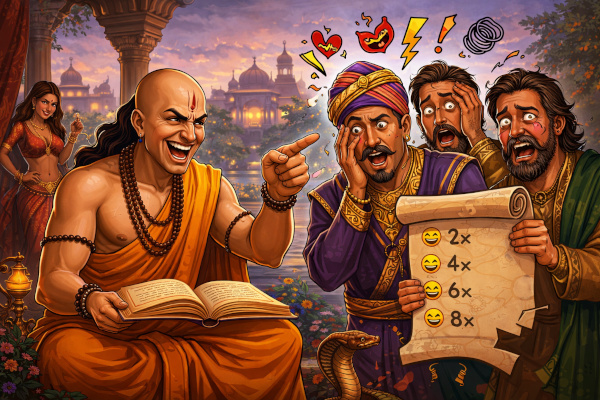
Chanakya does not enter the room gently. He kicks open the door of male overconfidence, walks in with full ancient authority, and announces something that must have caused generations of smug men to sit up, blink twice, and clutch their egos like injured poultry. He says women have twice the appetite, four times the modesty, six times the courage, and eight times the desire. At this point, one can almost hear a room full of self-important men dropping their snacks in spiritual confusion.
What makes the verse so funny is not whether the arithmetic is scientific. Obviously Chanakya was not running a controlled laboratory study with clipboards, data sheets, and three peer-reviewed journals. This is not biology. This is social dynamite. He is exaggerating with purpose, and the purpose is delicious: to mock the male tendency to underestimate women while simultaneously overestimating themselves with the confidence of badly informed peacocks.
For centuries, men have had this touching little hobby of seeing grace and assuming weakness, seeing softness and assuming passivity, seeing modesty and assuming low voltage. A woman sits quietly, speaks gently, lowers her gaze, smiles politely, and immediately some man’s brain begins writing fiction. “Ah yes,” he thinks, “fragile creature, easily understood, probably simple.” Meanwhile Chanakya is in the background coughing theatrically and muttering, “You magnificent fool.”
Because that is really the joke of the verse. Chanakya is saying there is often far more happening beneath elegance than your average man, vibrating with misplaced confidence, is equipped to notice. Appetite? Stronger than you think. Modesty? Deeper than you understand. Courage? Sharper than your imagination allows. Desire? Let us just say Chanakya did not write this verse to comfort the male ego. He wrote it to fold it neatly and place it under a table leg.
The comedy lands even harder because of the order in which he says it. First food, then modesty, then courage, then desire. It starts almost like a domestic observation and ends like a direct assault on centuries of masculine delusion. By the time he reaches the final number, the average overconfident fellow who thought he was the natural emperor of appetite and passion is left looking like a part-time intern in the department of human intensity.
And really, Chanakya’s deeper point is not about numbers at all. It is about hidden force. He is warning men not to confuse composure with emptiness, silence with innocence, or refinement with lack of fire. Civilization has always produced men who look at a woman in control of herself and assume she contains less. Chanakya says the opposite: perhaps what you are mistaking for softness is simply restraint; perhaps what looks like gentleness is actually disciplined power wearing jewelry.
So this verse survives because it is funny, provocative, and gloriously rude to male vanity. Chanakya is not merely describing women; he is teasing men for their chronic inability to read them properly. His message, stripped of all drama, is wonderfully simple: never assume the person speaking softly is operating on low power. Sometimes the calmest presence in the room is the one with the deepest appetite, the fiercest nerve, and enough hidden voltage to turn your confidence into smoke.
You may also like
-
When the Tongue Declares Victory and the Kingdom Quietly Shops Elsewhere
-
Chanakya Niti- Chapter 3
-
Matsya Nyaya: Or, Why Civilization Exists to Stop Large Idiots from Eating Smaller Ones
-
Matsya Nyaya from Chanakya: A Comprehensive Guide to Being Eaten with Professional Courtesy
-
Chanakya Niti- Chapter 2