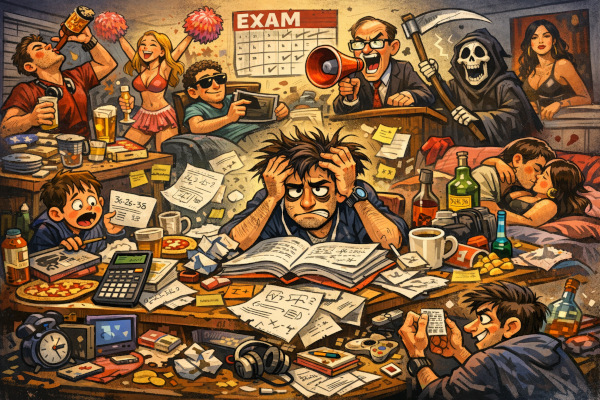
Exams are not tests of knowledge. Let’s get that myth out of the way immediately. Exams are society’s most elegant way of checking whether you can confidently write nonsense on paper for three hours without crying. It is not education. It is performance art under stress.
And every year, without fail, you can see the symptoms. Faces become long. Eyes become hollow. Students begin walking around like unpaid interns in life. At first, I thought it was because IPL cheerleaders weren’t performing up to expectations anymore, but no — it turns out the real tragedy was exams.
Exams are that magical time when students are expected to remember things they have successfully ignored for an entire semester. Topics that had zero relevance to life suddenly become urgent. You are asked to write answers to questions that even the person who set the paper doesn’t fully understand. And if you dare to be original? Congratulations. You will be punished for creativity.
So how does one prepare?
First, you must prepare your environment, because exams are not cleared by studying — they are cleared by convincing people that you are studying. The biggest challenge is not the syllabus. It is your parents, also known as “investors,” who expect returns. To handle them, you must master the constipated face. This is a powerful expression. It hides everything — confusion, laziness, panic, and Netflix schedules. Maintain this face at all times. Walk slowly. Nod occasionally. Look like you are processing complex data, even if you are thinking about biryani.
Next, your room must look like a crime scene of intelligence. Scatter books everywhere. Open the thickest one — nobody reads thick books, but they create respect. Take a few sheets of paper, write random equations that look like you’re about to launch a satellite, and leave them lying around. Keep pens uncapped. Keep a scientific calculator on the table like it’s a Ferrari parked outside your brain. Anyone entering the room should immediately feel like disturbing you is a violation of national progress.
Of course, all entertainment material must be hidden. Movies, games, magazines — keep them out of sight like illegal assets. The trick is simple: look busy, remain useless.
Time management is equally important. You must create a realistic schedule — not for studying, but for catching up on all the movies you missed during the semester. Exams are the perfect time for this, because everyone else is busy pretending to study, which means less crowd in theatres and faster downloads at night. A relaxed mind is key. Experts say take breaks every 30 minutes. I say take a two-hour nap after watching a 30-minute show. Balance is everything.
Now comes the most important rule: know yourself. You are not a scholar. You are a survivor. You have passed exams before using methods that cannot be explained in public forums. Trust that process. Do not suddenly become ambitious. That is dangerous. Instead, refine your skills. Improve handwriting in tiny chits. Upgrade your bluffing technique. Remember — exams are not about knowing the answer. They are about making the examiner doubt themselves.
Then we come to lifestyle choices. Cutting down on your daily “vitamins” — be it sleep, junk food, or questionable habits — will only weaken you. You must stay strong. Alcohol, for example, is known to clear mental cache. It removes unnecessary thoughts like syllabus, fear, and responsibility. Social gatherings are essential. That is where you meet classmates and exchange critical information like “Which movie is worth watching” and “Who actually studied.”
Revision is also important — but let’s not be unrealistic. You must revise all your downloaded content methodically. Organize movies into folders. Test your memory by guessing file names like AVSEQ01.DAT. If you can identify the movie, your brain is functioning at elite levels. As for textbooks, keep them open on your lap, plug in earphones, and allow knowledge to enter through osmosis while you think about life, love, or your crush.
Speaking of crushes, this is where advanced memory techniques come in. If your girlfriend’s name is Paula, highlight every “P” in your textbook. If it’s not Paula, make it Paula. This emotional connection will help you remember absolutely nothing but will feel productive.
Testing yourself is also important. Ask your younger sibling to quiz you. When they fail to pronounce complicated words like “cummingtonite,” laugh at them. Confidence is key. If they feel dumb, you feel smart. This is basic psychology.
Sticky notes are another powerful tool. Write important “formulas” like 36-26-38 and stick them where you can see them. Not because they are useful, but because they give you a sense of purpose. Every time you see them, you will feel like you are on track, even if the track leads nowhere.
Hanging out with friends is essential. Exams are not an individual battle. They are a group confusion event. Meet regularly. Exchange useless information. Avoid serious students — they are dangerous and can cause self-doubt. Remember, talents differ. Some people study. Others have the gift of copying upside down from the front bench.
Combined study is the peak of this entire ecosystem. It is not study. It is a festival. Hosted in the house of that one friend whose parents are away, it begins with good intentions and ends with noise complaints. There will be movies, games, food, drinks, and somewhere in a corner, a book pretending to matter. The session begins with someone shouting, “ARE YOU READY?” and ends with nobody remembering what they were supposed to study.
If anyone mentions exams seriously, they must be neutralized immediately — preferably with snacks or distraction.
When things get tough, ask for help. Not academic help — emotional help. Talk to friends. Talk to Google. Talk to posters on your wall. There is nothing a good internet search or a Monica Bellucci poster cannot temporarily fix.
Finally, always have a backup plan. Not a practical one — an entertaining one. If studies fail, there are many career options that require confidence, creativity, and zero moral hesitation. Politics, for example. A natural upgrade. Or sales. Or anything that involves convincing people of things that are not entirely true — a skill you have already mastered.
And remember to exercise. Not for health, but to maintain the illusion that your life is under control. Walk around. Send texts. Stalk your crush from a safe, non-arrestable distance. Movement is important.
At the end of the day, exams are like a hot person in a crowded mall — everyone is staring, everyone is nervous, and ultimately, it’s every man for himself.
So relax.
You are not alone.
Millions of students are equally unprepared, equally confident, and equally ready to bluff their way into the next semester.
And somehow…
Most of them will survive.
That is the true miracle of education.
“Exams are that magical time when students are expected to remember things they have successfully ignored for an entire semester. “- Sorcerer
You may also like
-
When the Last Peace Meeting Became a Premium-Grade Boardroom Disaster
-
Ashtavakra in the Boardroom: When Talent Threatens the Boss
-
Hanuman and the Perils of Being Too Obedient to Function
-
Matsya Nyaya: Or, Why Civilization Exists to Stop Large Idiots from Eating Smaller Ones
-
Pingalaka: Power, Paranoia, and the Middleman