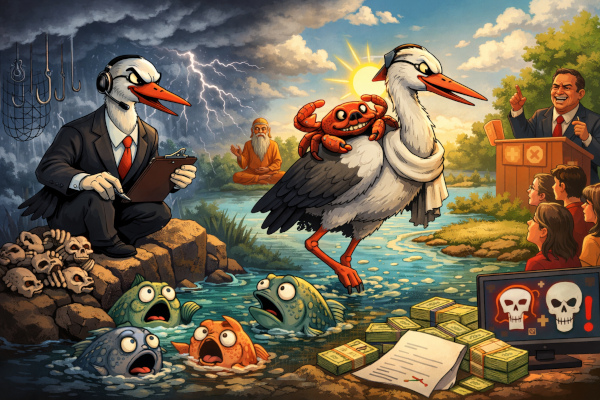
Fear is one of the oldest currencies in the world, and the clever never waste a crisis when they can invoice it.
The crane understood this beautifully.
Age had made him slower, weaker, and less competent at the honest mechanics of hunting. Once, he could seize fish with the clean athletic confidence of a predator doing his job. But time had reduced his speed and sharpened his imagination. Since direct murder now required cardio, he moved into a more sustainable profession: concerned guidance.
So one day he stood by the pond looking devastated.
Not hungry. Not violent. Not dangerous.
Devastated.
This is an important distinction, because the truly skilled exploiter never begins with appetite. Appetite is crude. Appetite alarms people. Concern, however, is elegant. Concern gets invited in. Concern is allowed to sit down and explain things in a low voice. Concern says, “I just want you to be safe,” while quietly measuring the distance to your throat.
The fish, being fish, noticed his theatrical sorrow and asked what troubled him.
Now, a less evolved fraud would have said, “I plan to eat you.” But that lacks finesse. The crane had graduated into the higher arts of manipulation, so he sighed and said he had heard terrible news: fishermen would soon come, drain the pond, cast their nets, and destroy them all.
Panic entered the water at once.
That is the power of fear. It saves manipulators the labor of persuasion. Once people are frightened enough, they begin cooperating with their own exploitation. They stop asking, “Is this true?” and start asking, “How quickly can I obey?”
The fish trembled. Their little watery society collapsed into anxiety, speculation, emotional chaos, and the rapid spread of unverified doom. One imagined hooks. Another imagined suffocation. A third had already mentally died and was discussing the situation with the solemnity of a badly informed television panelist.
The crane watched all this with professional satisfaction.
Then, once terror had ripened properly, he unveiled the second half of the scam: the rescue offer.
He told them there was another pond. Safer. Peaceful. Better managed. He, out of pure compassion, could carry them there one by one.
This is the classic move.
First create fear.
Then offer protection.
Then charge access.
The fish, in their panic, saw no issue with entrusting their entire future to the very beak that had spent years trying to eat them. Because fear has this charming side effect: it turns obvious danger into acceptable leadership. Suddenly the creature who frightened you yesterday becomes “the only one with a plan” today.
So the crane began his humanitarian work.
He lifted one fish gently in his beak, flew off, and ate it on a rock.
Then he returned wearing the expression of a nonprofit founder.
Again and again, he carried them away “to safety.” Again and again, the fish vanished into his digestive system. And each time he returned to the pond looking grave, humble, and burdened by service.
It is difficult to improve on that as a model of public fraud.
He had discovered the perfect arrangement: he no longer had to chase victims. They volunteered. They thanked him. They likely felt guilty for doubting him. Somewhere in his soul, if cranes have souls, he was probably offended by how easy the whole thing had become.
That is the true genius of fear-based manipulation. The victim stops seeing the helper clearly. Once frightened enough, people stop evaluating character and begin evaluating promises. The helper’s motives become irrelevant so long as the helper seems active, informed, and slightly sad.
And then came the crab.
The crab, unlike the fish, had the invaluable habit of noticing things.
He too asked to be rescued, and the crane, bloated with success and self-regard, agreed. Why not? Fraud always becomes sloppy once it starts mistaking repeated success for moral legitimacy.
So the crab climbed on.
As they flew, the crab looked down and saw the truth: bones. Fish bones. Piles of them. A little administrative archive of trust misplaced.
At that moment the entire structure of concern collapsed. The soothing language, the solemn face, the performative burden of service — all of it dissolved into the simple, ancient reality that the crane had merely found a more efficient way to eat frightened people.
And because the crab possessed what the fish tragically lacked — claws and clarity — he ended the arrangement.
The crane died the death all false helpers deserve: exposed halfway through a rescue narrative.
Because that is what the story is really about.
It is about how easily fear makes people kneel before the nearest voice claiming authority.
It is about the predator who realizes that panic is more efficient than force.
It is about the helper who arrives in crisis wearing sympathy like a uniform.
And above all, it is about the humiliating fact that many victims do not get destroyed by enemies.
They get destroyed by solutions.
This story survives beautifully in modern life because the crane never really died. He simply changed industries.
Today he appears whenever people are scared and confused.
He becomes the financial advisor who begins every sentence with “Markets are collapsing,” then sells expensive products to save you from a disaster he narrates with suspicious enthusiasm.
He becomes the wellness fraud who tells you your hormones, gut, liver, sleep, skin, aura, and soul are all in immediate danger, but fortunately his course, powder, consultation package, and ceramic bottle can rescue you.
He becomes the relationship parasite who tells you the world is cruel, people are unsafe, nobody understands you like he does, and therefore your best chance at emotional survival is to trust the exact person rehearsing your dependence.
He becomes the corporate manager who whispers that layoffs are coming, the market is unstable, times are uncertain, and therefore everyone should be grateful for extra work, less pay, more silence, and the rare privilege of being exploited by leadership during “challenging times.”
Same crane. Better tailoring.
The pattern is always identical.
First they identify a fear. Sometimes real, sometimes exaggerated, sometimes fully manufactured.
Then they dramatize it. Urgency is important. If you remain calm, you may start asking adult questions, and that would be terrible for business.
Then they position themselves as the only route to safety.
Then, while you thank them for their guidance, they carry you off in installments and eat your money, dignity, freedom, time, confidence, or peace of mind.
That is why the lesson of the crane is not merely “beware predators.” Predators are obvious. The real warning is this:
Beware the man who profits from your panic and calls it protection.
Because fear is the pond.
The helper is the beak.
And by the time you see the pile of bones, the consultation fee has already been charged.
You may also like
-
The Lake, the Crane, and the Ancient Indian Version of “Please Read the Instructions Before Dying”
-
The Camel, the Lion, the Leopard, and the Jackal: A Corporate Tragedy in the Jungle Division
-
Matsya Nyaya from Chanakya: A Comprehensive Guide to Being Eaten with Professional Courtesy
-
Savitri, Satyavan, and the Day Death Met a Better Lawyer
-
The Mahabharata’s Most Elegant Case of Profile-Based Love