
The Yaksha at the lake episode is basically the Mahabharata doing a painfully accurate group-chat roast of overconfident men even before group chats were invented. The Pandavas are out in the forest, already deep into their exile era, which in modern terms is somewhere between a forced digital detox, a survival retreat, and getting cancelled by fate for no reason. Naturally, everybody is dehydrated, tired, dramatic, and operating on the kind of judgment that usually produces either spiritual growth or a terrible Instagram caption. They find a beautiful lake, the sort of place influencers would now describe as “hidden gem,” “untouched,” and “healing,” right before dropping the location and ruining it forever. But because this is the Mahabharata, the lake is not just a lake. It is, of course, a trap with philosophy.
A mysterious voice, linked to a crane hanging around the water like some deeply unbothered cosmic moderator, says the most basic thing imaginable: stop, answer my questions first, then drink. That is it. One instruction. One boundary. One very manageable condition. And what follows is one of the greatest ancient case studies in elite male incompetence. Nakula arrives first, sees a random supernatural bird issuing life-and-death instructions near water, and instead of thinking “this is suspicious,” he goes with the eternal mindset of people who believe consequences are for civilians. He drinks. Immediately drops dead. No battle music or heroic speech,or low-motion sacrifice with violin in the background.. Just instant collapse because apparently listening was not part of the skill set.
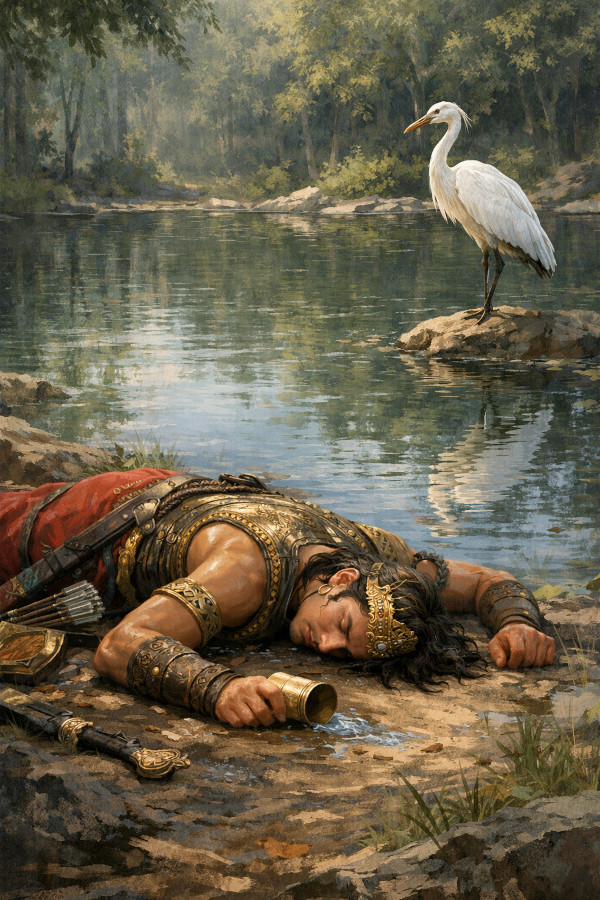
Then Sahadeva comes in, sees his brother lying there like a failed wellness influencer, hears the same warning, and still thinks, yes, but perhaps I personally am exempt from the rules of enchanted lakes. He drinks. He drops too. At this point the story stops being mystical and starts feeling like a thread on social media titled “Men will literally die of supernatural causes instead of following one instruction.” Then comes Arjuna, who is basically the franchise player, the verified account, the blue tick of archery, and he somehow manages to look at two dead brothers, a haunted lake, and a talking crane, and still respond with the confidence of a man who says “I know what I’m doing” moments before becoming a cautionary reel. Down he goes. Then Bhima arrives, whose entire personality is gym rage with mythological credentials, and he reacts exactly how you would expect a man built like a siege weapon to react to metaphysical procedure: by treating it as a personal insult and charging straight into irreversible nonsense. Dead as well. Four brothers. Four losses. Zero learning curve. It is honestly kind of inspiring how committed they are to not adapting.
So now the lake looks less like a sacred site and more like the aftermath of a failed alpha-male retreat. Everyone has been folded by a voice and a hydration boundary. And then Yudhishthira shows up. The eldest sibling. The human equivalent of reading the terms and conditions or instruction labels on a conditioner bottle. He sees the dead brothers, hears the warning, and for the first time in this entire disaster, somebody decides not to act like a motivational podcast with a sword. He pauses. Which in itself is so rare in epic storytelling that it practically counts as a superpower. The Yaksha begins asking questions, and suddenly the entire vibe shifts from “forest emergency” to “civil services interview hosted by a bird.” What is happiness? What is the path? What is the greatest wonder? Imagine being on the edge of dehydration while a crane starts a philosophy podcast and the only way to get water is to become the comments section’s smartest person.
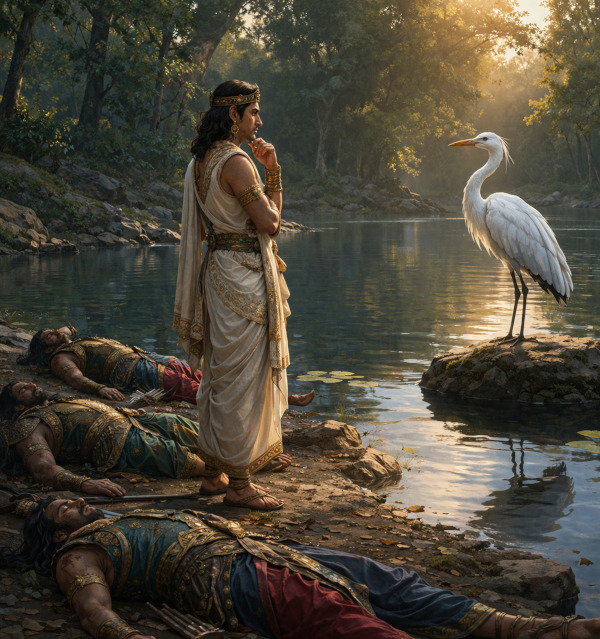
But Yudhishthira, unlike his brothers, does not treat every obstacle as something to be ignored, punched, or dramatically overridden by self-belief. He answers. Calmly. Correctly. Patiently. Which is deeply annoying to action heroes everywhere but very useful when the universe is in one of its “lesson time” moods. And this is where the episode becomes unintentionally hilarious in a very modern way. Because the entire thing is basically four men with elite résumés failing a simple compliance test, and the one sibling with emotional regulation has to come in, fill out the form properly, answer the security questions, and recover the account.
The funniest part is that Yudhishthira’s famous answer about the greatest wonder — that people see others die every day and still live as if they themselves are immortal — is not just profound. In that exact situation, it is also premium family shade. Because, sir, your brothers literally watched the evidence pile up in real time and still chose chaos.
He is essentially delivering a profound lecture on how human beings never learn from death while standing beside four brothers who have just turned themselves into a cautionary dataset at a forest pond. That is not just wisdom. That is a subtweet in Sanskrit.
And then, because this is epic literature and not a public health campaign, the Yaksha is delighted. The brothers are revived. Everybody gets another chance. The mood resets. But the humiliation remains eternal. Because no matter how heroically the story is told, the core event cannot be changed: Ancient India really looked at human arrogance and said, let us represent it with beautiful men dying beside a pond because they refused to read the pop-up.
Which is why this story feels so aggressively current. The Yaksha is every verification screen, every workplace policy, every warning sign, every “are you sure you want to continue?” box humanity has ever ignored with arrogant little taps of the finger. And the Pandavas, for all their greatness, briefly become the patron saints of people who skip the instructions and then act shocked when the app deletes everything. Arjuna is the guy who thinks expertise in one domain means universal immunity. Bhima is the man who believes enough confidence is a substitute for process. Nakula and Sahadeva are those polished, competent people who somehow still walk into obvious disasters because elegance is not the same thing as judgment. And Yudhishthira is the exhausted responsible sibling who did not want this leadership position but keeps getting it because everyone else is determined to turn life into a preventable incident.
So yes, the Yaksha at the lake is a spiritual episode. It is philosophical. It is profound. It is a meditation on wisdom, mortality, patience, and dharma. But it is also, unmistakably, the oldest surviving story of a group project collapsing because nobody wanted to follow instructions and one overworked, emotionally literate person had to salvage the situation through competence. Which means the Mahabharata, in its majestic ancient way, understood something social media has also taught us: being talented is nice, being strong is useful, being iconic is great for engagement, but if you cannot pause, listen, and answer the universe will humble you in front of everybody.
You may also like
-
The Camel, the Lion, the Leopard, and the Jackal: A Corporate Tragedy in the Jungle Division
-
Matsya Nyaya from Chanakya: A Comprehensive Guide to Being Eaten with Professional Courtesy
-
Savitri, Satyavan, and the Day Death Met a Better Lawyer
-
The Mahabharata’s Most Elegant Case of Profile-Based Love
-
Fear, For Sale – The Business Model of Fear