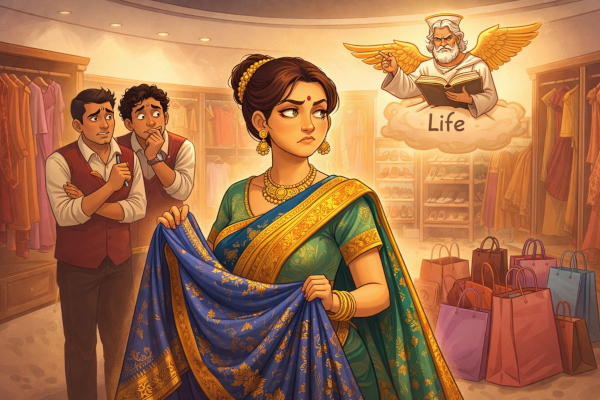
Life has a charming way of teaching you survival lessons when you least expect it. Not the noble kind involving mountain climbing, bear attacks, or escaping a sinking ship. No. I’m talking about the kind that sneaks up on you on a peaceful Sunday afternoon when you are quietly eating lunch and minding your own business like an innocent civilian in a war movie.
There I was, heroically suffering through a plate of aggressively green food, trying to separate green chillies from the rest of the leafy suspects before they launched a militant uprising in my stomach. It was delicate work. Surgical, even. At that exact moment, my phone started vibrating on the table with the emotional persistence of a three-year-old denied ice cream. It kept blinking at me as if to say, “Pick me up. Pick me up. Your peace ends here.”
I answered.
“Are you free this afternoon?” came a familiar voice.
Now, that is never a harmless question. No friend in the history of friendship has ever called and asked, “Are you free this afternoon?” and then followed it with something pleasant like “I found a suitcase full of money and want to divide it fairly.” No. This sentence is always the opening line of a disaster.
Still, I said yes, because apparently my ancestors did something terrible and I am now paying off the karmic debt.
“I need your expert advice,” he said. “I’ll come pick you up. We need to go to Calicut.”
Expert advice. That phrase landed on my head like a falling cupboard. This is the problem with appearing moderately intelligent and watching too many nature documentaries. People start assuming you are a specialist in everything. Animal migration, foreign policy, plumbing, emotional trauma, tyre pressure, quantum mechanics, gift shopping. Suddenly you are not a man anymore. You are a public utility.
This friend, by the way, has been with me since childhood. In our circle, he was less a friend and more a community experiment. If something needed to crash, explode, sink, or fail spectacularly, he was our test subject. Yet somehow he had grown into adulthood carrying the same calm confidence of a man whose IQ had once been left out in the rain and never fully recovered.
Within half an hour, we were on the road.
“So,” I asked, “what exactly requires my expert advice?”
“I need to buy something for my girlfriend,” he said. “An Onam gift.”
I turned slowly and stared at him.
“Onam was yesterday, you magnificent buffalo. Are you buying for this year or preparing emotionally for the next one?”
He ignored the insult with the serene stupidity of a monk and continued. “Something useful.”
That narrowed it down beautifully. Useful could mean anything. A book. A pen. A kitchen mixer. A chainsaw. A medieval shield. The man was giving me nothing.
After several rounds of interrogation that would have impressed international intelligence agencies, the truth finally emerged.
He wanted to buy her clothes.
Clothes.
For a woman.
And he wanted me to help.
I nearly demanded that he stop the car and let me roll into traffic.
Men are not built for this mission. Women’s clothing is not shopping. It is advanced applied mathematics mixed with astrology, geometry, emotional archaeology, textile diplomacy, and the occult. There are sizes, cuts, fits, fabrics, shades, silhouettes, patterns, necklines, shoulder lines, and mysterious codes clearly designed by people who hated men and wanted them to suffer before witnesses.
He tried to calm me down. “We’ll just go in, grab the first thing, pay, and leave. Five minutes.”
This was the kind of lie people tell before the opening credits of a horror film.
By the time we entered the mall, my soul had already started drafting its will. The women’s section stood before us in all its glory — endless racks, endless colours, endless choices, all arranged in a way that suggested no man had ever entered and come out unchanged.
I asked the most important question. “Do you at least know her size?”
He nodded with the confidence of a man about to ruin several lives.
“Yes. Thirty-six C.”
I froze.
“Thirty-six C?” I whispered. “That is not a clothing size. That is classified information.”
He looked offended. “Women use a different metric system.”
Of course they do. Naturally. Why would humanity ever choose one simple system when it could invent separate numerical languages just to watch men sweat in public?
We found a blue top he liked. Blue, apparently, was the big romantic vision. He checked the tag.
“It says 28 slash L.”
Wonderful. We had gone from ordinary confusion to algebra. Somewhere in the mall, Pythagoras began laughing in his grave.
As fate would have it, a group of college girls nearby had already noticed us. They were watching the two of us the way people watch monkeys trying to use cutlery. My friend and I, however, pressed on with the grim determination of soldiers who know they are doomed but would still like a receipt.
Eventually we summoned a sales assistant.
“What size are you looking for?” she asked politely.
My friend, with the confidence of a man setting fire to his own trousers, said, “Thirty-six C.”
Her expression changed instantly. Her face opened like a theatre curtain. I could actually hear the internal laughter trying to claw its way out.
Trying to rescue the situation, I jumped in. “Errr..that ..that is the size of her jeans.Aint it?“
He nodded enthusiastically. “Yes. Thirty-six… C.”
I watched the sales girl’s face perform an entire opera. Her expression flickered through confusion, realization, restraint, and the visible struggle not to laugh directly into our souls. She deserved an award. A pension. Government land.
The sales assistant, determined to salvage some fragment of order, asked for more practical measurements. Shoulder width, maybe. Something remotely useful. My friend, now functioning like an overheating robot, announced, “Fourteen inches shoulder to shoulder.”
And that, somehow, became our operating system for the next two hours.
Two hours.
Two full hours of watching trained professionals measure tops while we wandered behind them like confused archaeologists decoding an ancient textile civilisation. Blue tops came and went. Navy, sky blue, deep blue, almost-blue, blue with regret, blue with lace, blue that looked expensive, blue that looked dangerous. At some point, a second sales assistant was summoned, as though the situation had escalated beyond normal retail protocol and now required reinforcement.
By then I was sure we had become the entertainment for the entire staff. Somewhere in the back room, tea was being poured and our story was being retold under the title “The Two Donkeys of Section B.”
At last, after enough inspection to qualify as an audit, my friend chose a blue top.
As we walked out, I finally understood why women take so long to shop. This was not indecision. This was systems engineering. Buying women’s clothing involves more variables than a pre-flight inspection of an Airbus. At least airplanes come with manuals. Here, we had only fear and shoulder width.
Back in the car, my friend stared at the packet and asked, “What if it’s too tight?”
I looked at him with the emotional exhaustion of a retired war correspondent.
“Message her this,” I said. “‘Either the dress fits, or destiny is asking you to become fitter.’”
He thought about it seriously. “We improvise, right?”
I sighed. “There is always scope.”
After a long silence, he said, “We should have bought her a sari.”
And there it was. The truth. The answer. It was the kind of wisdom that shows up after the fire, holding a bucket and a thoughtful expression.
A sari.
The glorious diplomatic solution. One size, infinite forgiveness, no algebra, no public humiliation, no sales staff trying not to laugh in your face.
If life had a curriculum, that day’s chapter would have been called “Consequences.” The main lessons: five minutes in a mall means geological time, guessing women’s sizes is a form of assisted suicide, and the sari remains civilization’s most reliable emergency response system as a gift.