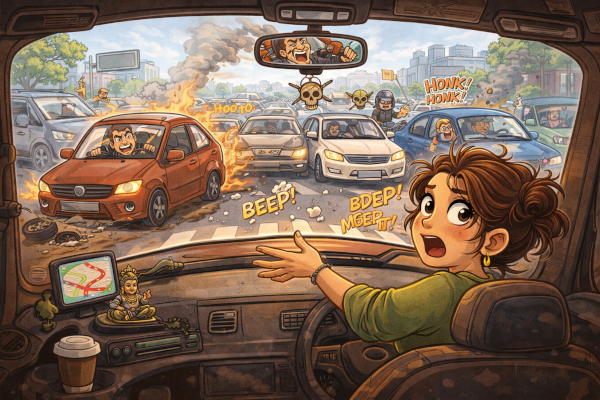
This is a purely educational and motivational article, written in the noble spirit of public welfare, social upliftment, and preventing traffic lights from dying in vain. It is not biased against any gender, species, engine type, gearbox preference, or level of emotional instability. It merely seeks to serve humanity by addressing one of the great modern crises: people operating motor vehicles with confidence vastly disproportionate to their talent.
For years, I have seen jokes, memes, whispered prayers, and dashboard-level panic surrounding bad driving. Entire civilizations have risen and fallen with more grace than some people show while reversing out of a parking space. And I thought to myself: enough. Why should society merely complain? Why not contribute? Why not educate? Why not stand boldly at the edge of reason and publish a guide so breathtakingly irresponsible that future historians will cite it as the exact moment common sense packed a suitcase and left?
So here we are.
This is a humble attempt to explain the fine art of driving to those who approach the automobile the way a goat approaches a typewriter: with curiosity, optimism, and no clear plan for what happens next.
Perhaps you are someone who has spent years in the passenger seat, issuing spiritual guidance like “slow down,” “careful,” and the timeless classic, “oh my God what are you doing.” Perhaps you have sprinted behind buses, cursed auto drivers, judged strangers at signals, and decided that the time has come to take control of your destiny. Or perhaps you simply woke up one morning and thought, “How hard can it be?” — a sentence that has historically preceded explosions, divorces, and new government regulations.
Let us begin.
The first step in learning to drive is mental preparation. Empty your mind of fear, caution, and any lingering respect for infrastructure. A car, at its core, is a large metal object designed to convert fuel into motion and motion into consequences. People may tell you it is a machine. That is technically true. But it is also a confession booth, a vanity mirror, a mobile argument chamber, a snack storage unit, and, for some, a heavily air-conditioned mistake.
You may feel the urge to bond with the vehicle. This is natural. Human beings name ships, storms, dogs, and WhatsApp groups. You may therefore name your car as well. Just understand that once you do, it stops being transport and becomes a family member — which means you will defend its scratches, blame others for its behavior, and insist that it has “never done this before” while smoke rises from under the bonnet.
Getting into the car is itself a journey. First, you must locate the keys. These will not be in the place where keys belong, because that would insult the ancient household tradition of creating chaos and then calling it memory. The keys may be in a handbag, another bag inside the handbag, a side pocket, a secret zip compartment, yesterday’s jeans, or in the hand of the one person currently not answering their phone. This is a sacred ritual. Do not rush it. Fumbling for keys is how the universe tests whether you are emotionally fit to command two tons of engineered impatience.
Once the keys have been recovered after a search operation involving facial tension, accusations, and the reopening of the same pocket eight times, stand beside the car and take a moment. Look at your reflection in the window. This is important because the car journey may end in enlightenment, humiliation, or a small insurance conversation, and you deserve to enter it looking prepared. Adjust hair. Reassess life. Open door.
The first thing you will notice upon entering the car is the smell. Every car has a smell. Some smell of air freshener trying heroically to overpower old upholstery, petrol memory, and unresolved masculinity. Some smell like coconut perfume sprayed over stale regret. Some smell like ten years of family arguments preserved in fabric. Breathe it in. This is the scent of ownership and impending responsibility.
Now let us discuss the internal layout of the beast.
There is the driver’s seat, which is the throne from which your judgments shall be issued. There is the front passenger seat, meant for one of three categories of people: the navigator who is wrong with conviction, the relative who brakes with their soul, or the friend who says “go go go” during impossible turns and then vanishes when the damage report arrives. Behind these lies the rear seat, a magical zone where children fight, adults offer unwanted advice, and shopping bags slide around like they too are trying to escape.
In front of you is the steering wheel, the circular reminder that all major life decisions come back to hand control. Turn it, and the car turns. Turn it too much, and destiny becomes decorative. Behind or around it you will see an instrument cluster full of dials and symbols. These are not suggestions. They are the car’s way of communicating distress before it escalates to performance art.
Near your feet are the pedals. These are the true exam. One makes the car move, one makes it stop, and, in manual cars, one exists solely to ensure that driving remains inaccessible to the arrogant. The accelerator invites disaster with enthusiasm. The brake exists as apology. The clutch is there to remind you that machinery, like marriage, requires timing, coordination, and occasional forgiveness.
In the middle sits the gear lever, standing there with the self-importance of a minor official in a district office. Respect it. Do not yank it around as if trying to uproot a vegetable. It has a purpose. It is not a sword in a fantasy film. It is not a stress toy. It is not there for spontaneous experimentation.
The mirrors deserve special mention because humanity has never fully agreed on what mirrors are for. Officially, they help you see traffic around and behind you. Unofficially, they become sites of self-reflection, suspicion, and emergency grooming. The rear-view mirror is not there to admire your own face at a red light for long enough to miss the green. The side mirrors are not instruments for composing a heroic profile shot. They are there so you can monitor the vehicles you are about to inconvenience.
Seat belts must also be acknowledged. The seat belt is modern society’s way of saying, “We know exactly what happens when confidence meets velocity”. It is not fashion-friendly. It is not glamorous. It occasionally crumbles your clothes in ways that feel personally insulting. It remains one of the few things preventing your face from learning the exact geometry of the steering wheel. Wear it.
Then there are the mysterious buttons and knobs — those glittering temptations spread across the dashboard like bait for the overcurious. Some control air, some control sound, some control light, and some appear to have been installed by engineers on a dare. Press them cautiously. Many a peaceful journey has been transformed into a documentary on human panic because someone “just wanted to see what this one does.”
The horn, however, is where civilization truly reveals itself. Officially, the horn is a warning device. In practice, it has evolved into an entire language. There is the polite tap, the offended stab, the sustained blast of moral outrage, the nervous little double-beep, and the majestic, extended honk used by people who seem to believe traffic can be bullied into metaphysical obedience. Use it wisely. Or use it emotionally like everyone else.
Indicators are theoretically meant to announce intent. In a just society, they would be used before turning, changing lanes, merging, or performing any act that forces others to react. But we do not live in such a society. We live among people who use indicators only after the maneuver, during the maneuver, by accident, or continuously for eight kilometers while spiritually absent. Do better. Or at least fail with style.
Now we come to the moment of ignition. This is the ceremonial awakening of chaos. Put the key in. Turn. The engine coughs, shudders, growls, and then settles into that faint vibration which says, “Fine. I suppose we’re doing this.” At this stage, many beginners experience a surge of false confidence. This must be contained immediately. The car starting does not mean you can drive, any more than owning a pen makes you a novelist.
Ease the vehicle into motion. Do not leap off the line like you are escaping tax fraud charges. Let the machine move. Feel the weight of it. Understand that from this point onward you are no longer a pedestrian with opinions. You are now a mobile administrative problem.
Driving itself is a blend of skill, prediction, emotional restraint, and sustained disappointment in others. You must observe the road, pedestrians, animals, potholes, cyclists, delivery riders, buses behaving like territorial deities, and that one man on a scooter carrying six mattresses and a loose sense of mortality. You must assume that everyone else is either distracted, furious, overconfident, undertrained, or all four at once. This is not paranoia. This is defensive driving.
You may be tempted to admire scenery, answer messages, adjust playlists, conduct video-worthy emotional conversations, eat snacks, or live an entire second life while operating the vehicle. Resist. A moving car is not a drawing room, beauty parlour, therapy couch, karaoke booth, dining table, or stage for content creation. You are not “multitasking.” You are becoming evidence.
Parking, too, is a spiritual chapter. Parking is where swagger goes to die. On the open road, anyone can pretend competence. But place them before two white lines and suddenly the soul leaves the body. Reverse parking, especially, has broken stronger minds than war. It requires geometry, restraint, patience, and the ability to accept that the car has dimensions beyond your optimism. There is no shame in adjusting. There is only shame in pretending you nailed it while the vehicle sits diagonally like it was abandoned during an earthquake.
And let us not forget road etiquette, that fictional concept whispered about in license offices and ignored at roundabouts. Good driving is not merely the ability to move. Even landslide can move!!!. Good driving is the ability to move without making strangers invent insults for you on the spot. It means giving way, staying alert, not blocking intersections, not weaponizing high beams, not treating lanes like abstract art, and not behaving as though the road is ancestral property granted to your bloodline by divine decree.
In conclusion, driving is not about domination. It is not about ego. It is not about proving a point to traffic, relatives, exes, school batch mates, or that one man in a hatchback who revs at signals like he’s one audition away from starring in Fast & Delusional. Driving is, in theory, a simple, elegant concept: you begin at one place, you arrive at another, and ideally, you do not feature in a WhatsApp forward by evening.
And yet, humanity—bless its consistent lack of restraint—has transformed this basic act into a full-blown festival of impatience, a parade of vanity, and a contact sport for people who believe indicators are optional and lanes are a philosophical suggestion. Roads are no longer pathways; they are emotional battlegrounds where logic comes to die, and horns are used less as signals and more as personality traits.
But take heart. This chaos, while impressive, is not irreversible. With a little less ego, a little more awareness, and a basic understanding that the accelerator is not a personality test, we might yet return driving to what it was always meant to be: a mildly stressful activity, not a live-action documentary on human overconfidence.
Drive carefully. The road is already crowded with people who thought they were the exception.
“A car, at its core, is a large metal object designed to convert fuel into motion and motion into consequences. “- Sorcerer
You may also like
-
When the Last Peace Meeting Became a Premium-Grade Boardroom Disaster
-
Ashtavakra in the Boardroom: When Talent Threatens the Boss
-
Hanuman and the Perils of Being Too Obedient to Function
-
Matsya Nyaya: Or, Why Civilization Exists to Stop Large Idiots from Eating Smaller Ones
-
Pingalaka: Power, Paranoia, and the Middleman