Alcohol is one of humanity’s greatest inventions, which is impressive, because humanity has also invented antibiotics, the wheel, and online food delivery. Yet somehow, fermented regret in a glass still holds its own.
Across civilizations, across continents, across income groups, alcohol has enjoyed one consistent reputation: it is the liquid that convinces otherwise ordinary people that they are charming, profound, athletic, multilingual, desirable, musically gifted, and fully capable of making excellent decisions at 1:47 a.m.
None of this is true, of course.
But alcohol has never been burdened by facts.
It is sold in pubs, bars, clubs, lounges, restobars, rooftops, terraces, dens, and other architecturally expensive environments specifically designed to separate people from their money, balance, and self-respect. Inside these establishments, highly trained professionals known as bartenders pour colorful liquids into glasses and watch, with the detached wisdom of battlefield surgeons, as human beings slowly devolve from taxpayers into content.
Alcohol is not a drink. Alcohol is an event. A ritual. A slow chemical coup against judgment. It enters the bloodstream like a motivational speaker and immediately begins firing the competent staff inside your brain.
First to go is caution. Then dignity. Then grammar.
And then the magic begins.
One of alcohol’s most beloved features is that it makes people believe they look stunning. Not just decent. Not just acceptable in dim lighting. No. Stunning. A person who, ten minutes earlier, looked like a man returning from a failed insurance seminar now stares into the mirror with the smoldering intensity of a perfume model who has known betrayal, velvet, and European train stations. Eyes half-closed. Shirt two buttons too optimistic. Chin tilted like a king with sinus trouble. Suddenly he is not Prakash from payroll. He is an exotic menace. A dangerous, tender storm in loafers.
This transformation happens entirely in his head, which is fortunate, because nowhere else is it visible.
Alcohol also gives confidence — not healthy, measured confidence, but the kind usually found in dictators, startup founders, and men who have watched one YouTube video on body language. Under its influence, people begin to feel they are under performing society by not immediately taking center stage in every room they enter.
A shy man who says “sorry” to chairs when he bumps into them sober will, after three drinks, lean back, widen his stance, and speak about life as though he personally drafted the Constitution. He will put one hand on a friend’s shoulder and say things like, “Bro, listen to me. You don’t understand your own value.” This from a man who, two hours earlier, was unable to ask a waiter for extra chutney without emotional preparation.
Then comes dancing.
No scientific institution has yet found a polite way to describe what alcohol does to the human skeleton. It appears to remove all rust, all shame, and most major structural supervision. Knees begin making independent policy decisions. Hips discover federal autonomy. Shoulders start behaving like they have escaped captivity. Men who normally walk like staplers suddenly begin rotating like devotional ceiling fans. Women who were merely tapping their feet become celestial forces of rhythm while nearby men, inspired by false hope, attempt movements that look like they are trying to unhook an invisible bra from the air.
This is why dance floors are important. They contain the damage.
Without them, society would collapse into spasms.
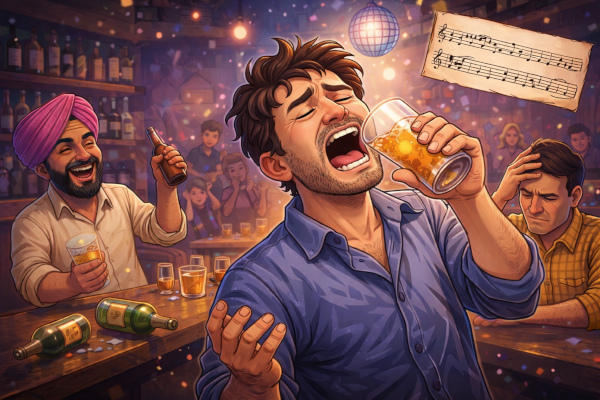
And then there is singing. Ah yes. Alcohol and singing: one of civilization’s longest-running hate crimes against melody.
When sober, most people know their limits. They know, for instance, that their voice sounds less like Arijit Singh and more like an auto-rickshaw struggling uphill. Alcohol destroys this valuable self-knowledge. Suddenly, every person with a pulse believes they have been silenced by the music industry. They hold a glass like a microphone, close their eyes, and begin singing from the deepest wound in their soul — often in the wrong key, wrong language, and wrong century.
A drunk singer never sings at a room. He sings through it, like a spirit seeking revenge.
What comes out may resemble pain, weather, or a goat defending its property, but in his mind it is velvet. Pure velvet.
Alcohol also has a remarkable ability to manufacture romance where none existed. It is Cupid in a bottle, except Cupid is drunk, cross-eyed, and working without a permit. Under its influence, people begin finding each other breathtaking for reasons that would never survive a sobriety review. A face that in daylight might have prompted no more than a nod now appears bathed in soft cinematic light. A laugh becomes irresistible. A shoulder brush becomes destiny. A person chewing ice becomes a sensual event.
The entire bar starts looking like a casting call for poor decisions.
This is particularly dangerous because alcohol does not simply make other people more attractive — it also makes you believe that you are now a realistic option for them.
A man with the emotional subtlety of a broken mixer grinder will smooth down his shirt, widen his nostrils, and decide that the woman at the next table is “definitely giving signals,” when in fact she is just trying to locate the washroom. He will interpret eye contact, body language, silence, weather patterns, and possibly municipal lighting as encouragement.
Alcohol is not a wingman. Alcohol is a fraud consultant.
It also turns ordinary conversations into international diplomacy. A man who cannot order lunch clearly in his mother tongue will, after four pegs, begin speaking English in an accent that appears to have been assembled from Dubai airport, two seasons of Netflix, and one emotionally charged cab ride through Kochi. Consonants go missing. Syllables begin reclining. Every sentence acquires mysterious imported confidence.
“Brooo, lisshen, honestly speaking basically, life eesh not that shimple, okay?”
No, it is not. Particularly now.
Then comes philosophy. This is unavoidable.
Alcohol makes everyone deep. Not actually deep, of course. Just wet and repetitive. But in the moment, drunk people are convinced they are delivering civilization-saving insights. They begin addressing ancient subjects such as love, betrayal, friendship, God, corruption, loneliness, capitalism, climate change, why Rohit should not have married Sneha, and whether dogs understand regret.
This happens usually at a volume suitable for public announcements.
One hand will be raised. One eyebrow will be half-functional. Then the sentence will arrive:
“Bro, at the end of the day… what is life?”
This question is never asked by a Nobel laureate or a monk in a cave. It is always asked by a man named Jijo standing outside a bar, holding one sandal, sweating through a printed shirt, and trying not to lean on the moon.
Alcohol also creates temporary emotional literacy. Men who have not expressed affection since the invention of cable television suddenly become fountains of tenderness. They clutch their friends by both shoulders and say, with the trembling sincerity of war survivors, “Machaa… you know I love you, right?” They begin apologizing for things nobody remembers. They forgive enemies. They praise school friends. They remember a tuition teacher from 2004 and go silent for five minutes.
Meanwhile, another fellow is crying near a parked scooter because somebody played an old song and his liver has apparently unlocked archival storage.
And let us not forget texting — the midnight cremation ground of dignity.
Alcohol has ended more self-respect through mobile phones than any military conflict in recent history. It gives people the dangerous illusion that now, at last, after years of silence, ambiguity, and failed closure, is exactly the right time to message an ex and say, “Hey… was jusht thinking about you.” Nothing good has ever followed this sentence. Civilizations have collapsed more gracefully.
The drunk texter becomes many things at once: poet, historian, victim, reformer, and part-time ghost from the past. He reopens chapters that even God had archived. He types with one eye closed, misses half the keypad, and still believes he is crafting literature. Somewhere in another part of the city, a sleeping woman wakes up, looks at her screen, and says the most powerful sentence in the modern language:
“What the hell now?”
Alcohol is also one of the few substances that can make a person believe a fight is an excellent idea.
A man weighing the moral equivalent of a folded bedsheet will walk up to a bouncer shaped like a wardrobe and say, “Do you know who I am?” Sir, nobody does. Least of all you, currently. But there he goes, chest out, jaw set, soul outsourced to ethanol, ready to be folded into a respectful geometric shape by reality.
And yet, for all this destruction, alcohol remains astonishingly versatile. It can turn some people poetic, some people horny, some people affectionate, some people violent, and some people into furniture. Entire personalities emerge from nowhere. A quiet chartered accountant becomes a nightclub philosopher. A software engineer becomes a Punjabi wedding cannon. A gym trainer becomes a tragic singer. One fellow removes his shirt and starts explaining cryptocurrency to a potted plant. Another sits on the pavement eating shawarma with tears in his eyes, whispering, “This is the best thing I have ever tasted,” as though he has discovered love in mayonnaise.
Then, of course, comes the morning.
The hangover.
The bill.
The forensic reconstruction.
A hangover is not merely pain. It is accountability entering the body without knocking. It is your organs forming a union and filing a joint complaint. Your tongue feels like an abandoned carpet. Your skull sounds rented. Your stomach behaves like it has been personally insulted. Even light seems arrogant. Sound becomes violence. Memory appears only in fragments: a laugh, a toilet, somebody saying “bro don’t,” a receipt, a traffic cone, deep emotional honesty with a stranger named Vinod.
You wake up with the expression of a man who has survived a failed coup.
Then comes the phone check. This is modern judgment day.
You unlock your screen with trembling fingers and discover seventeen sent messages, four missed calls, two blurry selfies, one video in which you are either dancing or resisting arrest, and a photo of your own forehead for reasons known only to the demon that briefly possessed you at 12:56 a.m.
And that is when alcohol completes its circle.
The same liquid that made you feel like a panther the previous night now turns you into an apologetic amphibian with acid reflux.
Still, people return to it.
Weekend after weekend.
Birthday after birthday.
Breakup after breakup.
Salary credit after salary credit.
Why?
Because alcohol offers something few institutions can: affordable delusion. It rents out temporary versions of ourselves — braver, hotter, funnier, looser, louder, more sentimental, more shameless — and for a few hours we get to live inside the badly lit myth of who we wish we were.
It is, in that sense, less a beverage and more a theatrical device.
A liquid costume.
A chemical lie with excellent marketing.
So let us stop pretending alcohol is just a drink.
Alcohol is an amplifier of idiocy. A sponsor of poor timing. A lubricant for bad decisions. A performance enhancer for karaoke, crying, flirting, overconfidence, and public collapse. It has caused first kisses, last warnings, surprise friendships, broken washbasins, heroic speeches, unheroic vomiting, and thousands of heartfelt declarations that should never have left the liver.
It does not reveal the real you.
That line is too generous.
What it reveals is the version of you that should be kept under observation.
“A drunk singer never sings at a room. He sings through it, like a spirit seeking revenge.” – Sorcerer
You may also like
-
Decluttered House, Same Emotional Hoarder
-
The Lake, the Crane, and the Ancient Indian Version of “Please Read the Instructions Before Dying”
-
The Camel, the Lion, the Leopard, and the Jackal: A Corporate Tragedy in the Jungle Division
-
Matsya Nyaya from Chanakya: A Comprehensive Guide to Being Eaten with Professional Courtesy
-
Savitri, Satyavan, and the Day Death Met a Better Lawyer