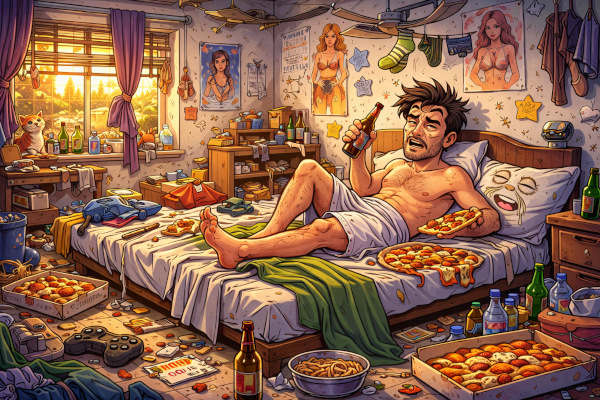
A bachelor is what happens when a man is left alone long enough for discipline to die, hygiene to become theoretical, and common sense to be replaced by improvisation. He is not a domestic being. He is a cautionary documentary. Society looks at him and says “failure,” but society is usually led by married people who haven’t slept properly in years and think buying curtains together is romance. A bachelor, on the other hand, lives in the final republic of personal freedom — a lawless state where there is no constitution, no accountability, and no one asking why there is a sock on the fan. Bachelorhood is God’s way of showing what Eden might have looked like if Adam had discovered beer, instant noodles, and broadband. It is innocence, yes, but the kind of innocence that leaves pizza boxes under the bed and calls it “storage optimization.”
In his natural state, a bachelor wears very little, partly because he is free, partly because laundry has become an ideological issue. The towel around his waist is not a garment but a diplomatic arrangement between shame and airflow. If it holds, civilization survives for another day. If it slips, then let history record that he died as he lived — under prepared and overconfident. He moves around his room in this state of soft collapse, pale and under-motivated, absorbing sunlight like a lizard with internet access. He calls it being close to nature. The neighbors call it “please shut the curtain.” Inside the bachelor’s residence, clothing is not worn because of modesty; it is worn only when the furniture becomes uncomfortably honest.
The bachelor’s room itself is a museum of arrested development. The walls are decorated not with taste, but with evidence. There are posters of women dressed in what can only be described as fabric rationing. There are mosquito kill marks like ancient cave paintings, each one a triumph of bloodlust and boredom. There are strange sketches done during phone calls, bottle caps that nobody remembers keeping, and footprints on walls that suggest either artistic ambition or a failed attempt to remove a lizard. Somewhere there will be a random glamorous poster from ten years ago, curling at the edges, hanging on through dust, humidity, and the collapse of empires. The room says many things, none of them reassuring.
The bed is the unquestioned center of power in a bachelor’s kingdom. It is not merely a bed. It is a chair, a dining table, an office, a library, a laundry segregation unit, a grief-processing center, and, in rare moments of reckless optimism, a site of imagined romance. Everything the bachelor truly needs must be within arm’s reach of this sacred rectangle — phone, laptop, remote, snacks, charger, bottle, stale hope. If he has to actually get up to fetch something, then either the system has failed or life is no longer worth living. The pillow often smells like sleep deprivation and emotional damage. The bedsheet may have once been white but now exists in a philosophical grey that no detergent can explain. A bachelor does not own linen; he owns layers of biography.
His relationship with clothes is even more disturbing. Married men wash clothes because they fear judgment. Bachelors rely on science, specifically the highly advanced field known as Smell-Based Decision Making. The process is elegant in its horror: pick up item, sniff cautiously, recoil if necessary, and classify as either wearable, almost wearable, or suitable only for use during a power cut when no one will come near. Jeans, in particular, enjoy complete diplomatic immunity. They are never really dirty, only “lived in.” A tear is not damage but ventilation. A stain is not filth but character. Matching socks are considered a symptom of spiritual defeat. A bachelor will wear one black sock and one thing that may once have been blue and call it confidence. He does not dress to impress. He dresses because society insists.
Washing clothes, when it finally happens, is never an act of habit. It is an act of war. Usually this occurs because every usable garment has crossed the line from “questionable” to “possibly sentient.” The bachelor then approaches the bucket like an underfunded scientist. Water goes in. Detergent goes in. Clothes go in. Then he stirs it with a stick as if brewing a village curse. If he is especially lazy, he simply wears the dirty clothes into the shower, thereby cleaning both himself and the outfit in one deeply concerning maneuver. He will call this efficiency. Future archaeologists will call it despair. Drying the clothes is another branch of madness altogether. Chairs become drying racks. Window grills become textile departments. Towels hang from doors like surrendered flags. Socks rest on tube lights as though this were endorsed by electrical engineers. Somewhere in the room, a pair of underwear will always be drying in a place that forces visitors to reconsider the friendship.
The bathroom is where the bachelor’s genius becomes criminal. He believes in multi-purpose products because he is too lazy for categories. Shampoo is not a hair product; it is an entire value system. It can become soap, face wash, body wash, toilet-side philosophy, laundry detergent, and in moments of extreme collapse, even something dangerously close to toothpaste. The soap itself is always dissolving in a puddle, reduced to a slimy relic floating in a dish of its own failures. The mirror wears the fingerprints of ancient grooming attempts. The bucket contains memories. Yet from this damp and morally unstable chamber emerge the bachelor’s greatest thoughts. All false confidence begins in a bathroom. Every man who has looked into a stained mirror and thought, “Still got it,” despite overwhelming evidence to the contrary, has participated in bachelor civilization.
Cooking in a bachelor’s life is less cuisine and more tactical survival. He can create miracles with eggs, noodles, leftover rice, and the conviction that chili powder can fix most mistakes. He does not cook meals; he manufactures emergencies into edible form. Anything that can be made in one pan qualifies as culinary excellence. If free food is offered, he accepts it with the reverence of a pilgrim receiving sacred ash. If beer is available, it becomes both beverage and emotional support. Nutrition, in bachelor life, is a rumor spread by people with storage containers. He knows the number of every delivery place in a three-kilometer radius better than he knows his blood group. At 2 a.m., he can order fried chicken with the precision of a military commander under fire.
A bachelor also develops very specific forms of knowledge, none of them academically useful. He knows which movie theatres to avoid when on a date because ticket prices can murder a month’s budget faster than heartbreak. He knows which friend owns a bike, which cousin can lend cash, and which terrace offers the best vantage point to observe the neighborhood under the pretense of “getting fresh air.” He can bluff through any topic under the sun with terrifying authority. Politics, cinema, economics, cricket, climate change, ancient philosophy — all are fair game as long as he begins with “According to me” and ends with something vague enough to escape accountability. He has read headlines, half-heard podcasts, and built an entire worldview out of parking lot conversations. He is wrong often, but never uncertain.
Romantically, the bachelor is a creature of both courage and delusion. He flirts with the shameless optimism of a man who has not yet paid school fees for anyone. He believes eye contact is chemistry, politeness is destiny, and one reply with a smiley is practically a wedding rehearsal. He must flirt, because bachelorhood comes with the terrible awareness that one day, if he marries, all this free-range stupidity will become archived memory. So he throws himself into bad conversations, absurd risks, and small humiliations with the enthusiasm of a gambler who knows the casino is closing soon. Rejection does not kill him. It merely gives him material. Every failed flirtation becomes a story, and stories are the only assets bachelors appreciate more than discounts.
The real comedy, though, lies in the emotional weather of bachelorhood. For all his filth and nonsense, a bachelor is often a deeply sentimental animal. At night, when the room is quiet and the charger only works if bent at a specific angle, he becomes philosophical. Suddenly he remembers old crushes, broken friendships, unreturned calls, and opportunities that expired while he was pretending not to care. Then come the dangerous impulses — the late-night messages, the theatrical declarations, the “hey, just remembered you” disasters that have embarrassed entire generations of men. A bachelor can spend all day acting like a pirate and all night feeling like an abandoned poet in a damp towel. That is his true curse: he is ridiculous, but self-aware enough to know it.
And yet, for all the ugliness, there is something glorious in this ruin. Bachelorhood is chaos without witnesses, stupidity without committee approval, and freedom so raw it often smells bad. No one asks where he was last night. No one audits his expenses. No one cares if he ate noodles three times in a row or used a chair as a cupboard. He can watch an entire match in peace. He can disappear into a friend’s room, return the next day, and offer no explanation. He can laugh at married men being summoned home by a phone call that begins with “Where are you?” and ends with silence heavy enough to bend metal. This freedom is stupid, unhygienic, and absolutely intoxicating.
Because the truth is, bachelorhood is not noble. It is not efficient. It is not healthy. It is a glorified mess run by underwashed men with inflated confidence and poor storage habits. It is a phase of life where one mistakes recklessness for character and survival for success. But it is also the one period where a person gets to be magnificently, irresponsibly selfish before life grows teeth. One day the towel will be replaced by proper clothes, the bed will stop being an empire, and some poor soul will insist that socks do not belong on tube lights. One day there will be routines, responsibilities, compromises, and somebody else’s happiness to place above your own. And perhaps that is why bachelorhood matters. Not because it is admirable, but because it is gloriously temporary.
A bachelor, then, is like a fire extinguisher filled with petrol — chaotic, unnecessary, and almost always one mistake away from national concern. But if he has lived this life fully, stupidly, and with enough laughter, then one day he can leave the ruins behind without regret. He can walk into the next chapter knowing he has already been an idiot in peace. And that, honestly, is the closest thing to maturity some men will ever achieve.
“Bachelorhood is God’s way of showing what Eden might have looked like if Adam had discovered beer, instant noodles, and broadband.” – Sorcerer
You may also like
-
The Lake, the Crane, and the Ancient Indian Version of “Please Read the Instructions Before Dying”
-
The Camel, the Lion, the Leopard, and the Jackal: A Corporate Tragedy in the Jungle Division
-
Matsya Nyaya from Chanakya: A Comprehensive Guide to Being Eaten with Professional Courtesy
-
Savitri, Satyavan, and the Day Death Met a Better Lawyer
-
The Mahabharata’s Most Elegant Case of Profile-Based Love