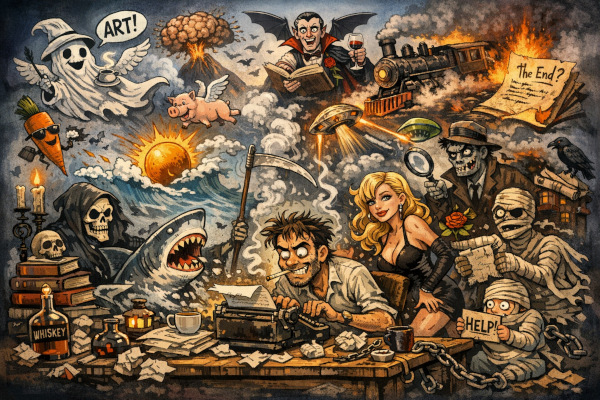
Creative writing is one of the greatest gifts given to humanity, right after fire, sarcasm, and the ability to pretend we understood a poem in school. It is the noble art of taking a simple idea and dressing it up so extravagantly that by the time it reaches the reader, even the original thought has no idea what it has become. According to me, which is already the strongest possible academic citation in matters like these, anybody who has ever sat staring at a blank page with fifty ideas trapped inside the skull like panicked pigeons already has the soul of a writer. That feeling, when your brain is swollen with thoughts but your hand produces nothing useful, is basically literary constipation. It is the creative equivalent of sitting on a toilet with ambition in your eyes and tragedy in your heart. And that, my friend, is not failure. That is talent knocking from inside and asking to be let out before it dies of suffocation.
The first requirement of becoming a writer is not grammar, discipline, intelligence, or even the ability to spell “discipline” without help. No. The first requirement is blind, unreasonable, almost criminal confidence. You must believe that you can write absolute nonsense and still call it art with a straight face. This is the foundation of all literature. Somewhere in the world, there is a man writing a story about a detective with amnesia solving crimes on the moon while secretly being a reincarnated carrot, and he believes in that manuscript with the faith of a prophet. That is the energy you need. Never say, “This may be bad.” Say instead, “The world is not yet ready.” Great writers are not born; they are simply people who refused to feel shame at the correct time.
Then comes vocabulary, the cheap cologne of the insecure writer. A good writer does not merely know words. He hoards them like a dragon with emotional damage. He collects odd phrases, aggressive adjectives, dramatic verbs, and strange little verbal grenades that can be thrown into sentences to make them sound deeper than they really are. You begin modestly, of course. First you read T-shirts, billboards, shampoo labels, cinema posters, and restaurant menus. Then you graduate to magazines, subtitles, internet comments, and other advanced educational material. Eventually you begin using words that nobody asked for but everyone fears to question. This is how true literature is born. A sentence should not walk politely into the reader’s head; it should kick the door open and throw around words like “tohubohu,” “cataclysm,” “bewildered,” “romantic catastrophe,” and “stupidazfuck” with enough swagger that the reader becomes too intimidated to object. The trick is simple: if people understand you immediately, you have explained too much.
A writer must also know the audience, though this advice is mostly decorative because half the joy of writing is deliberately ignoring the audience and then calling their confusion “interpretation.” If you are writing for children, write about nuclear physics, quantum mechanics, or tax reform, but add diagrams and stars and maybe a monkey in a lab coat. Children love pictures. They will not understand a word, but they will feel respected. Adults, on the other hand, read anything. Adults will read cereal boxes, legal disclaimers, and WhatsApp forwards about turmeric curing sadness. So for adults, you can write whatever you want — romance, murder, philosophy, emotional nonsense, or a detailed breakdown of how your neighbour peels an orange like a war criminal. If written with enough confidence, everything becomes content.
The opening paragraph is where weak writers die. It must grab the reader by the collar and scream into the face. It should arrive with the subtlety of a power cut during a wedding. You cannot begin softly with things like “It was a nice day” because nobody respects that kind of laziness. No, your first line must hit like a slipper thrown with maternal accuracy. It must create curiosity, confusion, alarm, and ideally a tiny bit of scandal. A good opening paragraph should make the reader feel as if something illegal, sexy, or deeply stupid is about to happen. Preferably all three. The reader must not be allowed to leave. Once you have hooked them, you may proceed to disappoint them gracefully over several pages, which is itself an art form.
Then there are characters, those unfortunate puppets we create only to ruin their peace. A story without characters is just a government circular. You need people in it, preferably unstable ones. The hero must always be in the wrong place at the wrong time, armed only with confidence, weak judgment, and a tragic inability to mind his own business. He should poke his nose into situations that smell dangerous and still act surprised when the universe punches him in the mouth. He should talk to himself, because nothing says “main character” like a fellow holding long internal debates while disaster unfolds around him. Supporting characters are equally important, not because they matter, but because they exist to make the hero look more tortured, more attractive, or more confused. You may also kill them whenever the plot gets boring. This is your kingdom. You are God here, only with worse habits and better control over weather.
A proper story must have flow, though not the neat, respectable kind. No. It should move like a shopping trolley with one broken wheel. It should swerve. It should make strange noises. It should appear to head somewhere and then violently lunge in another direction. If the reader feels completely safe and oriented, you have failed. Great writing takes the reader through fog, smoke, emotional potholes, and dark hallways with flickering tube lights. Characters should disappear for three chapters and return later as if nothing happened. Dead people should show up casually. A man declared dead in chapter two should stroll back in during chapter nine, scratch his crotch, and say he took the last train from hell. That is not bad writing. That is suspense with confidence. The reader may be confused, but confusion is merely curiosity wearing slippers.
Dialogue deserves special attention because dialogue is where literature puts on lipstick and leans forward. Characters should not speak the way real people speak because real people are boring and often ask where the charger is. Fictional dialogue must sparkle, punch, seduce, confuse, expose, and occasionally insult. Every line should either reveal character or worsen the situation. Preferably both. Let one man emerge from an elevator, gaze at a woman as if his eyeballs are giving her a full-body massage, and ask a line so ancient and ridiculous that it should have been retired by the Ministry of Culture. Then let the supposed woman reply with something so deranged that the reader drops the book briefly to reassess life. That is dialogue. It is not there to mimic reality. It is there to make reality feel unemployed.
Description, too, is essential. Never say a thing plainly when it can be said in a way that causes mild injury. If the sun sets, do not say “the sun set.” Say it dropped like the Titanic on a bad day, dragging dignity and orange light down with it. If a man has a problem, do not merely mention trouble. Describe him as sitting on a problem like a rocket about to blast him into oblivion. If a drink tastes bad, compare it to his fashion sense, his academic record, or the emotional aftertaste of a failed reunion. The reader must never be allowed the comfort of simplicity. Overstatement is not excess. Overstatement is architecture. It is how mediocre ideas are given chandeliers and a balcony.
Suspense is another sacred tool. It is basically the art of withholding basic information like a manipulative relative. A writer must know how to say just enough to make the reader anxious and not enough to make them calm. Mention a woman named Dawn and then say a man woke up in something called Black Charlie’s Opening. Explain nothing. Move on. The reader will now follow you like an abandoned puppy because the human brain cannot tolerate unfinished nonsense. That is how suspense works. It is not mystery. It is strategic annoyance.
And then comes the ending, where the writer either earns applause or gets hunted down by the reader with agricultural tools. Endings should not be neat unless you hate literature and joy. A proper ending must leave the reader dazed, irritated, half-impressed, and slightly betrayed. If the story is romantic, ruin it. If the hero is in love, make him impotent by fate, machinery, or bureaucracy. If the plot is simple, twist it until the reader feels personally attacked. If you cannot think of a proper ending, simply end with a sentence that sounds dramatic and explains nothing. “She unbuttoned her shirt.” “The butler killed who?” “The cop winked at him romantically.” “It was the same black lingerie from the 1980s.” Then walk away. Do not elaborate. Let the reader suffer. That suffering is called engagement.
So what is creative writing, really? It is the disciplined act of being gloriously undisciplined on paper. It is the ability to convert confusion into style, exaggeration into voice, nonsense into momentum, and shamelessness into a career. It is where ordinary people become gods, murderers, lovers, liars, and philosophers by simply sitting down and assaulting a keyboard. A good creative writer does not just tell a story. He kidnaps the language, drives it recklessly through traffic, invents three new crimes and a metaphor, and returns at dawn smelling of coffee, ego, and burnt adjectives. That is writing. That is art. That is the beautiful disease. And if you do it long enough with enough confidence, one day people will stare at what you wrote, understand absolutely nothing, and whisper in reverent tones, “Genius.”
“If people understand you immediately, you have explained too much“- Sorcerer
You may also like
-
When the Last Peace Meeting Became a Premium-Grade Boardroom Disaster
-
Ashtavakra in the Boardroom: When Talent Threatens the Boss
-
Hanuman and the Perils of Being Too Obedient to Function
-
Matsya Nyaya: Or, Why Civilization Exists to Stop Large Idiots from Eating Smaller Ones
-
Pingalaka: Power, Paranoia, and the Middleman