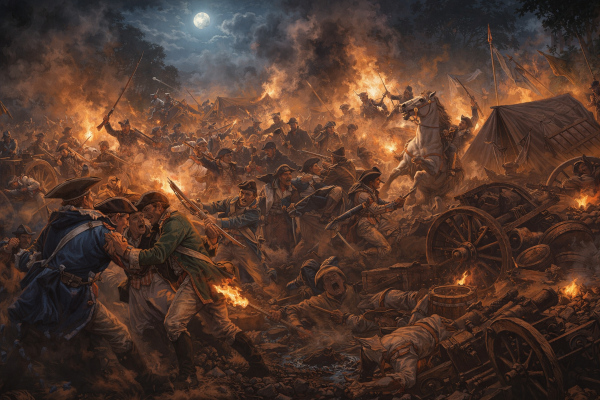
The Battle of Karánsebes is one of history’s great achievements in the field of military self-sabotage, a glorious episode in which an imperial army appears to have looked at the absence of the enemy and said, with admirable initiative, “We can still make this a disaster.” The event took place during the Austro-Turkish War of 1788–1791, when Emperor Joseph II had the excellent idea of campaigning against the Ottoman Empire and then discovered that marching a huge Habsburg force through disease, confusion, and multilingual panic was less a war plan than a practical joke staged by logistics.
By the time Karánsebes arrived, the Habsburg army was already in a condition best described as imperial soup. Mayer’s research on Joseph II’s 1788 campaign emphasizes disease, poor preparation, and a generally collapsing military experience long before this particular masterpiece of confusion burst into bloom. This was a giant composite army drawn from a multilingual empire, meaning that even under ideal conditions it already possessed the smooth internal harmony of a diplomatic banquet where half the guests suspect the soup. Add night movement, nerves, weak communication, bad intelligence, and the collective exhaustion of men who had marched a long way to discover that war is mostly paperwork with fever, and you had all the ingredients necessary for history to lower its standards.
Then came the famous night of 21–22 September 1788, when the Habsburg army, finding the Ottomans inconveniently absent, took the bold and innovative step of collapsing into chaos by itself.
With cavalry discovering alcohol before discovering the enemy. A group of horsemen rode ahead, encountered liquor sellers, and did what disciplined soldiers throughout history have often done when confronted with strategic spirits in the dark — they purchased them with enthusiasm and began drinking like men who believed campaign planning was now a matter for tomorrow’s headache. Soon infantry arrived, saw the arrangement, and decided that if the empire was handing out disaster, they too deserved a share. Voices rose. Tempers thickened. Somewhere between patriotism and schnapps, the whole thing curdled into argument.
Then a shot rang out.
That was all the night required.
What followed was less a battle than a rapidly expanding rumor with bayonets. Someone panicked. Someone shouted. Someone else heard something in the dark and translated it into catastrophe. Then came the immortal cry: “The Turks! The Turks!” — the military equivalent of yelling “fire” in a crowded theatre.
From that point onward, reason packed its bags and left the encampment.
In the darkness, one unit heard gunfire and assumed attack. Another saw men running and assumed defeat. Officers tried to restore order, which in moments like this usually means adding louder confusion in better tailoring. Commands were shouted across a multilingual imperial army already held together by fatigue, disease, and administrative optimism. Some troops fled because others were fleeing. Others fired because something moved. Wagons overturned. Horses bolted. Tents collapsed. Cannons were abandoned. The entire Habsburg force began behaving like a civilization that had mistaken its own echo for invasion.
And the beauty of it — if one may use such a cruel word for such magnificent foolishness — is that the enemy had not arrived there yet. The Habsburgs supplied the fear, the noise, the smoke, the panic, the stampede, the self-inflicted gunfire, and the collapsing decor all by themselves. This was an army turning a dark field into a full theatrical production of Ottoman attack without requiring the Ottomans to perform so much as a guest appearance.
By the time the thing had run its course, the scene looked as though war itself had gotten drunk and fallen down a staircase. Soldiers had fired at one another, units had scattered, equipment had been lost, wagons and tents had been overturned, and the emperor’s own account later read with the exhausted dignity of a man trying to describe catastrophe without admitting that his army had essentially mugged itself in the dark. At that point, extra embellishment becomes almost unnecessary. The schnapps, the shouting, the panic, the midnight stampede, the airborne cutlery — the whole episode already carries the polished absurdity of a military empire deciding, for one glorious night, that enemy action was an optional extra.
Joseph II’s reported letter to his brother Leopold is especially wonderful because it has the dry, exhausted dignity of a man trying to summarize chaos without admitting he has just spent the evening inside an imperial slapstick performance. According to the account, Joseph wrote that the column in which he found himself was completely dispersed, that cannons, wagons, and tents were overturned, and that his soldiers had been shooting at one another. He also mentioned the loss of “all the pots and tents” and three pieces of artillery. There is something almost majestic about an emperor leading a major campaign and ending up with correspondence that reads, in essence, “the men panicked, the cookware is gone, and if the Turks had shown up at the right moment, we might all be decorative ruins.”
The army’s deeper problem, of course, was that it came from the Habsburg Monarchy, that magnificent political machine where peoples, languages, uniforms, accents, and assumptions all traveled together under the broad management philosophy of “surely this will sort itself out.” Karánsebes has therefore become famous as the battle where confusion itself seemed to receive a field commission. Orders struggled, panic spread, rumors reproduced like rabbits with bayonets, and every frightened movement in the dark became the possible opening chapter of an Ottoman ambush. It is the military equivalent of one unclear email sent to a large office on Friday evening, after which six departments collapse, someone starts crying in procurement, and finance loses a horse.
What makes Karánsebes immortal is that the Ottomans scarcely needed to do the main work. When Ottoman forces later benefited from the debacle and took the area around Karánsebes/Caransebeș, the whole affair acquired the polished elegance of a man arriving late to a duel and finding his opponent already unconscious in the shrub. It is one of the rare episodes in military history where the enemy’s finest tactical decision may have been showing up after the Austrians had completed their internal review process with gunfire.
Then there is the famous claim of 10,000 casualties, a number that has strutted through popular retellings with the self-confidence of a lie that has found good tailoring. “An emperor’s army panicked in the dark and fired on itself while losing artillery and kitchenware” is already more than enough. One does not improve champagne by pouring nonsense into it.
In the end, the Battle of Karánsebes survives because it captures a truth too embarrassing to die: under the right conditions, a large institution can become its own most efficient enemy. Give human beings stress, bad information, darkness, hierarchy, poor coordination, and alcohol, and they will produce catastrophe with almost artisanal dedication. Karánsebes is therefore more than a battlefield fiasco. It is a universal management parable. It is an empire discovering that panic can scale.
You may also like
-
USS William D. Porter: The Warship That Treated Friendly Fire Like a Personality Trait
-
Savage French General Tells Trump Officials ‘Stop Snorting Cocaine’ Over Bonkers runway Plan
-
Missiles, Mood Swings, and NATO’s Awkward Silence
-
The Empire vs. the Flying Toaster
-
F-35: The Flying Supercomputer That Occasionally Needs Psychiatric Support